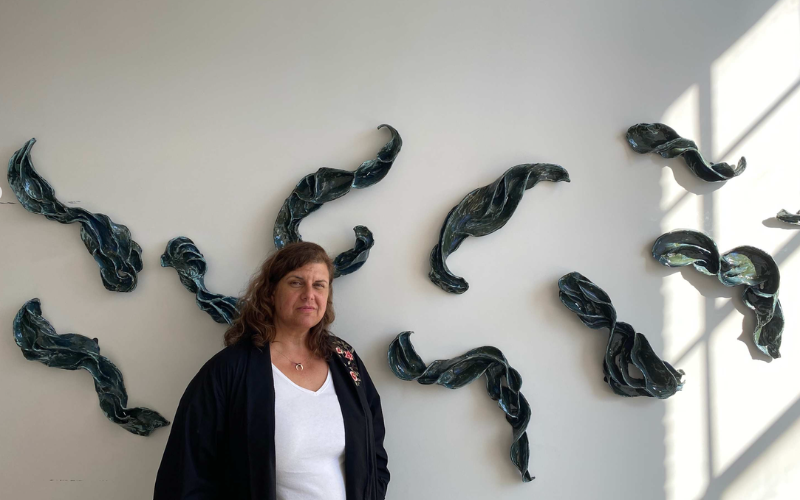

Tamara Rafkin, Down on the Cooper, 2015, Installation at Newburgh NY, 2022, 48 x 84 x 5 in
"Place and self are inseparable."
The places we grow up, the homes we leave, and the streets we know by heart all become part of how we understand ourselves. But our relationship with the places we inhabit is rarely straightforward. Some become sources of comfort and stability. Others are tied to periods of change, loss, or uncertainty. Still others exist beyond the physical world, living instead in the digital spaces that carry our creative identities forward.
For Featured Artist Tamara Rafkin, these connections have become the foundation of a decades-long artistic practice.
Based in the Fort Worth area, Rafkin works across photography, assemblage, sculpture, and ceramics, using architectural forms and landscapes to explore the relationship between memory, identity, and belonging. Her work considers how spaces, both built and natural, can hold personal histories, and how those experiences continue to shape our understanding of ourselves.
Having spent much of her life moving between different places, she's developed a practice that examines what we carry with us, what we leave behind, and how the two are often inseparable.
We had the chance to chat with Tamara Rafkin about the experiences that first drew her to this idea, what she discovered during a residency in Jingdezhen, China, and how a gallery break-in changed the way she protects the history of her work.

Tamara Rafkin, Cantilevering Existence 3, May-July 2025, 17 x 28 x 22 in
The Early Instability Behind Tamara Rafkin’s Inquiry Into Place and Belonging
The connection between place and self has fascinated Tamara Rafkin from an early age. "My interest in place comes from a history that was shaped by instability, loss, and a lack of rootedness," she explains.
Following the death of her father and years of instability tied to her mother's mental health, Rafkin spent her teenage years moving through a series of foster homes. Each move revealed a new version of what home could (or couldn't) provide. Every threshold she crossed offered a different perspective on people's relationships with place, safety, and belonging. The stability she needed during those years didn't come from a single house. "Stability came from the architecture and environment of the town I was living in," she shares, the familiar streets grounding her when everything else felt uncertain.
Then, abruptly, that stability disappeared. Sent to live with extended family in a large city, Rafkin experienced a sudden upheaval that severed her from the environment she had come to rely on. "The transition was disorienting," she recalls, "but it also marked the beginning of my inquiry into how emotional and physical landscapes intersect."
For decades now, she has loosely explored this theme across mediums, researching how memory lingers in the spaces we inhabit and leave behind. Then, a few years ago with a move to Texas, that lifelong theme began to directly feed into her studio work. Watching new housing developments spring up and reshape the ground around her, she saw the rapid reinvention of place happening in real time. Those developments "acted as a catalyst," pulling decades of personal history into the sculptural, architectural forms she builds today.
Moving Through Photography, Ceramics, and Sculpture
To translate these complex emotional landscapes into physical objects, Rafkin relies on a fluid, intuitive creative process. "I work in a variety of ways," she says. "Sometimes I set out with a piece fully formed in my mind's eye, and sometimes an idea evolves through exploration and play." This way of working allows her to unpack ongoing questions about "memory of place, experience, and using architectural elements as metaphors for emotional frameworks."
Her choice of medium is just as dynamic as her concepts. Rather than forcing an idea into a predetermined shape, she lets the work dictate its own form. The process often begins as a series of sketches, written notes, or phone images. "Then the idea moves into 2D or 3D spaces. It doesn't always work in one form or the other," she adds, "sometimes it moves through them."
Rafkin has a deep trust in the messier, less certain phase of her process. "I’m fond of saying something needs to go through being bad before it is good," she notes. "I know when it’s at the ‘bad’ point to let it be for a while or keep working on it to get to the other side." Pushing past this point takes patience, especially when juggling materials like concrete, metal, and clay. But she enjoys the whole creative process: "the making, the puzzling, and the problem solving." When the materials start cooperating and a piece is progressing, the work takes on a life of its own. As she puts it: "when it's going well, it feels like dancing with the universe."
Clay in particular has been a steady partner in that dance, eventually pulling her across the world to the historic home of porcelain.

Tamara Rafkin at work inside her studio. Photo courtesy of the artist
How an Artist Residency Abroad Deepened Tamara Rafkin's Work
There's a city in China that revolves almost entirely around ceramics. With over 2,000 years of porcelain production woven into its identity, Jingdezhen is known globally as the "Porcelain Capital," and in 2025, Rafkin experienced it firsthand.
When she arrived at the Taoxichuan International Artist Residency in Jingdezhen, Rafkin knew she was stepping into a city with a distinct pull for anyone working in clay. "Going to Jingdezhen for a ceramic artist is a bit of a holy pilgrimage," she tells us. Invited after participating in a museum exhibition, she had just two months to absorb an environment where most artists spend three or more.
Stepping into a brand-new city meant learning daily life from scratch, from navigating errands through phone translation apps to adjusting to unfamiliar weather and local clay that behaved differently in her hands. Taking in so many new experiences alongside a tight residency schedule meant her days were packed. "It was a bit intense," she remembers. "Luckily, I've had enough experience in my life changing places and languages and learning not to be thrown off when things aren't easy, and I knew I'd figure it out." Living and working alongside roughly 30 international artists, she balanced morning walks through the city with studio sessions fueled by skill-sharing and weekly lectures.
Just as Jingdezhen carries thousands of years of ceramic history inside its daily street life, the pieces Rafkin created as a resident deepened her exploration of how human memory layers one experience on top of another. "The work I made while I was there was partially a reaction to the visuals of new and ancient that were all around me," she explains. The pieces became a way to work through "the layering of all the elements around me and how my memory holds layered information from the experience."
She spent her life learning who she is by moving through unfamiliar terrain, and stepping out of her comfort zone again solidified her pursuit of the bond between place and self, sparking ideas she's already eager to return and explore further. It's the same reason she advises fellow artists to step outside their usual spaces and give themselves the gift of experiencing a residency. "It allows you to get outside your normal routine, have conversations about your work with new people, and it stretches you," she shares, recommending programs tailored to an artist's need for "solitude, community, experience, or material knowledge."
Learning how to adapt in unfamiliar places is only half of Rafkin's story, as an earlier loss back home taught her how fragile physical work becomes without a system to protect it.
💡 Artwork Archive Tip: Turn Scattered Opportunities Into a Tracked Shortlist:
Applying to residencies and juried shows means juggling dozens of deadlines at once. Artwork Archive lets you search open opportunities, save the ones that fit, and get email reminders before each submission date, all tied to the same account that holds your artwork records and application materials. You can even apply to select calls directly through your Artwork Archive account.

Tamara Rafkin, Cantilevering Existence 6, May-July 2025, 7.5" h x 13" w x 9" d
How a Gallery Break-In Changed the Way Rafkin Protects Her Artwork Records
In her late twenties, Rafkin was juggling a busy exhibition schedule alongside a commercial photography career and running a non-profit art organization. While those roles had already taught her the value of formal agreements, she hadn't yet brought that same level of organization to her gallery exhibitions. "That wound up causing some issues," she admits.
When she sent a large group of pieces to an exhibition in New Orleans, she relied on a word-of-mouth agreement rather than a written contract. "About a week after the show opened," she says, "the gallery was broken into and most of my work was stolen." A lapse in the gallery's insurance meant they couldn't reimburse the artists for the value of what was taken. "It was a devastating event," she recalls. "Luckily, the people that ran the gallery were good people, and they organized a fundraiser to pay us for our lost works." While the fundraiser didn't raise the full amount, it came close to paying what she would have earned if the pieces had sold, helping her offset the steep costs of her large-format color photographs and handmade wood frames. Still, the art was gone. Six large prints and several smaller works were never recovered. "I just hope those works are out there being enjoyed by people and weren't destroyed," she says.
Losing physical artwork without a paper trail forced Rafkin to look differently at how she ran her studio. "What I learned from that was that I needed better recordkeeping, and to pay closer attention to having my contracts and documentation in order every time I send work anywhere," she reflects. "It was the catalyst for me to organize my art studio records better."
The lesson learned in New Orleans marked a broader realization about what it takes to sustain a creative life. It also signaled a reality she's watched intensify across the entire art world.
💡 Artwork Archive Tip: Always Know Where Every Piece Is:
Across exhibitions, consignments, and shipments, it’s easy to lose track of where your work actually is. Artwork Archive tracks the location and status of every piece, from studio to gallery to collector, and keeps the images and paperwork attached to each one.
Why Artists Can No Longer Treat Business as an Afterthought
Over four decades of exhibiting, Rafkin has watched the expectations placed on working artists change dramatically.
At the start of her career after earning her undergraduate degree, the business of art moved at an analog pace, driven by physical letters, slide sheets, and hand-delivered portfolios. "The world was very different," she adds. "It's moved to a fast-paced digital environment and there's so much more information, imagery, and recordkeeping."
"Artists were given grace before, and now we must be creative explorers and makers while also running our own business," Rafkin says. Without a large budget to outsource marketing, websites, or other business tasks, artists have had to take on every role themselves. "You have to find a way to wear all those hats."
She also let go of what she calls "the myth of the magical gallery relationship that would take care of the business and allow you to just be a creative entity." Instead, she found long-term stability by cultivating multiple outlets, markets, and opportunities for her work. For Rafkin, putting strong systems in place from the beginning is what actually protects her creative life. "Setting up the business side to run well from the start frees up time to make sure you work on the important part of the career, the time in your studio," she notes. "The way I see it, you won’t have an art career if you aren’t making work, right?"
Still, making the work is only half of the equation, especially when both you and your pieces are moving from one place to the next.

Artist Tamara Rafkin delivers a lecture at her solo exhibition, Up Near the Roof, All Our Thoughts Are Clear, presented by Eclectika in Dallas. Photo courtesy of the artist.
Managing Overlapping Exhibitions With Artwork Archive Reports and Private Rooms
For most of her career, Tamara Rafkin's art records lived wherever she happened to be: "They started as a ledger book and slide sheets back in the 1990s and early 2000s!" she remembers. Contacts and other items were filed by hand. In the 2010s, her records moved to a digital format, first through a spreadsheet program another artist had built, then across folders scattered over various drives. "It worked but was time-consuming," she tells us.
Eight years ago, she learned about Artwork Archive through the collectors and galleries she was doing freelance administration for, and after seeing how it compared to her own patchwork system, she moved her workflow over. "I realized Artwork Archive was more functional," she goes on to say. "It's much better to have everything streamlined and able to work together."
She started by organizing her inventory and invoicing collectors, then gradually expanded into building Collections, sharing Private Rooms with curators, and tracking exhibition deadlines. Her system proved essential this past spring, when she was juggling five exhibitions with overlapping shipping, delivery, and pickup dates. "I couldn’t have kept track of it without the working components of Artwork Archive," she admits. Building a digital archive became a way for Rafkin to keep her career anchored even as her pieces traveled across the world. "One of the biggest benefits I’ve found is how I can log in from anywhere and access my records to do business even when I’m not at my studio," she says. "It's made it easier to keep my career in motion with my global lifestyle."
Having worked on the administrative side herself, she also appreciates how quickly she can generate clean reports and delivery notes for galleries. Time and again, the galleries and curators who receive her reports have noted how much easier her organized files make their jobs. "I think people will work with you again if they feel you do things professionally and help make their jobs easier," she points out.
Being easy to work with, Rafkin has learned, counts for a lot in the art world.
Why Documenting Your Artwork Early Protects an Art Career
"A lot of the art world is about relationships," Rafkin believes. "While it may seem like recordkeeping isn't related to that, when dealing with galleries, agents, interior designers, curators, and collectors, having professional materials and staying organized really makes a difference." In her view, artists can no longer afford to treat administration as someone else's responsibility. "The myth of an artist who doesn't know how to handle business is long gone. Our worlds are intertwined with all the others, so it benefits you to treat the business as business and be professional."
Asked what she would do differently if she were starting over tomorrow, Rafkin points straight to the habit of recording the journey in real time: "I wish I had better documentation of work in progress, past exhibitions, and opportunities I've been involved in," she states. Those things are the raw materials of an art practice, and recording them as they happen builds a permanent record that memory alone cannot hold.
Early in life, Tamara Rafkin learned how disorienting it feels when the spaces you rely on suddenly disappear. For decades, she's explored how those spaces hold personal history, and today, she uses Artwork Archive to build that same lasting foundation for her art career.

Artwork Archive gives you one place to organize your art inventory, sales records, professional artwork images, and more so you can spend more time making art. Try Artwork Archive free for 14 days.