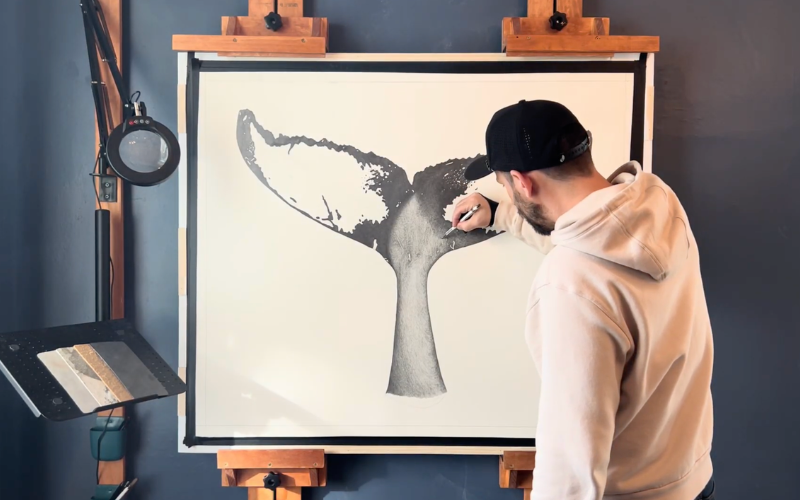
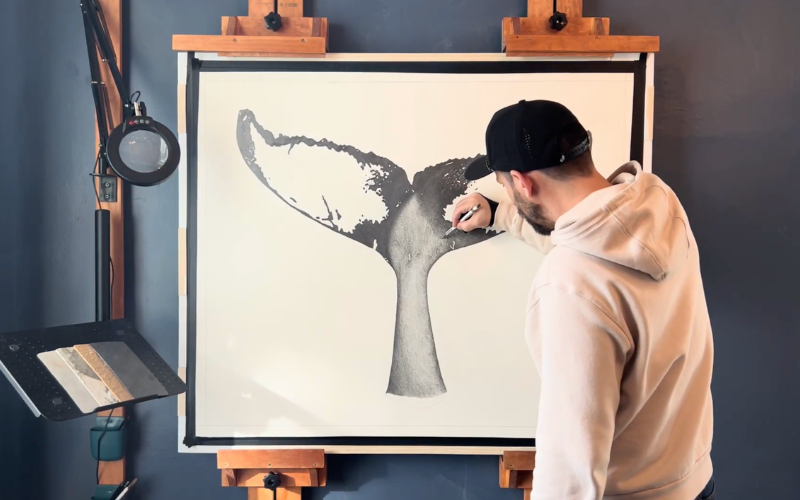
"I'll spend between 40 and 100 hours on a large drawing."
That's a long time to spend looking at anything. But for Featured Artist Gunnar Norquist, the longer he looks at something, the more he finds worth paying attention to.
Based in Providence, Rhode Island, Norquist finds himself drawn to ordinary, everyday subjects bearing details that are easy to overlook. An ancient olive tree, the markings on a whale's fluke, and a scarred landscape carrying traces of the people who have passed through it all hold Norquist's fascination as much as they hold the evidence of time. His large-scale graphite compositions are built slowly, over hundreds of hours and thousands of individual marks, as the simple act of drawing becomes more about understanding a subject than about depicting it.
His drawings are about paying attention, but also speak to the importance of looking. Through sustained observation, we can understand not only what something looks like, but what it might reveal about endurance, memory, place, and belonging.
We had the chance to chat with Gunnar Norquist about what happens when you spend months studying a single subject, the story behind a several-thousand-year-old olive tree in Palestine, and why paying attention to the history of your own artwork is part of making sure it isn't lost to time.
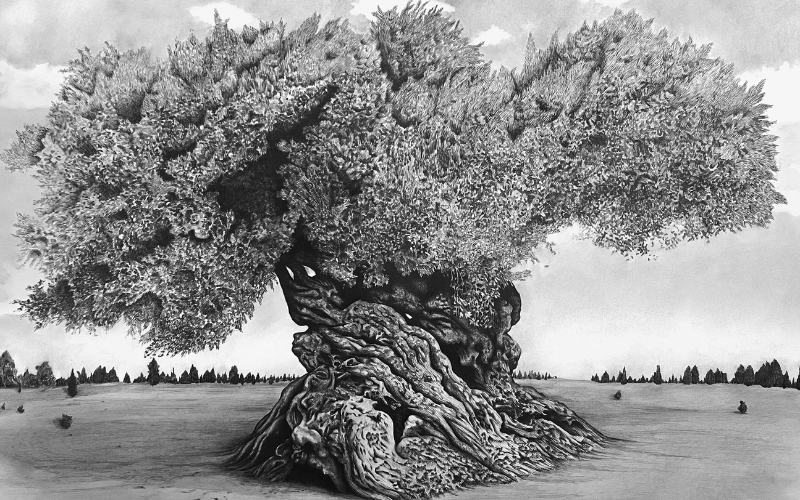 Gunnar Norquist, Olive Tree of Vouves, 2024, 40 x 52 in
The Art of Looking a Little Longer
A tree is familiar to most of us. We recognize its shape, pass beneath its branches, occasionally lounge in its shade, and maybe even notice the color of its leaves as the seasons change. Most of us will move through the world past thousands more trees and millions of other familiar, ordinary, deceptively homogenous things. But rarely do we give them our sustained attention. For Gunnar Norquist, "drawing is a catalyst that turns looking into seeing and seeing into knowing."
"When you spend months drawing a tree," the artist goes on to explain, "you begin to notice its particular architecture: the way a branch has responded to the weight of its own growth, the scars left by the weather, or the irregularities that make it unlike any other tree." These details, revealed over painstaking hours, are what make any tree become that tree. The things most of us never give a second thought to become, in his words, "cherished and cared for."
His choice of medium plays an important role in that process. "Graphite is well suited to this kind of looking," he says. "It allows me to spend an extraordinary amount of time with a subject, attending to the subtleties of its form, texture, and character." His background in sculpture also informs the way he approaches a drawing, and he credits it for his interest in volume, weight, and the way light moves across a surface. "Even on a flat sheet of paper, I'm thinking about how a subject occupies a space and how its form can be made to feel present."
The sense of physical presence that comes with this kind of attention is what Norquist hopes to accomplish with his work. To care for something, he believes, is to try to preserve it. However, his drawings aren't meant to serve simply as straightforward depictions of places or things. Instead, "they are attempts to preserve something of an encounter: the character of a particular tree, the history suggested by a landscape, or the sense of wonder that comes from recognizing that a seemingly ordinary subject has a story of its own," he clarifies. "Ultimately, I am interested in the things that endure and the stories they carry. Drawing is my way of paying attention to them."
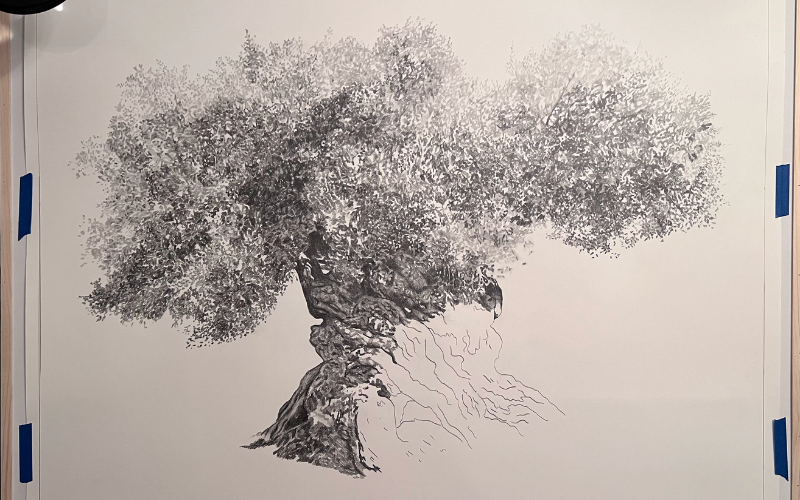
Gunnar Norquist's drawing, Olive Tree of Vouves, as a work in progress. Image courtesy of the artist
How a Single Graphite Drawing Takes 40 to 100 Hours
For Norquist, there's something compelling about the simplicity of his materials: a pencil, some paper, and the slow accumulation of thousands of graphite marks built up over hundreds of hours. "My process usually begins with an idea for something I want to explore, metaphysical, spiritual, or social," he explains, "and my asking where, what, or who in the physical world speaks to that question." The subject he chooses, in other words, is whatever answers his question.
From there, he dives into an exhaustive research phase, spending weeks looking at hundreds of reference images, reading articles, and digging through books. Sometimes he travels across the country or further, just to see the subject in person and stand in its presence. Using the information he gathers, he creates preliminary sketches and digital collages until the composition finally locks into place.
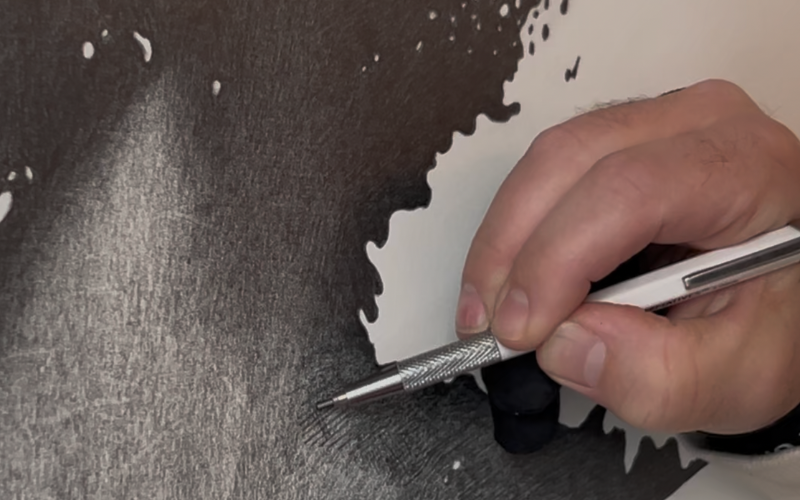
The actual drawing is a long process, comprised of making marks, looking at his research material, making a decision, making more marks, and looking again. Norquist allows the work to develop gradually, forty to a hundred hours of labor easily disappearing into a single large drawing. As he works through "a mixture of long, concentrated sessions and shorter stretches of time," he tries to understand "not only what something looks like, but what it might reveal about endurance, memory, place, and belonging."
"That extended process is important to me," he goes on to say, "because a drawing often reveals things I couldn't have anticipated at the beginning." Spending this long on a single piece returns to the idea of paying attention. "One of my favorite parts of the creative process is when a subject begins to feel fully present on the paper," he notes, "as though it has become more than a description of something and has turned into an encounter with it." The hours of layered marks become a way to keep a story alive, and Norquist's fascination with process, presence, and historical survival is exactly what drew him to a pilgrimage halfway across the world.
💡Artwork Archive Tip: Keep a Record of the Hours Behind Each Piece
Gunnar Norquist tracks the hours he spends on a drawing with a clipboard in his studio. If you're an artist who also tracks time spent on your pieces, those records don't have to disappear once the artwork is finished.
Whatever method you use, a clipboard, a notebook, a timer, you can preserve it: take a picture of your log when your piece is complete and upload it as an Additional File to the artwork's Piece Record.
The hours stay attached to the artwork instead of on a sticky note or buried in your phone.
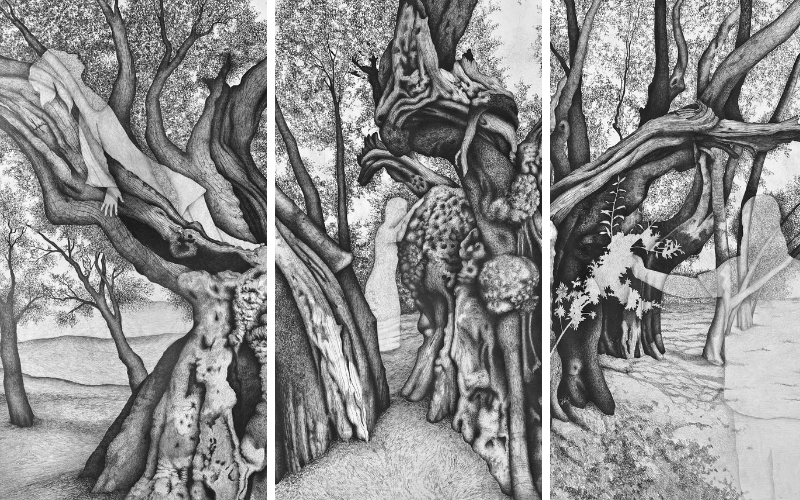
Gunnar Norquist, Sumud (The Olive Tree of Al-Walaja), 2026, three panel triptych
The Olive Tree of Al-Walaja: A Drawing Rooted in History
Just outside the village of Al-Walaja, Northwest of Bethlehem in the West Bank stands an olive tree. At between three and five thousand years old, the tree is widely regarded as the oldest living tree in Palestine. "But what makes it especially meaningful," Norquist tells us, "is that it represents something much larger than its own longevity."
The tree is both a biological marvel and a living witness to centuries of life. "In Palestine, the olive tree is deeply connected to family, inheritance, livelihood, and the enduring relationship between a people and their land," the artist explains. "My drawing of the Olive Tree of Al-Walaja grew out of my pilgrimage to Palestine and my desire to engage with the history and lived experience of the Palestinian people."
Rendered in dense, patient layers of graphite, Norquist's depiction of the olive tree—titled Sumud after the Arabic word for 'steadfastness' and belonging to his series of the same name—honors both its monumental form and the generational devotion that has kept it alive. While working on the drawing, he remembers "thinking about what it means for something to remain rooted in a place across generations, particularly when the people connected to that land face displacement and uncertainty." The olive tree, like the people who have protected it, persists through that displacement, violence, and time itself. "Its twisted trunk bears the marks of weather, pruning, and history, yet it continues to fruit," he says.
His hope for this piece in particular is "for viewers to spend time with the tree itself—with its remarkable form and evidence of age—and begin to consider the deeper story of endurance, belonging, and the connection between people and place." He hopes that even without knowing the full history of Al-Walaja, "the drawing invites them to look more carefully at what beautiful histories a tree can hold within its gnarled branches."
Why Paying Attention Borders on the Sacred for Gunnar Norquist
While Norquist's subjects are ordinary, they've left a mark that reaches well past his paper. His way of looking, of really paying attention, has influenced how he experiences the world beyond the studio. “I’m more attentive to the histories carried by ordinary things and to the marks that time leaves on people, places, and landscapes,” he reflects.
Attention, to him, even carries a significance that borders on the sacred. “I think this way of looking has spiritual dimensions, too,” he muses. To give a subject that kind of time is to decide that it matters, for no reason other than that it exists. “It's a way of acknowledging the significance of something beyond its immediate usefulness or appearance,” he offers. Almost every spiritual tradition rests on that same premise, that things have value beyond their function; that a person, a place, or even a tree is sacred rather than merely useful. “Drawing gives me a reason to slow down, but the hope is that the practice changes how I live, as well.”
Ultimately, what he's paying attention to is time itself: the evidence of it, the survival of it, the amount of it spent on a single drawing. Looking hard at something that's outlasted generations puts you in contact with something much bigger than your own lifespan.
It also raises the question about what happens to the artwork itself long after the artist is gone.
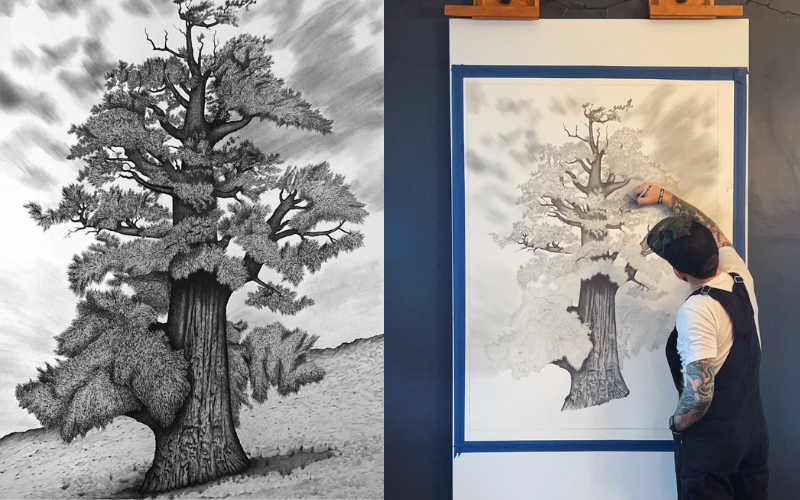 Gunnar Norquist, Bennett Juniper, 2025, 55.5 in x 40 in
How Gunnar Norquist Preserves His Artwork's History With Artwork Archive
Norquist has spent his career paying attention to the things that endure. The thousand-year-old olive tree, the weathered landscape, an animal scarred with a record of its own survival. All things that refuse to erase evidence of their existence. It makes sense then, why he would treat his body of work the same way.
A drawing's history survives only if someone keeps it. Not to mention the details like when a piece was made, when it was sold, or where it has been exhibited are all a lot easier to lose than a tree. It's why Norquist uses Artwork Archive to keep an inventory of his artwork, maintaining an individual record for each piece. "I want to be able to see a work not just as an image, but as something with its own identity and history," he says. "Keeping the artwork and its information together gives me a consistent way to document the work as my practice develops."
Inventorying is also an act of preservation. "An inventory isn’t just a list of things you’ve made; it’s a record of your development as an artist,” he tells us. “Over time, that record can help you understand the scope of your work and preserve information that might otherwise become difficult to reconstruct.” While preserving records of your artwork is important, Norquist knows that keeping track of a growing body of work can become its own job, especially when information is scattered across spreadsheets, folders, and individual documents. "Having a reliable system [like Artwork Archive] means I can spend less time managing information and more time in the studio."
The care he gives to the subjects he draws is the same care he gives to the work he makes and the legacy he leaves behind. He encourages artists to establish consistent documentation early. "You don't need to wait until you have an enormous inventory to benefit from keeping good records," he adds. To Norquist, inventorying is yet another form of paying attention. The details might seem small or insignificant now, but they can mean the world to someone trying to understand your artwork years from today.
💡 Artwork Archive Tip: Good Records Are the Backbone of a Growing Career (And Beyond)
An up-to-date inventory keeps your work organized and your progress visible, and it lets you respond to a sales or exhibition inquiry like the professional you are. Over a career, those same records become something larger: the foundation of your artistic legacy.
Learn what that legacy can look like, and how to plan for it.
→ Explore our free workbook, Mastering Art Management + Building an Artistic Legacy
Gunnar Norquist on Attention, Records, and an Artist's Legacy
If attention is the center of Norquist's work, patience is the center of his career. "One important shift has been learning to think of an art practice as something built over time rather than something that depends on individual moments of recognition," he explains. "It's easy to focus on exhibitions, opportunities, and external validation. Those things matter, but they aren't entirely within your control." What matters more, he believes, is continuing to make work, developing and sharing ideas, and building relationships with people who care about what you're doing.
In other words, there's more to an art career than the next show or sale. "I've come to appreciate the value of consistency and the importance of a sustainable practice around the work itself," he goes on to say. "That means taking the practical side of being an artist seriously, even when it isn't the most exciting part."
"It also means allowing a body of work to develop at its own pace instead of constantly chasing the next opportunity," he adds. He urges other artists to think "in terms of a long vocation." To keep "making work you believe in, take care of the practical things that allow you to continue," and to "never assume that a lack of immediate recognition means you're on the wrong path."
Much like the subjects of his drawings, the habits that seem ordinary or unimportant at first "become increasingly valuable as your practice develops." Documenting your work, photographing each piece, maintaining accurate records, and keeping track of where it goes may feel like small details in the day-to-day business of being an artist. But they're what give a body of work its history long after we're gone.
"It probably sounds pompous and presumptuous," Gunnar Norquist admits, "but sometimes I imagine the gift that records would be to collectors a hundred years from now trying to find out about my work." A gift made possible by the simple act of paying attention, and by the records that preserve what might otherwise be lost.
Artwork Archive gives you one place to organize your art inventory, sales records, professional artwork images, and more so you can spend more time making art. Try Artwork Archive free for 14 days.