"Painting is my way of taking up space in a world that often asks us to shrink."
After a career as a pediatric ENT surgeon, Artwork Archive's Featured Artist Sandy Palasti traded the operating room for the art studio.
Blending a scientist's curiosity with an artist's intuition, Palasti now spends her days in her Charlotte, NC studio working in acrylics, oils, inks, and pastels. Her bold color choices and gestural strokes create abstract florals, figures, and landscapes that pulse with energy, expressing the emotional truth of experiences without being tied to literal details.
While her figurative paintings are almost always inspired by her life, she leaves the door wide open for others, pointing to abstraction as a way to tell a deeper truth and inviting her viewers to each bring their own experiences, memories, and emotion.
"In the end, painting is my way of taking up space in a world that often asks us to shrink. My work is both a declaration and an offering: a way of saying I am here, I will not vanish, and I invite you to find your own reflection in that same act of becoming." Endlessly experimental, Palasti deems each piece she creates as an invitation to feel as much as to see.
We got the chance to chat with Sandy Palasti. Read on to learn more about why she paints in almost the exact opposite way she once operated, how she knows a piece is finished, and the business lesson she had to learn the hard way.
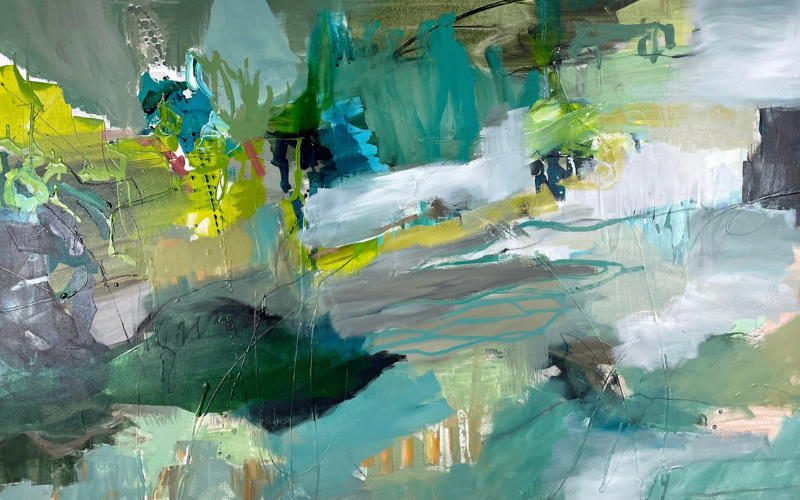
Sandy Palasti, Greenway, 36 x 48 x 1.5 in
Moving Away From Medicine
At 45 years old, Palasti left the medical field as a surgeon to chase an entirely different kind of passion. "There was nearly a decade when I explored all kinds of creative pursuits," she remembers. She picked up a guitar, sat down to write a memoir, shaped clay into pots...each attempt an effort to find, in her words, "the right language to express myself."
Painting ended her search. "When I finally discovered painting, I knew I had found it," she recalls. But she quickly realized it wasn't anything like the medical career she left behind. "Ironically, I paint in almost the exact opposite way that I performed surgery," she says. In the operating room, her work demanded precision, planning, discipline, and attention to detail. In the studio, she finds herself drawn toward intuition, mess, uncertainty, and the patience it requires to allow a painting to reveal itself.
"Looking back, I think I needed that freedom after so many years in such a highly structured profession." The freedom she found still had a direction, though, aimed straight at the stories she had never managed to tell before.
The Stories She Couldn't Write Down
"Before I became a painter, I tried to write a memoir."
Writing had been one of Palasti's earlier creative pursuits, fueled by the desire to tell the truth about her own life. But the closer she got to writing those experiences on the page, the more vulnerable Palasti felt. "I found it incredibly difficult to be completely honest knowing that my thoughts, memories, and relationships would be there on the page for everyone to read," she admits. "I felt too exposed." Written language, she eventually realized, was not her language.
Painting became another way to tell the same stories.
What words could not do, paint could. "The work became less about documenting my life and more about capturing what it felt like to live it." Through abstraction, Palasti found a way to reach the emotional truth of an experience without being bound to every literal detail. The vulnerability she struggled with while writing became something she could explore on the canvas instead.
The freedom of abstraction also changed the relationship between artist and viewer. While a literal image asks someone to enter the artist's story, Palasti wants to create something a bit more open. "My story becomes just the starting point for someone else's." To her, abstraction carries a deeper truth than any recognizable scene, precisely because it leaves room for another person's interpretation.
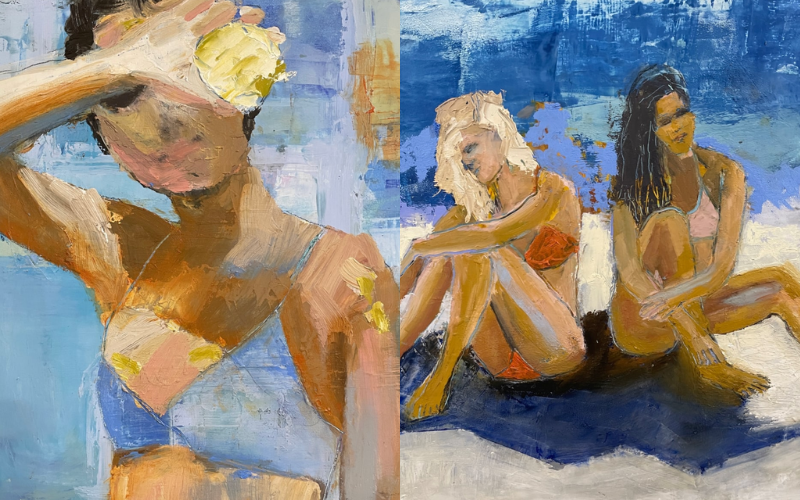 Sandy Palasti, One Small Moment, 16 x 16 x 0.75 in | We Told Our Secrets, 18 x 18 x 2 in
An Amalgamation of Faces
While Palasti's figurative paintings leave the door open for others to interpret, they almost always begin with her own life. "Many are inspired by specific moments, relationships, or emotions that I've experienced," she tells us. Sometimes she stays fairly close to those memories. Other times, they act as only the starting point before wandering and transforming into something else entirely. Eventually, her stories are carried off by the imagination of others.
So who are the people in those paintings? No one...not really. They're composites, each one "an amalgamation of faces I've encountered over the years, whether in old photographs, social media, printed images, or simply remembered in passing," she shares.
Each figure grows from something familiar: a specific moment, a relationship, or something she felt. But as she paints, those references dissolve into something new. The person on the canvas becomes less about one individual and more about a shared human experience. The ambiguity is intentional; a figure tied to no single person can stand in for many at once. "My hope is that viewers see something of themselves or someone they love, rather than feeling they're looking at a portrait of a stranger," she offers.
The Language She Keeps Learning
After such a drastic career change, finding painting gave Palasti the language she had been searching for. But like any language, it requires practice, curiosity, and a willingness to keep learning.
From the start, her goals have remained simple: "to get better, stay curious, and continue making work that feels honest." Since entering the art world, she's noticed a common trait shared amongst artists who build lasting careers: "They're the ones compelled to create."
"They don't create because they think they should," Palasti points out, "they create because they have to. Painting is as necessary to them as breathing."
"I feel that same pull." Most mornings, she wakes up with an idea already forming: an unexpected color combination, a composition, an ambiguous face she dreamed of, or a question she can't stop thinking about. She heads to the studio not always knowing where it will lead, but eager to find out.
That sustained curiosity, she believes, is what lets artists to keep growing. It's not something that exists separately from the finished work, but rather built into every stage of making it. Each piece becomes another opportunity to look closer, experiment, question, and discover what happens when intuition takes the lead.
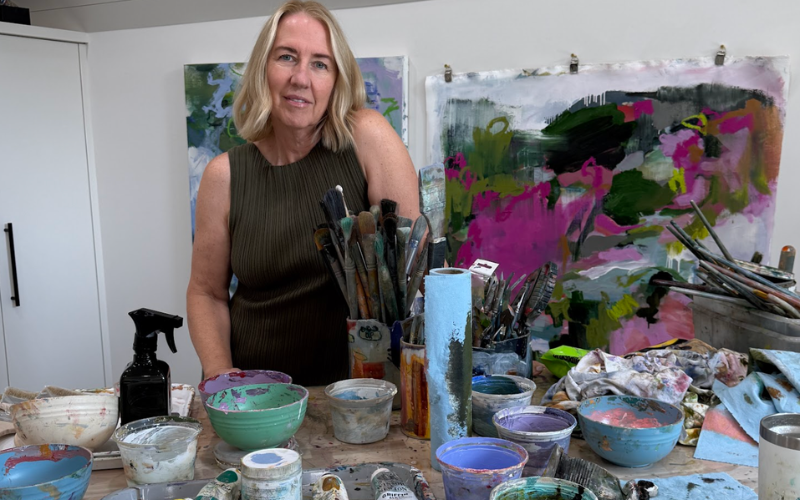
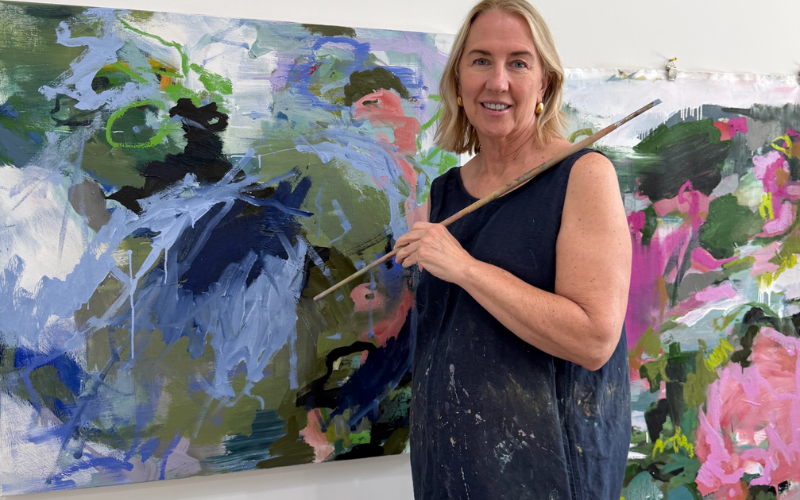
Palasti in her Charlotte studio surrounded by the tools of her practice. Photo courtesy of the artist
A Conversation on Canvas
Palasti rarely approaches two pieces in exactly the same way. "My creative process is highly varied, and that's one of the things I enjoy most about painting."
She might start with loose drawings, layers of acrylic, or plunge straight into oils. Many of those first marks disappear beneath layers, no longer visible but still an important part of the painting's history. "They help establish its energy and direction," she says.
Those invisible marks act as hidden beginnings, revealing something important about the way Palasti works. Every sketch, brushstroke, and change of mind leaves its imprint, even if we never see it in the final composition. Those early marks simply start a conversation on canvas. Palasti's role is to respond.
Rather than forcing a predetermined outcome, she follows whatever unfolds, allowing one decision to naturally lead to the next. Her favorite part comes when the painting finally begins to take shape. "There's a point where the chaos starts to settle," she describes. "The composition becomes clearer, and I can begin organizing my ideas into something that feels intentional and cohesive." It's the moment where intuition and design start working together, each decision strengthening the story emerging on the canvas.
She knows a piece is finished when everything feels settled, when "every element feels necessary and nothing is asking for more attention than it deserves." Every mark, color, shape, and layer has a role to play, contributing to what Palasti describes as "a sense of balance where composition, color, and emotion all feel aligned."
💡Artwork Archive Tip: Keep the history a finished painting hides
A finished painting only shows the final layer of its story. The decisions, experiments, and revisions that shaped it often disappear.
In Artwork Archive, you can preserve the history of each piece by adding progress images, process notes, and other details directly to each artwork record. Whether you want to revisit your own process years later, share a work's development with a collector, or keep better records for exhibitions, all of those behind-the-scenes moments are worth saving.
The Skill She Carried Forward
The greatest thing carried from medicine into Palasti's art practice wasn't precision, or technical discipline, or even the steady hands both artists and surgeons tend to share. While worlds away from each other, one important skill followed her from the operating room to the art studio: "the love of learning."
When she entered the art world without formal training, she approached it the same way she had approached medicine: "with curiosity and dedication." She painted in the mornings and studied in the afternoons, taking more than 150 courses over the years covering everything from painting techniques and art history to professional practice and the business of art.
"That commitment to continual learning has been one of the greatest gifts my previous career gave me," she acknowledges. But it also taught her that growth, especially in a creative industry, sometimes requires learning things the hard way.
Early on, Palasti was tempted to say yes to every opportunity that came her way. Like many artists building a career, she saw each invitation as a chance to progress. Over time, though, she realized that every opportunity came with a cost: time and energy that could either support her practice or pull her away from it. Moving forward, she learned, sometimes meant saying no.
"Protecting my creative process is just as important as growing my career," she holds. Teaching became one example of where she needed to make that distinction. "While I'm honored by those requests, I don't think my creative process translates well into a structured course," she explains.
The lesson learned here grew bigger than any single opportunity. Palasti discovered that building a lasting art practice meant understanding what allows the work to thrive, then making choices that protect those conditions.
The realization also changed the way she measured success.
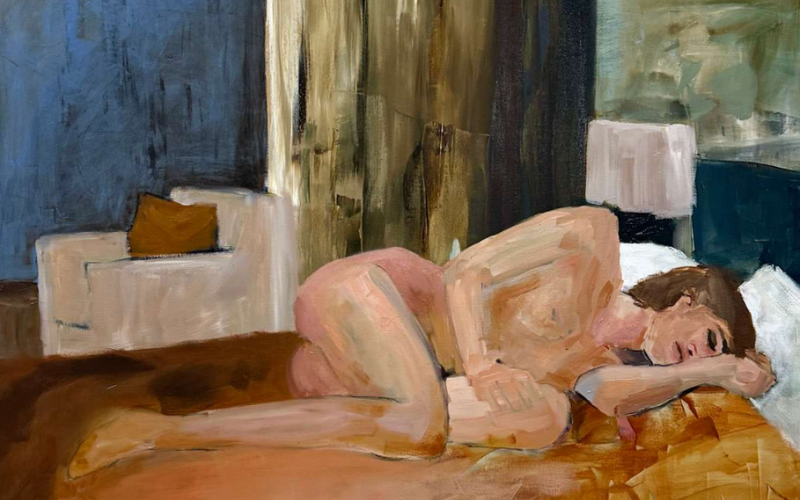
Sandy Palasti, Not Yet Morning, 36 x 48 x 1.5 in
How Success Changed Over Time
Protecting her creative process shaped the kind of career Palasti wanted to build.
In the beginning of her art career, success meant something simple: "I wanted to find my people," the collectors and viewers who connected with what she was making. Once she found that audience, her definition expanded.
Success now means having the freedom to paint every day, working with galleries that trust her work, and following new ideas wherever they lead. She's let go of the pressure to create something that appeals to everyone, trusting that if she "stays curious and honest in the studio, the right people will find the paintings."
For this artist, success has become the ability to "sustain a creative life—one where I can continue to grow, experiment, and remain genuinely excited about what comes next." And sustaining that creative life requires protecting more than the creative process, but also the work beyond the canvas: the history, details, and decisions that support the practice behind it.
The System Behind the Studio
Everything that brought her to the art world: the search for a new language, the trust she built with her process, and the curiosity that keeps her returning to the studio, traces back to the same love of learning. It also shaped one of the earliest decisions she made as a professional artist: learning how to care for the career she was building.
Within six months of painting professionally, she enrolled in a course on the business of art taught by Cat Tesla and Julie Schumer, where she was introduced to inventory management platform Artwork Archive.
Starting an inventory habit early let Palasti build the history of her art career as it happened. "Because I began cataloging my work from the very beginning, I never had to reconstruct years of paintings, sales, and exhibition history," she notes. "Looking back, that early decision saved me an enormous amount of time and allows me to spend most of my energy in the studio making new work."
As her career grew, protecting her creative process remained central, and Artwork Archive became one of the systems supporting it. "One of my favorite features is how seamlessly Artwork Archive handles the administrative side of a sale," she shares. When a piece sells, she can quickly generate professional invoices and Certificates of Authenticity, giving collectors the kind of polished experience they expect. She also uses reporting tools and insights to understand where sales originate and make more informed decisions about her marketing and gallery relationships.
For any artist chasing a sustainable practice, the business side of art will always require attention. But with the right systems, that work becomes part of what protects the creative process. With Artwork Archive as the system behind her practice, Palasti has created more space for the thing that started it all: the curiosity leading her to keep experimenting, learning, and telling stories.
💡Artwork Archive Tip: Start documenting before you think you need to
Palasti's biggest advantage was starting her inventory practice early, but that doesn't mean an artist with years of work has missed their chance.
The best time to create a complete artwork record is now.
Start backwards, with your latest pieces and gather the details you already have: artwork images, titles, dimensions, creation dates, exhibition history, sales information, and any notes that tell the story behind each piece. Artwork Archive's inventory tools can help you build those records gradually instead of trying to recreate an entire career all at once.
Download the free artwork inventory workbook→ Use it as a step-by-step guide for organizing your existing body of work and creating a system you can maintain as your practice grows.
Becoming a Beginner Again
When Palasti left medicine, she was stepping away from a career where she had spent years becoming an expert. In painting, she had to become a beginner again. What carried her forward was the willingness to keep learning.
Her advice comes from that experience: give yourself time in the studio, stay curious, and let your work teach you.
"Paint every day if you can. There's no substitute for time in the studio," she urges.
For her, growth came from returning to the work again and again, and not from trying to force a finished version of herself as an artist. "Don't worry too much about finding your style right away," she says. "Your style will emerge over time, even if your subject matter continues to evolve."
After building an entirely new career later in life, Sandy Palasti understands that finding your voice can't be rushed. That thing that makes your art unmistakably yours is something that takes time. It develops through patience, attention, and the willingness to keep discovering what comes next.
The love of learning carried Sandy Palasti from the operating room to the studio, where she found the language she had spent a decade searching for. Now her days are spent chasing new ideas, protecting her creative process, and telling her stories. The system behind her keeps her whole career moving forward. 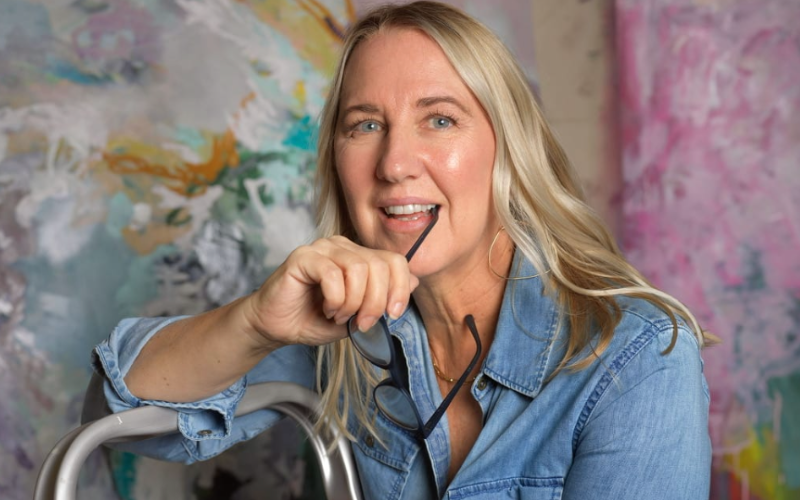
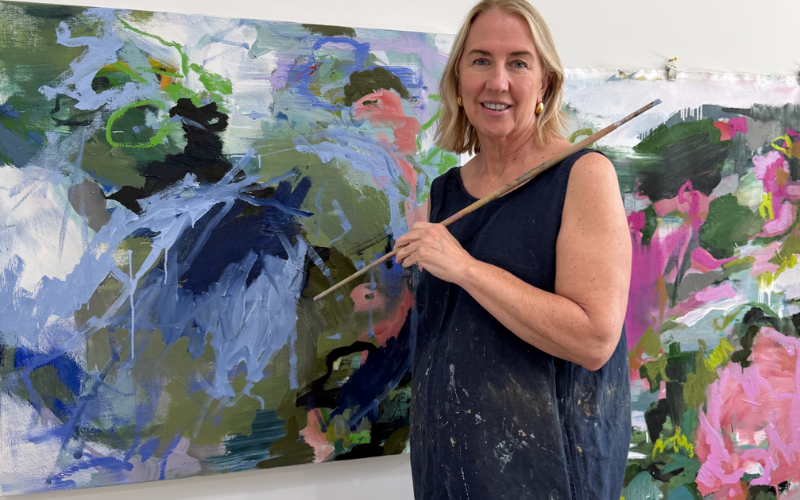
With Artwork Archive handling invoices, COAs, sales reporting, inventory, and more, Palasti spends most of her energy where she wants it: in the studio. Photo courtesy of the artist
Every art career needs an operational backbone. With Artwork Archive, you can handle your art inventory, sales records, and professional artwork images, and more, making it easier to spend more time in your studio. Try Artwork Archive free for 14 days.