Cleansing, change, renewal, and death. Water holds all of it at once.
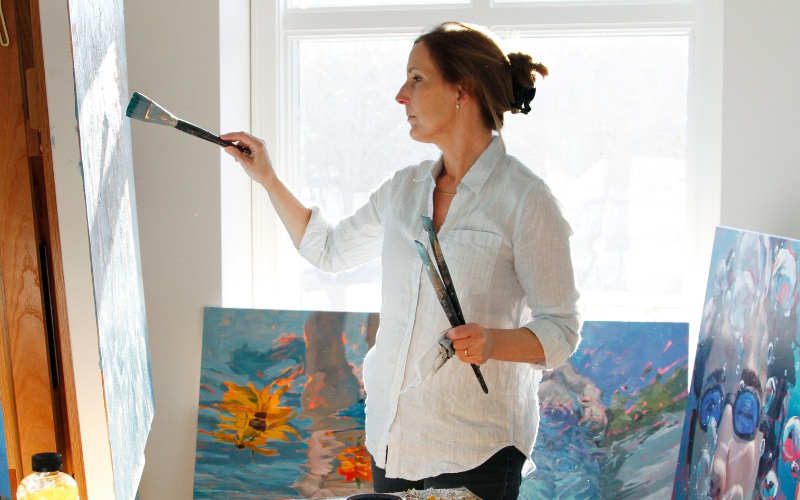
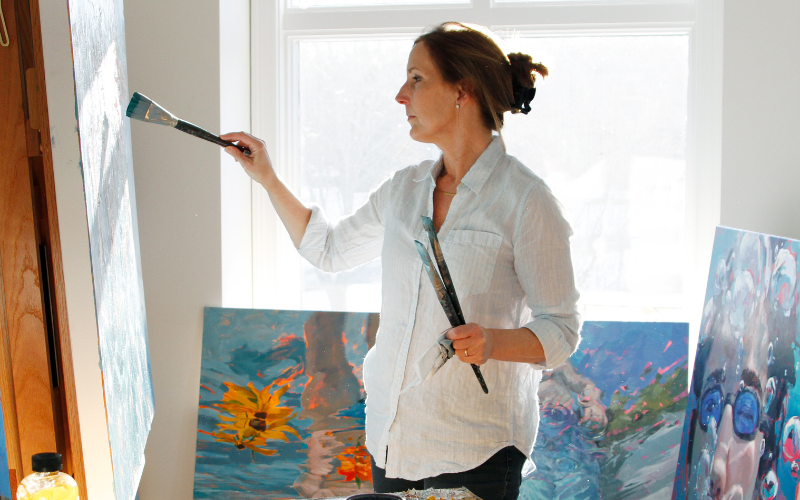
For over a decade, Artwork Archive's Featured Artist Michele Poirier Mozzone has focused her attention on a single, mesmerizing view: the human form suspended in water and time.
It all started at a pool one exceptionally beautiful afternoon in 2011. As Mozzone watched her daughter swim, she was struck by the ribbons of sunlight and distortions shifting through the moving water. Captivated by how quickly that moment was slipping past, she grabbed her camera, intent on anchoring the memory. Those impromptu snapshots became the catalyst for her acclaimed, internationally collected Fractured Light series.
Her mastery of rendering the intricate distortions of water and light has earned her awards in national juried competitions, featured spots in global art publications, solo exhibitions in New York City, and even a luxury handbag collaboration with Hammitt Los Angeles. Across this series, water serves as a powerful metaphor to explore aging, body image, release, and the simple desire to hold onto a passing moment. Every piece invites the viewer to look beneath the surface and submerge themselves in the unique experience of being alive.
We got the chance to chat with Michele Poirier Mozzone about how one afternoon at the pool became a fifteen-year obsession, what a "bogus email" turned into, and the one mindset shift she thinks every artist needs to make.
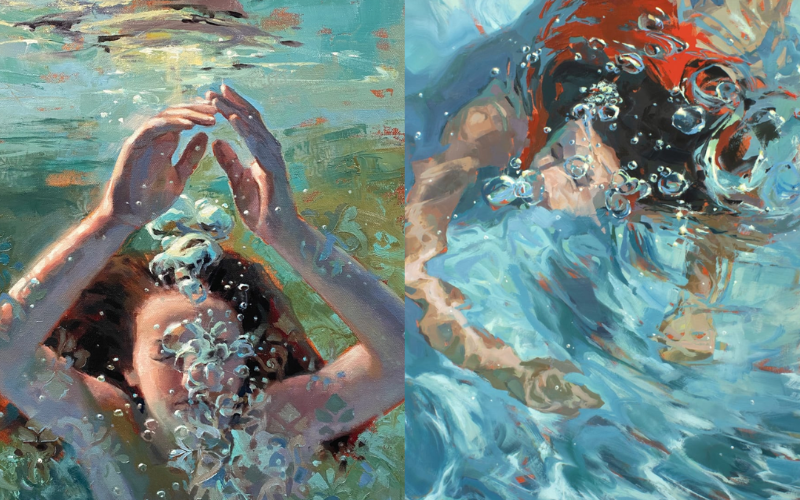
Michele Poirier Mozzone, Fleur de Lis, 20 x 20 x 1.5 in | Pollywog, 36 x 36 x 1.5 in
How a Single Series Evolved Over a Decade
Look closely at this body of work and you can almost feel the cool press of the pool and the weightlessness of being suspended within it. Solid edges melt away. Skin dissolves into bright ribbons of turquoise, gold, and amber. The water is turbulent and sunlit, catching the heat of summer and scattering it into painted lines of dancing light.
What began as a single afternoon’s flash of inspiration has evolved into a fifteen-year deep dive (pun intended). While the initial spark was born from the instinctive drive to capture a fleeting moment, Mozzone's Fractured Light series has continued to morph over the years. "I never imagined I would find a subject matter that could hold my interest for all this time," she shares. "I've found as long as I can keep evolving, adding new elements, and challenging myself, it continues to inspire me."
The deeper she slips beneath the surface, the more the water reveals layers of meaning. "Over the years, certain pieces have expressed different things," she muses. Clusters of silver air bubbles could represent a difficult, honest confrontation with "aging and body image," while colorful refractions might translate her "desire to decompress from pressures and troubling world events."
Ultimately, Fractured Light adapts to whatever phase of life Mozzone is navigating, and offers the space to process the realities of all that comes with the human experience. "But sometimes," she adds, "it's still simply about capturing one of life’s magical moments in the water."
💡Artwork Archive Tip: How to Group a Long-Running Series Using Collections and Tags:
A series that spans years is a lot of inventory to scroll through. Rather than filing one large series in a single Collection on Artwork Archive, use the Collections feature to group it in different ways: by year, by exhibitions, or by the sub-themes that emerged along the way.
Tags can then act as a second filter, applied for palette, reference photo, or mood so you can sort from within the series. When a gallery then asks for the "warmer, gold-toned" pieces, you'll be able to find them in one filtered view.
→ Organize a series with Collections, then learn how Tags work
Deconstructing the Creative Process
To create these intricate, underwater scenes, Mozzone blends the figurative imagery she loves with vivid abstraction applied with acrylic or oil paint.
"I spend a lot of time reviewing my reference photos," she says of each new piece. "Then, using the Procreate App, I manipulate the figures, color palette, and crop to arrive at a pleasing composition."
From a limited palette of five or six colors, she tones the white canvas with a warm, bright base layer, then loosely sketches in the figures. Paint follows, laid in thickly as the deepest shadows, midtones, and highlights start emerging. "This is my favorite part of the painting process," she continues, "when I start to see the image take shape on canvas."
Midway through, Mozzone makes the deliberate choice to put her tablet away. "I try to rely less on my reference photo and instead assess what the painting needs," she explains.
As the piece nears completion, the countless details become a maze of micro-adjustments, where tiny specks of stray light and the precise curve of a water ribbon demand constant scrutiny. "This is my least favorite part!" she admits. "To avoid needless 'noodling' around and losing the freshness of the painting, I try to ask myself if I have achieved that special thing that drew me to this image. If so, I try to leave it alone and keep some of the original spontaneity from earlier in my process. At that point, it’s usually done."
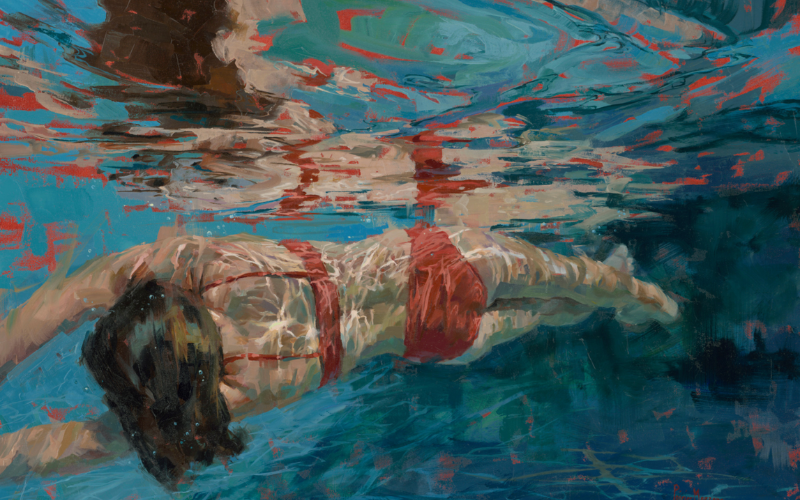
Michele Poirier Mozzone, Stretch, 24 x 36 x 1.5 in
The Limited-Edition Handbag Collaboration with Hammitt Los Angeles
"I thought it was a bogus email when I first received it!" Mozzone tells us of the unexpected message she received one day.
In 2022, her underwater world made a glamorous leap from the studio to the streets when luxury brand Hammitt Los Angeles reached out for their annual limited-edition artist collaboration. A design associate discovered her watery compositions on social media and reached out, sparking a creative partnership that challenged Mozzone to rethink her art.
Translating a painting onto the surface of a functional luxury object took a new kind of creative focus. Once the Hammitt team chose the image, Mozzone worked with them to simplify the color palette for printing on leather. "They included me on decisions such as which woven raffia to use and the water pattern on the matching wallet," she remembers. A trip to the coast brought the project full circle. "It was fascinating to tour their headquarters in Manhattan Beach, CA, meet their amazing team, and attend the launch party!" The project marked a major milestone for her studio, and turned out to be "an honor and career highlight I will truly never forget."
Questions Artists Should Ask Before Signing with a Gallery
While a surprise email turned out to be an unforgettable career highlight, Mozzone knows the difference between lucky breaks and the choices that propel an art career forward.
Channeling her years of experience, she wants emerging artists to know this: "If your goal is to be represented by a gallery, be cautious about entering into a gallery relationship unless you have done some vetting."
She stresses that standard gallery partnerships should never be entered into blindly. "Think of it as a partnership—a relationship that may last years—and a hassle to get out of if you’re not happy," she urges. Instead of waiting around to be chosen, she tells artists to do the choosing too. "It's just as important to discern if the gallery is right for YOU as it is for the gallery to carefully select their artists," she explains.
A few practical things Mozzone says to do before handing over your work:
- Check Out Their Website and Social Media: Look closely at their online footprint. "Is their website inviting and updated? Their social media content polished and current?" A stagnant online presence means your work will stay hidden.
- Get Comfortable Talking About Money: Ask upfront if they drop prices just to close a deal. "And if so, by how much (and are you okay with that?)." Understanding their discount habits will directly impact your bottom line and your artwork's perceived worth.
- Talk to Other Artists: "If you know an artist in that gallery, it's a great idea to ask what their experience has been." Find out if they pay on time, how sales have been, and whether they actively promote their roster, or just leave pieces sitting unseen in a back storage room.
- Test the Real-World Experience: If possible, walk into the physical space of the gallery as a visitor. "Were you welcomed by a friendly face and offered assistance? How is the work displayed?" The way they treat a stranger is how they'll treat potential collectors. If the energy is cold, or if art is crammed carelessly on the walls, the gallery isn't building the warm, welcoming environment needed to help buyers connect with your art.
💡 Artwork Archive Tip: Why Every Gallery Partnership Needs a Written Contract (and Where to Keep It):
So you did the homework and the gallery checks out. Now comes the step artists tend to rush: signing the contract. Slow down and read it closely, because a clear, signed agreement is what protects you if things go sideways.
Once it's signed, keep a copy in that gallery’s Contact Record in Artwork Archive using the "Additional Files" section. Your contracts stay safely backed up in the cloud, out of messy desktop folders, and easily accessible from any device.
→ Attach your contracts in Contact Records
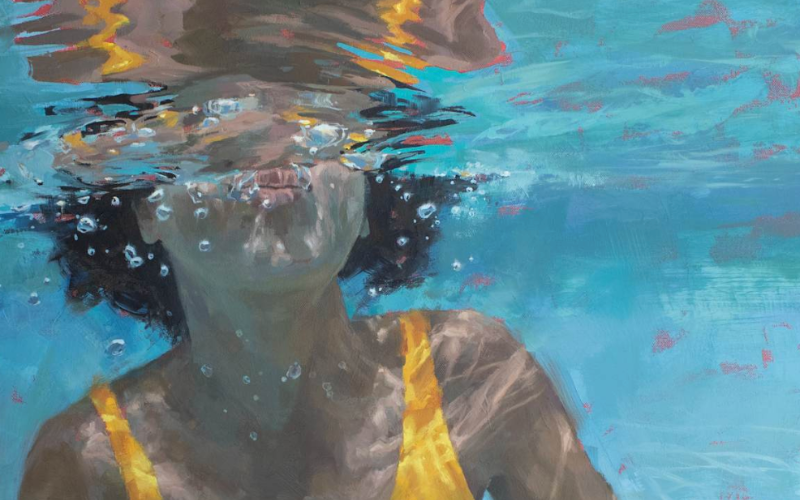
Michele Poirier Mozzone, Speak, 24 x 24 x 1.5 in
The Reality of Running an Art Business
While vetting galleries and negotiating contracts are essential parts of the job, navigating the daily admin of a fifteen-year art career can feel a lot like drowning. "I'm a hopeless procrastinator with paperwork and filing taxes," Mozzone admits. "I'm still learning that one the hard way, I guess."
On the recommendation of a trusted artist friend, Mozzone turned to Artwork Archive to organize a growing, decades-spanning inventory. Now, she uses it daily, and has even become "increasingly reliant on it to enhance [her] art business."
Her absolute favorite part of Artwork Archive "by far" is how easily it handles artwork information. "I often get inquiries about my available work," Mozzone says, "and in a matter of minutes I can reply to a potential buyer with professional documents listing images and all relevant information, including links to my galleries and website." Instead of scrambling to pull together details or format a PDF from scratch, she can send a clean, polished response right away. Collectors get a seamless experience, and she gets to keep her self-proclaimed procrastinator status. Mozzone is proof you don't need to change your creative nature to run a successful art career. With the right homebase backing you up, you can present yourself as a professional (even if you don't feel like one).
Redefining Success as an Artist
Just as the water Mozzone paints bends light, dissolves edges, and changes how everything looks beneath the surface, the meaning behind her work has naturally morphed over the years. It makes sense, then, that her own perspective on what it means to be a successful artist has evolved too.
"When I was much younger, I probably thought success as an artist was being represented by a prestigious gallery, being famous, and making a lot of sales and money," she recalls. But traditional ideas of commercial fame eventually dissolved into something else.
"Now, I receive the most validation from people who tell me they feel a strong connection to my work," she maintains. "Selling a painting is wonderful, but the most amazing part of a sale is knowing that the client connects with the piece enough to take it home and live with it. That's the highest compliment."
Finding that kind of fulfillment, she believes, calls for one hard mindset shift: stop painting for the crowd. "Create what you're passionate about, not what you think will sell," she counsels. Growing a sustainable art career means learning how to treat your work (and yourself) with respect. "Only put forth your best work at that particular moment. Not everything is worthy," she warns, and in the same breath, "don't undersell your work."
All of it circles back to that afternoon at the pool fifteen years ago. The Fractured Light series remains anchored to an authentic human experience, choosing passion over trends and connection over status. Water carries cleansing, change, renewal, and death, and Mozzone has spent her creative career proving it can carry connection too.
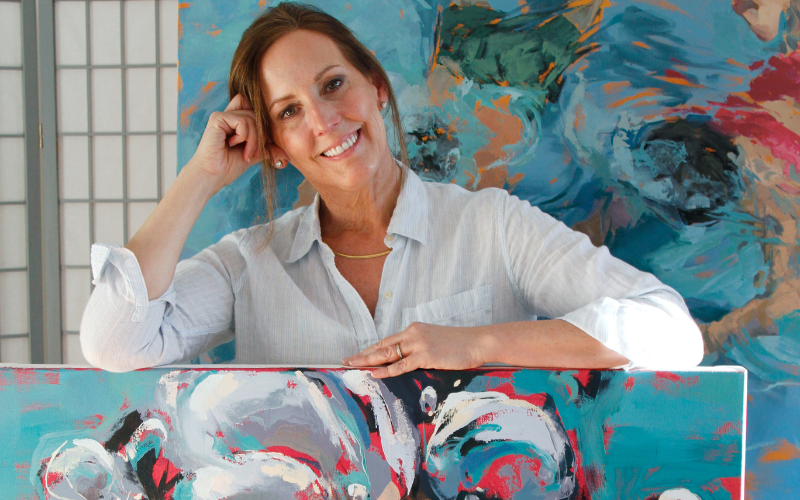
Every art career needs an operational backbone. With Artwork Archive, you can handle your art inventory, sales records, and professional artwork images, and more, making it easier to spend more time in your studio. Try Artwork Archive free for 14 days.