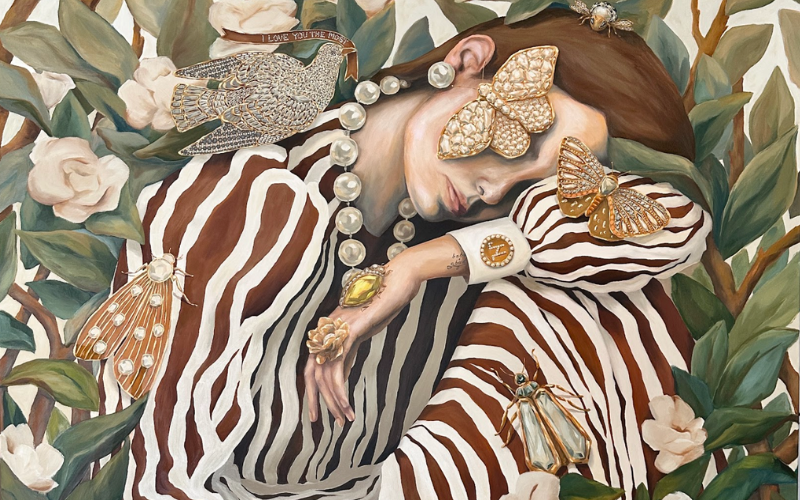
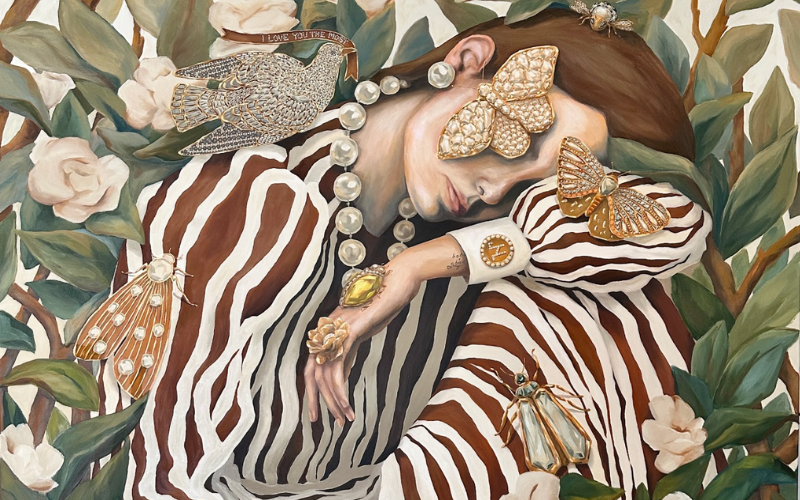
 Hannah Brown, I Love You The Most, 48 x 48 x 1.5 in
"I am a fan of anything that contradicts itself."
From fine jewelry to diamond-draped crows, Featured Artist Hannah Brown has always had a thing for unexpected combinations. After studying metalsmithing in college and working as a custom fine jeweler for an elite Dallas designer, Brown eventually turned her focus to painting. She brought with her a fascination with gemstones, precision, and intricate detail, constantly discovering new ways to apply her jeweler's eye to the natural world.
Her work moves between nature, memory, imagination, and, of course, jewels. A crow becomes a subject worthy of a diamond necklace, an insect takes on the brilliance of a precious stone, and delicate worlds are preserved beneath bell jars. Brown pairs things that seem to have little in common, finding something strangely beautiful in the space between them.
The result is a body of work fascinated with contradiction, and grounded in a deeper appreciation for the small things we might otherwise overlook.
We had the chance to chat with Hannah Brown about the memories behind her collections, the unexpected characters who make their way into her paintings, and how her background in jewelry continues to influence her work.
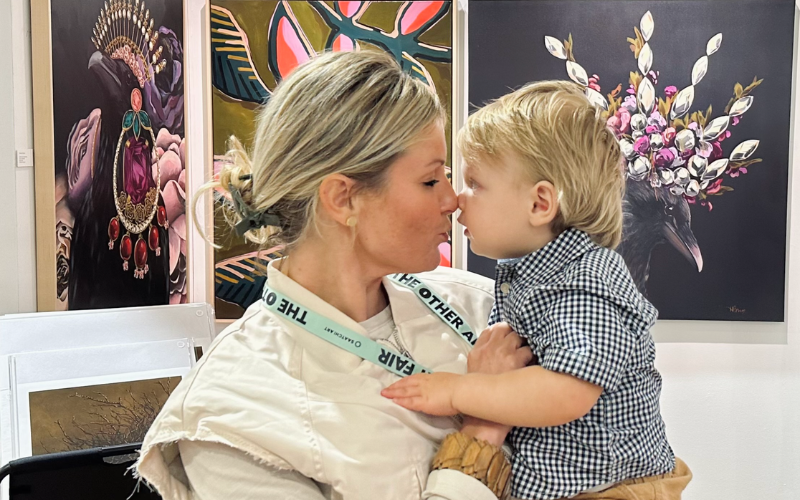
Hannah Brown pictured with her son at The Other Art Fair. Photo courtesy of the artist
Why Hannah Brown Traded Diamonds for Oil Paint
In 2005, Brown earned her BFA with a concentration in metalsmithing and jewelry from Colorado State University. While she had enjoyed her foundational painting courses, jewelry seemed to offer a clearer path to a steady career. Returning to Dallas right after graduation, she took a job with an elite designer, where she spent the next several years at the jeweler's bench making custom pieces by hand.
"It was fascinating to create one-of-a-kind pieces for some of earth's rarest finds," Brown shares in a recent interview with CanvasRebel. "I watched how diamonds and gemstones were treated like tiny treasures, and I learned quickly that being a jeweler meant living in the details."
Still, painting never really left her. "My favorite part of the job was creating renderings for clients," she tells Artwork Archive, "and I'd catch myself daydreaming about spending hours in an art studio." As the years passed, a recurring mental image became impossible to ignore. "I kept having flashes of myself as an old woman who never reached for her dreams," she remembers. So after eleven years as a jeweler, she walked away. "I decided I would rather try and have nothing come of it than never try at all," she reasons, "and I'm so glad I did. Now, I get to make work that matters to me."
While she doesn't make jewelry anymore, the instincts she honed at the workbench shape how she sees everything today. In fine jewelry, precision is everything, even on the smallest of scales. Now Brown brings that same eye for precision and value to her oil paintings. "I might paint a beetle the size of a pillow and 'set' it in gemstones, or paint bees out of pavé diamonds," she explains, "not to add bling, but to honor nature the way we honor fine jewelry, and to think of these tiny creatures as gems themselves."
Over time, her sense of what truly holds value has moved far beyond anything found in a display case. Stepping into full-time painting gave her the freedom to build her days around the people she loves. "Being my own boss gives me the flexibility to be a present mom," she adds. "To me, time is precious. Time with family and friends, creating memories in a world that is safe. No diamond could compete with that."
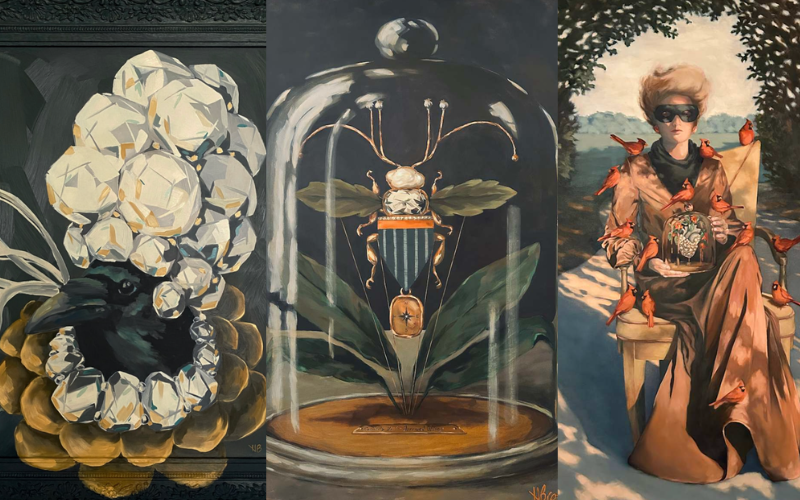
Hannah Brown, Diamond Lush, 28.5 x 22 in | Curiosity No. I - Borrowed Wings, 48 x 36 x 1.5 in | The Bandit, 71 x 64 x 2 in
Feathers and Facets, Beneath the Bell Jar, and Girl and Garden: Inside Each Series
"Jewelry trained my eye for tiny details, but painting changed the way I see the world," Brown tells Artwork Archive. "I’m more aware of color and of fleeting moments. I’ll find myself staring at a reflection in glass or at all the colors hiding in a shadow, thinking, How would I paint that?"
Every collection in her portfolio offers its own response to that question, unified by a curiosity about what we choose to value. In Beneath the Bell Jar, Brown asks us "to look closely at small things, the way you would at a specimen under glass." Feathers and Facets "plays with what we decide is beautiful, putting diamonds on animals we rarely stop to admire."
Then came Girl and Garden, the series she considers her most personal and transformative. Craving a lighter palette and deeper emotional honesty, Brown brought a female figure into her compositions for the first time. "I had always steered away from the human figure, especially the face, because I worried it would make the work feel too personal," she recalls. "But here we are!" More symbol than self-portrait, the figure gives viewers an emotional doorway into the canvas, deepening the bond between human memory and the natural world, while the bejeweled creatures embody everything we overlook.
Gems and jewelry appear across much of her work, but the creatures themselves didn't become jewels until Girl and Garden, the series that followed the birth of her son. "[The series] grew from my own memories and from watching my son marvel at the tiniest things," Brown points out. Spending slow days outdoors with her young son gave her a front-row seat to his boundless curiosity. "At that age, kids are endlessly curious about the tiniest things, the ones adults rush right past," she notes. "Following his lead made me slow down and notice what I'd been missing and reminded me that the moments that matter most are the ones that pass quickly, and they're worth slowing down for."
Soon, beetles, moths, and other tiny creatures began emerging on her canvases rendered in diamonds and set in precious stones. "They’re easy to overlook," the artist notes, "but they play a huge role in the world, and I wanted to give them the treatment we usually reserve for things we consider precious." Brown often places the creatures directly onto open hands to bridge the distance between people and the outdoors, a motif she says "draws the viewer in without a word, as if to say, 'these little guys matter.' It becomes a gentle reminder that we need to take hold of nature and care for it."
How Hannah Brown Turns a Moment into Something Monumental
The concepts behind each painting grow out of passing observations Brown refuses to let slip away. "It usually starts with an ordinary moment that holds something special, like my son pointing out how orange the clouds are, or a flash of color on a beetle," she explains. "I love taking those tiny things that go unnoticed and making them monumental. To me, that's a reminder of what's actually important."
Once a moment catches her attention, she translates it into digital sketches, experimenting with color palettes and layouts "until something feels right." From there, she moves to the canvas with a quick, loose acrylic underpainting. "This is my favorite part," she confesses. "It's fast and energetic, and there's no pressure for it to be perfect." Earlier in her career, she admits to "getting uptight" about matching her sketches exactly. But over time, "I've learned to treat it as a guide and let the painting change as I go."
Giving a painting room to unfold takes patience, especially when studio hours have to fit around motherhood. "I prefer long, uninterrupted sessions," Brown says, "but life with a family doesn't always allow for that, so how quickly a painting comes together depends on what else is going on." Learning to work in the margins of life, she's determined to give every piece the time it deserves. "Some fly along, and others have me stumbling in the middle. But they're all meaningful to me, so I try not to rush them."
Before a piece can be considered finished, it must pass a two-part gut check. First, she steps into the room with fresh eyes to make sure no jarring detail pulls her out of the scene. "Then comes the real test," she goes on to say. "I sit back, look at it, and if it makes me emotional, that's when I know it's ready to share."
With family life and slow, intentional painting filling her days, Brown has to be equally intentional about how she manages everything happening off the canvas.
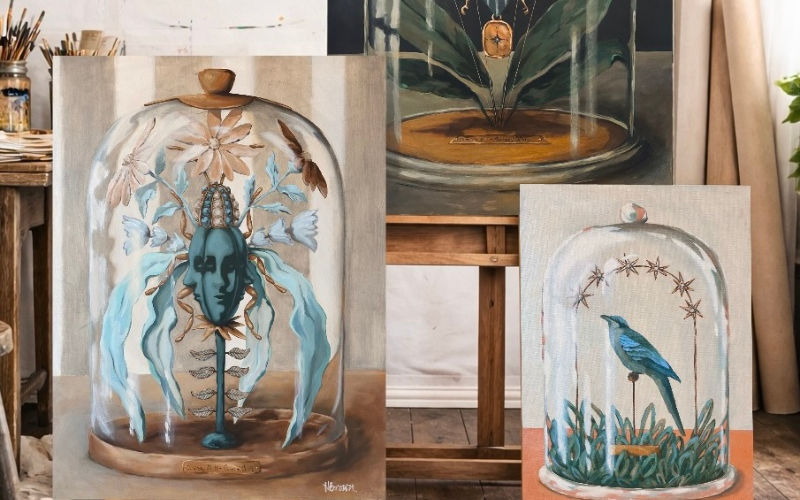
Hannah Brown's series, Beneath the Bell Jar pictured in her studio. Photo courtesy of the artist.
Two Business Lessons: Get It in Writing and Build an Art Inventory Early
Running a sustainable art practice means wearing every hat, often while squeezing studio hours around family life. For Hannah Brown, keeping pace with her artwork required learning a couple practical lessons on the business side, starting with setting clear boundaries upfront.
"Always get it in writing," she advises. Earlier in her career, working with acquaintances often made formal paperwork feel unnecessary. "They were usually people I knew, so I assumed everything would be fine, or I felt awkward bringing up an official agreement," she recalls. "Nothing terrible ever happened, but it caused a lot of stress when something came up that we hadn't discussed." Now, whether she's collaborating with another business or taking on a private commission, she puts every expectation on the table. "It can feel uncomfortable in the moment, but it's so much easier than a difficult conversation after the fact."
💡 Artwork Archive Tip: Manage Your Full Commission Workflow in One Place:
Commissions are one of the steadiest ways to build income from your practice, and they go smoothly when your client knows exactly what to expect at every stage. Artwork Archive gives you one place to capture the inquiry, present the concept, share progress, document changes, and collect payment. Everything connects back to a single Piece record, so you're never digging through an email thread to find out what you agreed to in March, and you'll always have it in writing.
→ Learn how to create, track, and manage commissions in Artwork Archive
Keeping her inventory organized demanded that same kind of upfront structure. When starting out, Brown remembers her business details were "all over the place," yet she took to heart a piece of advice she kept hearing from veteran artists: build an archive early. "After hearing about Artwork Archive on a podcast, my first thought was 'I need that!'" she remembers. "I'm not very tech savvy, and the idea of building spreadsheets to keep everything organized sounded miserable."
What began as an easy way to track expenses for tax season gradually evolved into the command center for her studio. "At first it’s easy to remember what you painted, when, and how big it was," Brown says. "Eventually everything starts to run together. I was recently looking at a painting and thought, 'I painted that THREE years ago?!'" Having one searchable home lets her filter available pieces, past sales, specific series, and dimensions in seconds.
Her favorite tools on the platform have also grown with her business. Using Private Rooms, she can quickly assemble a clean, focused presentation tailored to a client’s space and color scheme rather than asking them to scroll through her entire website. When multiple paintings leave the studio at once, Inventory Reports let her see where every piece stands at a glance. "Both features make my business look more professional, and that matters when you’re running everything yourself," she emphasizes.
💡 Artwork Archive Tip: Send Private Rooms to Galleries and Curators
Private Rooms work as well for professional pitches as they do for collectors. When a gallery or curator asks to see work for a show, you can put together a focused selection with your images and artwork details, then share it in a single link.
→ Create a Private Room
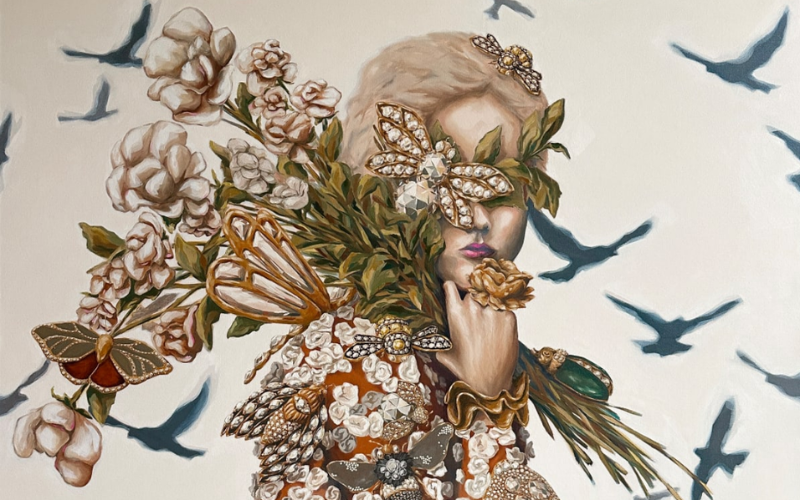 Hannah Brown, Church of the Wild, 48 x 48 x 1.5 in
An Artist's Advice: Building an Art Business Is a Long Game
Putting practical habits in place early has given Featured Artist Hannah Brown the freedom to protect the exact thing she values most: time. Having walked away from a decade in fine jewelry so she would never look back with regret, she knows firsthand how slowly a meaningful life and career can take shape.
"This is a long game, so be patient," she urges. "Make what's important to you and be yourself, because that's the one thing no one else can do. Stay organized from day one, since it's much harder to catch up later, get involved with your local art scene, and just keep creating."
Whether she's transforming a garden beetle into a diamond, holding onto an afternoon memory with her son, or building a studio rhythm that lets her be a present mother, Hannah Brown's work is an ongoing act of attention. She treats small creatures, fleeting shadows, and ordinary days with the preciousness they deserve, and reminds us to look a little closer at the treasures already in front of us.
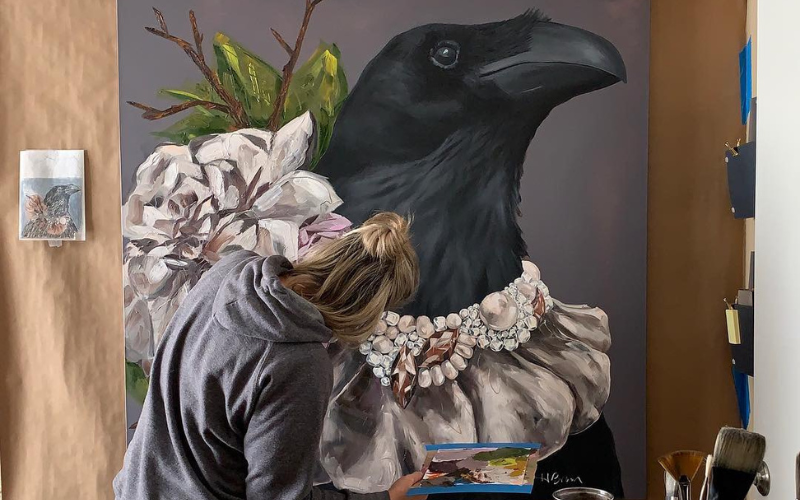
Hannah Brown working on one of her pieces, Bon Ton in her studio. Photo courtesy of the artist
Artwork Archive gives you one place to organize your art inventory, sales records, professional artwork images, and more so you can spend more time making art. Try Artwork Archive free for 14 days.