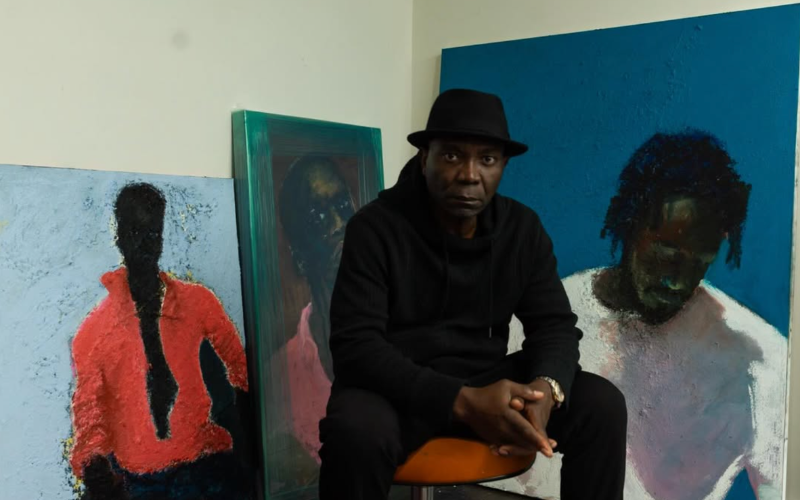
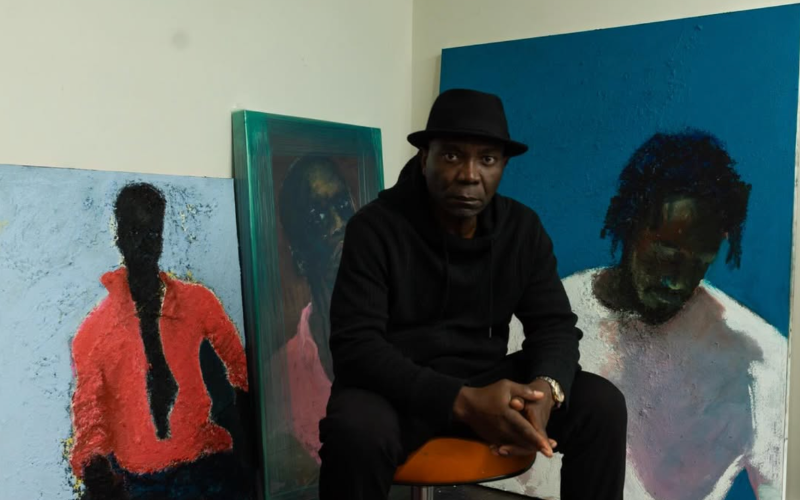
Temi Wynston Edun in his studio, surrounded by works from his figurative practice. Photo courtesy of the artist.
"The body often carries what speech cannot."
In Featured Artist Temi Wynston Edun's artwork, a figure can say a great deal without ever fully revealing itself. A head tilts away. A gaze meets ours. Painted figures sit, stand, and turn against muted fields of blue, ochre, white, and black, their postures heavy, seemingly holding something just beyond what words can explain.
Born in Ibadan, Nigeria, and now based in Columbia, Maryland, Edun "construct[s] figures of Black people that exist in states of psychological interiority." They're neither conventional portraits nor characters leading us toward a particular narrative. Instead, they occupy an ambiguous space, asking us to look a little longer.
His practice insists that an artwork does not need to explain itself to be felt. Asking us to slow down and make room for silence, Edun offers the possibility that not everything needs to be made immediately clear.
We got the chance to chat with Temi Wynston Edun about his creative process, the advice he gives artists chasing a sale, and how a self-described disorganized artist finally got the business side under control.
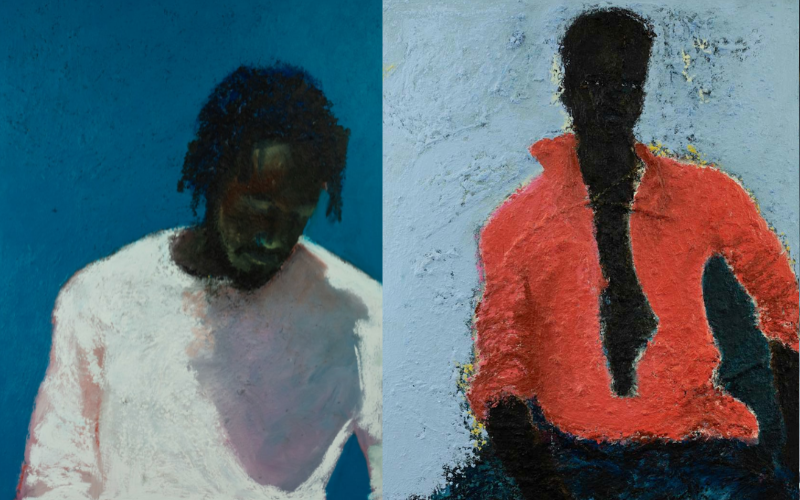
Temi Wynston Edun, a matter of inches, 60 x 48 in, 2024 | red feldspar, 40 x 30 in, 2025
How Temi Wynston Edun Builds Oil Stick Paintings Through Layering, Scraping, and Erasing
Every piece begins with what Edun calls an "imaging pulse": a photograph, a memory, a fleeting gesture, or a posture caught in passing. Yet the source material only gets him through the studio door, sparking the initial direction before he sits down to begin.
"The painting has to exceed the source," he asserts. "If it remains illustration to me, it has failed."
To move beyond illustration, Edun works primarily in oil stick, building up layers on the canvas only to take them back: scraping, compressing, erasing, and rebuilding. "I need the surface to think," he points out. He pushes the material until the work stops cooperating, continuing until the canvas "begins to resist me." Marks are buried, forms break down, a single face might emerge and disappear several times before it finally takes its place, while an ordinary background thickens into what he calls "psychological weather."
The physical evidence of his creative process remains in the final compositions. "I'm not trying to get to a point where it's polished for its own sake," Edun shares. Instead, each finished piece bears the raw, visible "record of decisions, hesitations, and recoveries," carrying the history of its own making.
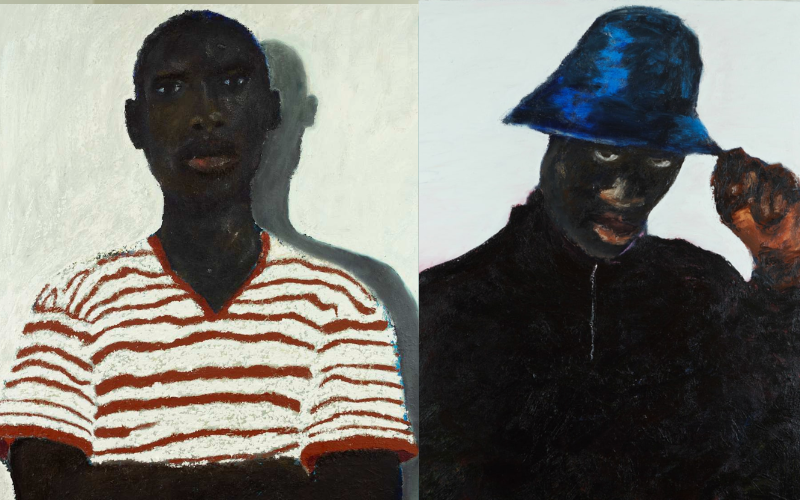
Temi Wynston Edun, second witness, 47 x 45 in, 2026 | blue bucket, 40 x 30 in, 2022
Painting the Black Figure Not as a Portrait, but as a Site of Psychological Presence
Edun's interest in the human figure has little to do with capturing a realistic portrait, and everything to do with a fundamental question: "What remains when language fails?"
"The body often carries what speech cannot," Edun says. Through this lens, the figure becomes "a site of psychological presence and restraint."
"When I use the word site, I mean that the figure is a place where something is taking place, rather than simply a representation of a particular person," he explains. "I'm interested in what happens between presence and perception, what the figure gives us, what it withholds, and what we as viewers bring to that encounter."
On his canvas, a face might remain visible without ever fully being readable; a gaze might hint at a deeper inner life, yet refuse to reveal what that life contains. The bodies he paints carry a heavy load, one he describes as a convergence of "psychological, historical, social, and spiritual pressures."
"They are often alone, but not isolated," he says of his figures. "They are composed, but not settled." Some meet the viewer's eye; others glance away, but none of them resolve into a single, simple story. Instead, they give you just "enough to establish a presence, but not necessarily enough to fully explain that presence."
The figure's ambiguity is also where Edun's influences come together. He draws from many things at once: the eloquence of Black social gesture and the knowledge packed into stance, dress, bearing, and coded movement, as well as the tension between modern abstract art and everyday composure. He also thinks about traditional African sculpture, which honors the head as "a site of destiny, consciousness, and spiritual orientation." These references are, in his words, "metabolized," absorbed fully into his work until they become part of its internal logic.
As a result, his figures always seem to "reserve something for themselves," insisting that the encounter between painting and viewer must be earned, and that looking must become an active part of the artwork itself. As viewers, we attempt to interpret posture, search a face for any recognizable expression, and read into a sideways glance, inevitably bringing our own assumptions, stories, and experiences to what we see. Edun thrives there, in the space between what a painting may offer and what a viewer thinks they recognize.
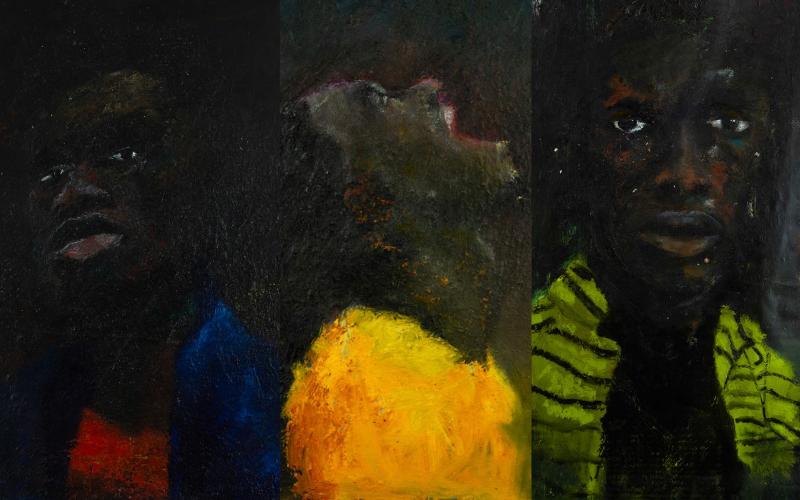
Temi Wynston Edun, mythologies of arrival (blue lineage), 46 x 36 in, 2026 | the weight of the well, 34 x 30 in, 2026 | green stripe shirt, 42 x 24 in, 2026
How Temi Wynston Edun Builds Silence Into the Structure of a Painting
When we think of silence, we often mistake it for an absence of something: a void waiting to be filled with noise, explanation, context, or anything else. But for Edun, silence is an active, structural force that shapes how his paintings function.
"Silence for me is not absence; it's not emptiness," he clarifies. "Building silence means making it part of the painting's internal logic—through what is withheld, how the figure occupies space, and how much the painting allows itself to disclose. "In his work, silence dictates posture, spacing, atmosphere, and surface texture. Far from a passive state, it "can contain dignity, refusal, contemplation, grief, composure, or withheld knowledge. It can be chosen or imposed. And at the same time, it can protect and it can burden."
This philosophy directly informs how Edun visually constructs a figure. "When a figure turns slightly away, when a face is spatially obscured, when the surface interrupts recognition, that is not evasion. That is structure," he emphasizes. Color and contrast play similarly active roles. A vibrant pop of color might heighten a figure’s physical presence without clarifying its emotional state, while sharp contrast can pull one detail forward and allow another to recede into darkness. This deliberate withholding acts as a rebellion against our culture of speed. "We live in a moment that demands instant legibility, instant explanation, instant position, instant transparency," Edun notes. "Painting offers another tempo."
By refusing to deliver a neat, instant message, Edun forces us to slow down and creates a space where meaning isn't handed to us directly. "Some truths do not emerge dramatically," he adds, "they accumulate in stillness, in silence."
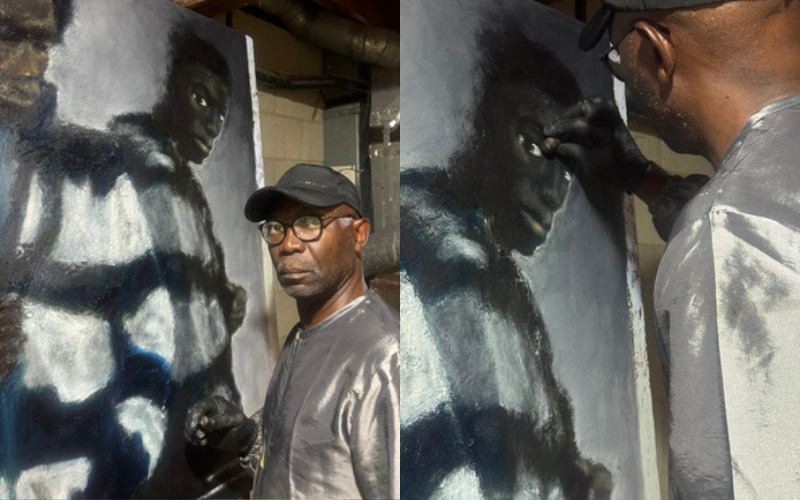
Temi Wynston Edun at work on bridge across the fourth in his studio, building the figure's surface by hand. Photo courtesy of the artist.
Managing an Art Business With Artwork Archive's Reports Feature
Edun will happily spend hours thinking about a painting. Organizing the business around it? Not so much. "I'm not the most organized person out there," Edun tells us. "Far from it."
His studio offers endless creative discoveries: "the canvases, the paints, the new discoveries and learning," as well as the physical problem-solving of making the work. But then come the other things:
Which painting went where?
What are the details of that piece?
Who was that client again?
What needs to go into the next exhibition application?
What exactly should be sent to the gallery?
Edun eventually realized he needed a better way to handle these aspects, and at one point even considering hiring someone to manage it all for him. Then Artwork Archive came along:
"The minute I signed up, it was like a godsend."
He can now spend a few minutes each day keeping up with the admin without it turning into a second job. "[Artwork Archive] gives me just about everything I need to get organized," he shares. His artwork records, client information, and professional materials can all live in one place and, perhaps most importantly, be ready when he needs them.
The Reports feature has become particularly useful for his practice. "The ability to quickly generate polished, professional materials in response to client inquiries has been invaluable," he tells us. "Having my artwork information organized and ready to present professionally when an opportunity arises is, for me, worth its weight in gold." Lately, he's also come to find out that several of the galleries he interacts with use Artwork Archive too, "which makes working with them seamless and something that I've found to be so valuable."
The admin that comes with running a professional art practice probably isn't what Edun imagined when he first began pursuing his career. But a professional practice has a way of expanding beyond the canvas, and having the right systems in place makes that load a lot easier to carry. Which is why, after several years of using the platform, Edun "will recommend Artwork Archive to anybody who's doing, or even thinking about doing art as a profession."
💡 Artwork Archive Tip: Apply to Open Calls Directly From Your Artwork Archive Account
Some galleries and organizations host their Calls for Entry through Artwork Archive, which means you can apply to those calls right from the Call Submissions page in your artist account. When a call is hosted on the platform, you'll see the "Apply with Artwork Archive" button, and be able to apply using work already in your inventory.
→ Apply to open calls on Artwork Archive

How Artists Can Build a Career Around Honest Work
At some point, most artists encounter the same question: Should I make what I want to make, or what I think people will buy?
The professional side of the career will inevitably bring other considerations to the forefront, especially when it comes to selling work. "Yes, you want to sell your work," Edun acknowledges. "That's how you make a living. I get that there's sometimes the urge to see what's out there, what's popular, and what will sell."
"But at the bottom level, you have to do what inspires you. You have to do what calls you. You have to be honest." That starts with having something of your own to explore. "I think as artists, we all have something that we're trying to say, trying to explore," he goes on to say. "And the more you do what you're inspired to do, and the more you develop the skill to create those things, the more fulfilled you'll be as an artist." That fulfillment, however, isn't a guarantee of commercial success. "It's easy to say that the sales will come," he's quick to point out. "That's not—I can't really say that, because that may not always be true." There are no guarantees in an art career.
What he does believe is that there's value in building a practice around work that continues to interest you enough to pursue: "You have to do what inspires you. You have to do what drives you. That's what keeps you going every day." And, perhaps unexpectedly, "the more you do what you are inspired to do, the more people are going to connect with what you're doing on an emotional level."
What it all comes down to is this: keep making the work. Get better at making it. Learn how to present it, document it, sell it, and build opportunities around it. But don't ever lose track of the reason you're doing any of it.
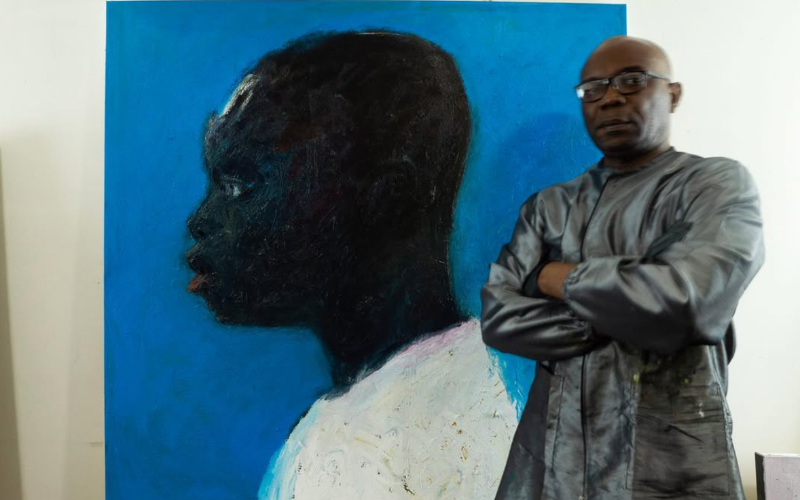
Artist Temi Wynston Edun stands beside one of his oil stick paintings, a Black figure shown in profile against a deep blue background. Photo courtesy of the artist's Instagram