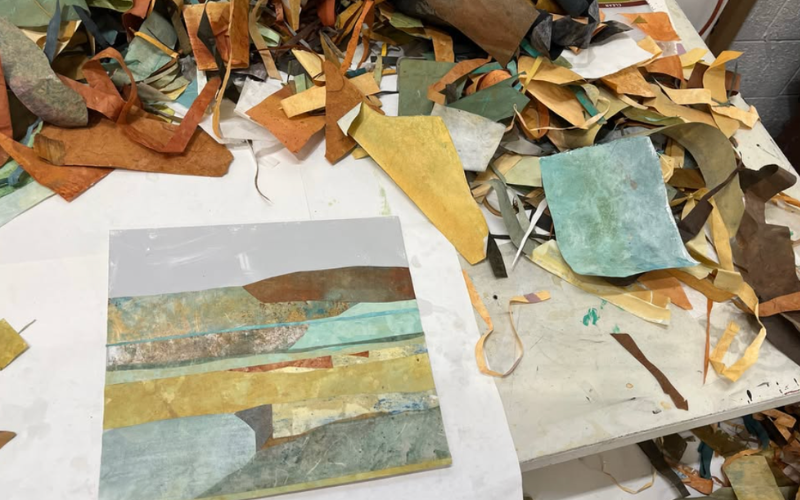
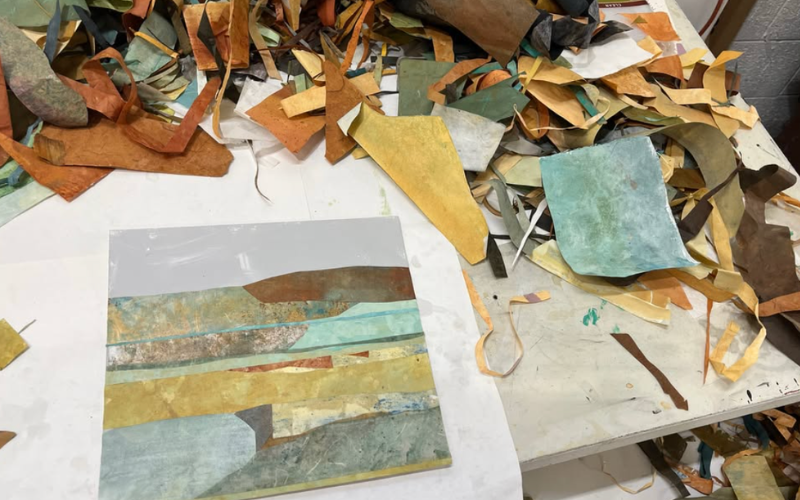
 "My hope is that my work takes the viewer into a world of imagination, peace, and calm."
Featured Artist Jeff Juhlin has spent two decades in the red rock country outside of Capitol Reef National Park in Southern Utah. Building landscape compositions from oil, cold wax, and stained Unryu paper, he works in the same red and yellow ochre he digs out of the ground around his Torrey studio.
Process and materiality are just as important to Juhlin as the landscapes he paints. The layered surfaces echo the terrain that shaped them, holding the raw geology, light, and color of the surrounding earth and the deep time written into it.
Across his body of work, he reimagines that landscape to reflect his own emotion and memory of living there. Free from any trends, narrative, or political agendas, Jeff Juhlin's work invites us to get lost in the vast, unhurried space of the desert itself.
We got the chance to chat with Jeff Juhlin about the stained paper he can't fully control, what changed his definition of success as he got older, and the habit he wishes he'd started decades earlier.
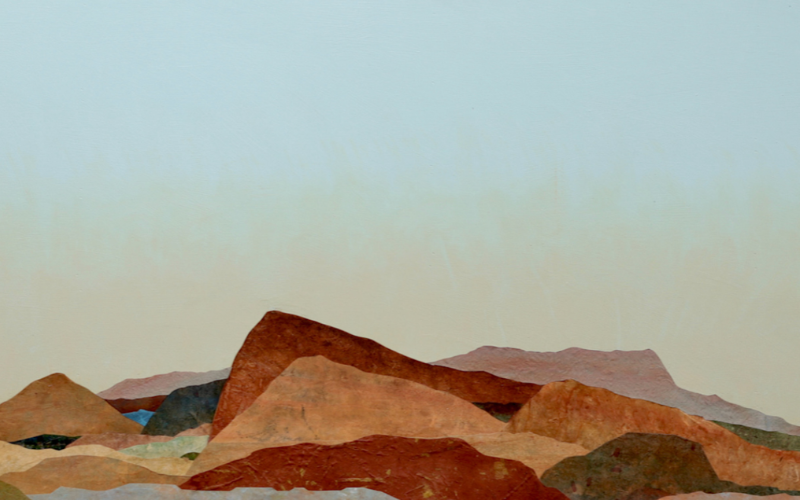
Jeff Juhlin, Incline, 24 x 60 x 1.5 in
How Jeff Juhlin Paints Desert Light in Utah's Red Rock Country
Jeff Juhlin lives in the middle of his subject. The desert he paints is framed by his own studio's window as the dry, sun-bleached valley floor and flat-topped mesas stretch out before him. A constant, grit-laden wind sweeps across the open basin, and deep, hard shadows huddle tight against the bases of jagged cliffs. Twenty years in, and it never gets old. "I'm always surprised by the ever-changing quality of light, color, and the stunning desert geology."
On his blank panel, the restlessness of the desert goes still. The compositions stay "generally flat with little volume," while he turns his attention to "the overall quality of light and atmosphere." The raw elements of the land are flattened into wide fields of color that sit quietly on top of one another. The color palette, subdued and drawn directly from the land, is set before Juhlin knows how any of it will truly fit together.
His finished pieces read like geological core samples: layer built upon layer, matching the way the massive cliffs around him keep thousands of years of sediment stacked beneath their surface. There's no set story in his paintings, and no narrative to follow. There's no trend he's following or political agenda he's subliminally buried. What he's chasing is the simple, physical act of creating. And if those creations take a viewer out of their own chaotic world and into one "of imagination, peace, and calm," then he's done something worthwhile.
Building a Desert Landscape from Oil, Cold Wax, and Unryu Paper
Every piece begins in Juhlin's shop, at the workbench where he builds the rigid, cradled wood panels by hand. Before any color touches the wood, he sketches a loose layout, a rough map of surrounding canyons and plateaus, and washes a background of open sky in acrylic. He then turns to the raw paper. Sheets of delicate Unryu are stained with a thin oil slurry. "It creates amazing color and texture variations," he says of the stained sheets, "which I cannot always control. But that's the fun of it, never knowing what you're going to get." Once the paper dries, he collages mineral-toned shapes onto the wood panel with a cold wax medium, repositioning the elements as he works and curing them into a permanent bond.
From there, the composition takes over, making its own demands. "I try to let the painting tell me what it wants as I progress," he tells us, "and not get too hung up on a specific outcome." The tactile assembly is his favorite part of the process: "putting all of the stained pieces of paper together until they seem to work as a whole," like fragments of rock fitting together in a canyon wall. He won't force an ending to his work. Rather, each piece is only complete "when I can live with it a while and it still holds up."
💡 Artwork Archive Tip: How to Log an Artwork's Materials in Artwork Archive
A painting like Juhlin's is a physical recipe as much as an artwork: oil, cold wax, Unryu paper, and local ochre gathered from the surrounding hills. Logging these materials in each Artwork Archive record, alongside images and dimensions, keeps the full makeup of a piece attached to it as it develops.
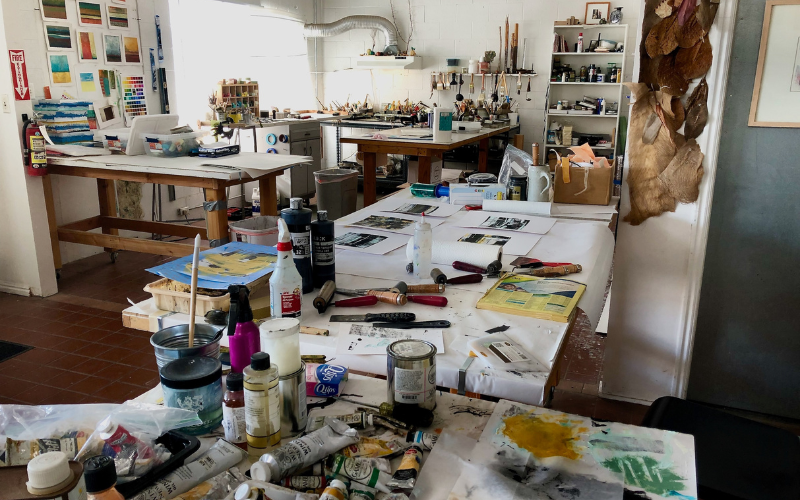
Juhlin's Torrey worktable mid-process. With Artwork Archive keeping his art business organized, he spends less time on admin and more time here. Photo courtesy of the artist
The Studio Discipline Behind a Twenty-Year Art Practice
Behind Juhlin's serene compositions sits a sprawling, decades-long map of professional milestones. His art career has taken him far from the isolation of the Utah desert, with residencies in France and Virginia, teaching stints in Park City and Idaho, and galleries carrying his work from Santa Fe to Sun Valley. Yet, as the years have piled up, the driving force behind him has shifted. The recognition and sales that come with a traditionally "successful" art career are nice when they show up, but by his own account have become "less important to me as I get older."
Today, his definition of success has narrowed to a single, sacred space: the constant, everyday pull of his art studio. "It's still about being able to show up in the studio and explore the creative process," he explains. Success, for him, comes down to longevity: "being able to keep my art practice through all the hurdles and distractions life presents along the way." As it turns out, longevity rarely waits for inspiration to strike. Instead, it's made up of tiny decisions, dug out of the days he would have given anything to skip. "I've made some of my best work when I didn't want to be in the studio," he admits. "But I showed up and pressed through whatever was blocking me." For Juhlin, to survive twenty years as an artist requires a stubborn, unyielding rule: "Make art your top commitment and stick with it. Keep showing up and making work even in the tough times and days you don't want to work."
How a Self-Described Hermit Keeps His Artwork Organized With Artwork Archive
For all the discipline he pours into the physical act of creating, there's a corner of the art world that never came naturally to Juhlin. Shaking hands, networking, and navigating the crowded social circles of the art community are all skills he had to learn the hard way. "I am particularly bad at it and basically a hermit," he says, "but I'm learning to be better."
Despite his solitary instinct, Juhlin's career includes a surprising amount of community coordination. He helped launch the annual Wasatch Open Studios Tour in Salt Lake City, and his teaching stints have filled studios across the state. These days, his professional life mimics the stark seasonal shifts of the landscape, splitting his time between a studio in the city and the quiet expanse of Torrey, a balancing act he's built for himself.
But the social side of an art career wasn't the only hurdle. The administrative side was equally daunting. "I'm a very poor record keeper and organizer," he acknowledges. Years ago, while surfing the internet, Juhlin stumbled onto Artwork Archive. Ever since, the platform has functioned as his digital studio manager, organizing his inventory, and keeping a solid archive of his legacy. "I often use the Portfolio Pages, Certificates of Authenticity, and Private Rooms," he lists.
As the hidden framework that supports his practice, Artwork Archive allows Juhlin more time in the studio, protecting his solitude while seamlessly supplying galleries with fresh work. "I can't imagine not having Artwork Archive."
💡 Artwork Archive Tip: How Artists Use Artwork Archive's Private Rooms to Share New Work
Private Rooms are an essential tool for artists who prefer isolation over networking. Instead of scheduling formal in-person studio visits, you can utilize a Private Room to send a tailored, exclusive collection of new work straight to a trusted collector or gallery director.
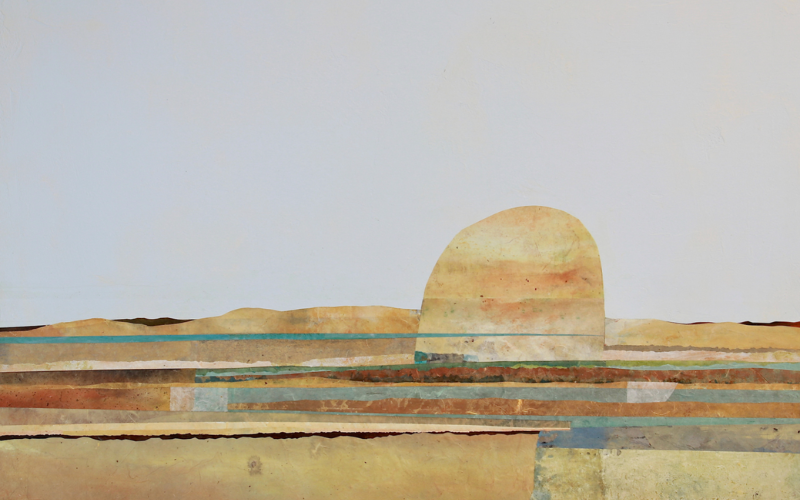 Jeff Juhlin, Golden Inselberg, 36 x 47.5 x 1.5 in
Jeff Juhlin's Advice for Artists Just Starting Their Careers
Juhlin has watched the light change over the high desert for two decades, and that same intentional, observant perspective shapes his attitude toward a lifelong career. "Don't get discouraged. Keep working no matter what," he urges. "Things will happen over time that will support your practice."
But while patience is what he preaches when it comes to the creative process, when it comes to the business side of being an artist, he advocates for immediate discipline. "Make sure you start early documenting your work with good images and information," he warns, looking back at years of unrecorded history. "I wish I had started with Artwork Archive much sooner than I did."
In an industry all too often obsessed with the next fleeting trend, Juhlin's final word to emerging artists is an invitation to slow down and let the work mature: "Don't be in a hurry for success."
If you strip away the layers of wax, the stained sheets of Unryu paper, and the decades of desert light folded into each one of his pieces, you find the uncomplicated, guiding pulse that has kept Jeff Juhlin showing up at his studio day after day: "Just keep doing the work."
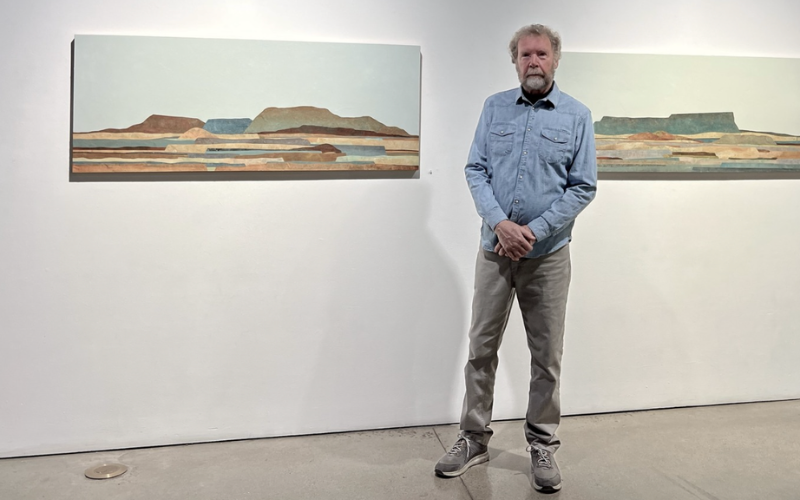
Juhlin stands between two paintings from his exhibition Dreaming the Landscape: A Contemporary View, the flat-topped mesas built from his signature bands of muted color. Photo courtesy of the artist
Every art career needs an operational backbone. With Artwork Archive, you can handle your art inventory, sales records, professional artwork images, and more, making it easier to spend more time in your studio. Try Artwork Archive free for 14 days.