What happens when we make room for the things that matter?
Paper has a way of accumulating. A stack of mail on the counter, bills and half-written notes tucked into drawers, all set aside with the intention of dealing with them later. It's one of the most common sources of household clutter. But in the hands of Featured Artist Kelli Nyman, paper becomes a catalyst for calm, a way to explore what it means to make room for the things that matter.
As a self-taught artist working from her studio in Somerville, Massachusetts, Nyman pleats, folds, cuts, and arranges paper into minimalist, sculptural paintings in muted, monochromatic palettes. Her work grows out of a long-held interest in how our physical surroundings affect the way we feel about ourselves and the way we connect with other people.
Through restrained compositions, she transforms a familiar material into something unexpected, and invites us to reconsider the space we make for the things we care about. She believes that making room "frees up our energy for the experiences, interactions, and relationships that matter to us most." Over the last year, Nyman has been learning what that means for her own art career.
Artwork Archive got the chance to chat with Kelli Nyman about how she turns paper into an antidote for chaos, her philosophy of making room for the things that matter, and how she finally streamlined her business logistics to protect her studio hours.
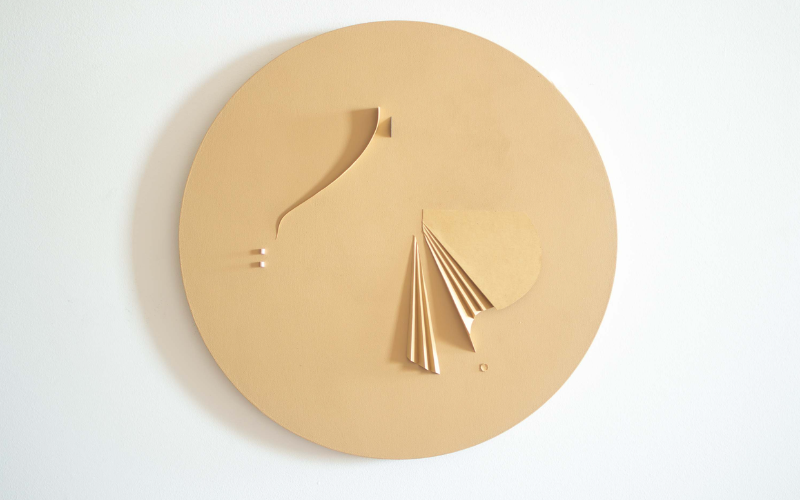
Kelli Nyman, Wishing You Wings, 2026, 20 x 20 x 2 in
Inside the Creative Process of an Abstract Paper Artist
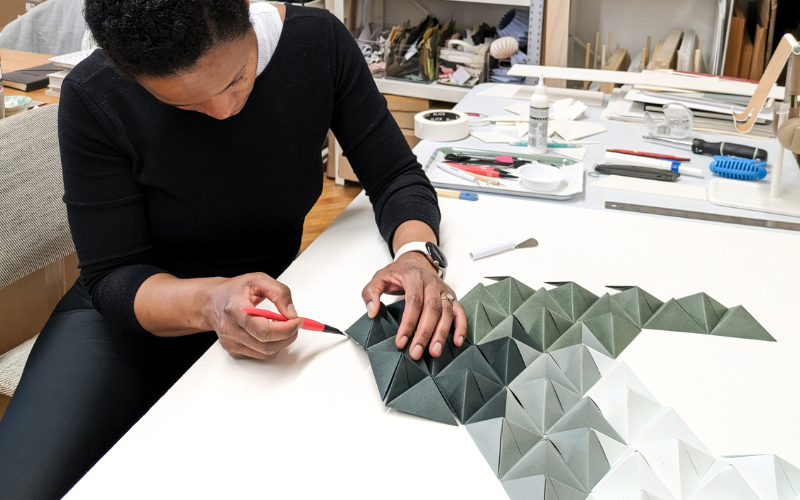
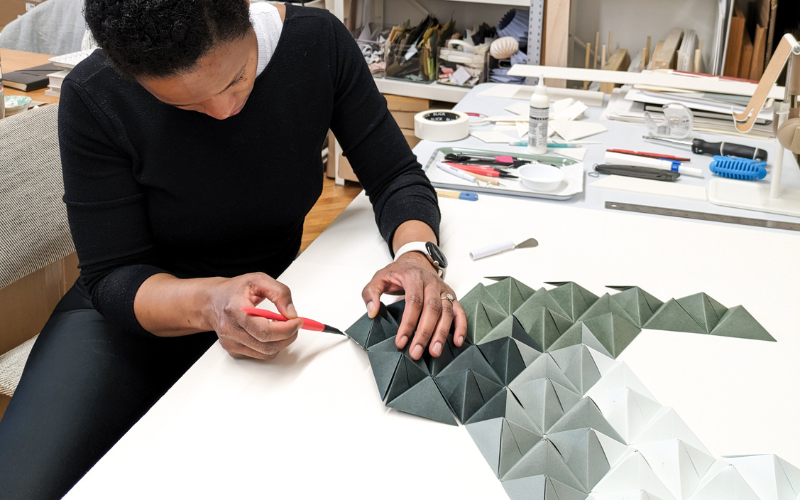
Kelli Nyman presses a pleated strip of paper against the wood panel, her fingertips firmly guiding the crisp edge into place. At this stage, a single slip, tear, or smear of adhesive could ruin weeks of work. "I have to be super careful at this stage, and it could be very nerve-racking," she tells us. Yet, as she concentrates on the precise placement of her folded paper, a distinct calm takes over, and she settles into a meditative state. "My breathing slows down, and I become very present and focused on letting my hands steadily do the work." For weeks, every creased form and sharp angle has been held together by tiny, temporary pieces of tape, constantly peeled back and shifted around. Now, the time for second-guessing is over. "I've made all of the difficult creative decisions, and I'm excited for everything to become permanent." It's her favorite part of the entire creative process. As she works her way across the board, the final piece emerges. "As each fold gets fixed in place, it really becomes itself, and it always looks better than I imagined."
Before the layout of her sculptural forms even exists on the panel, and before any paper is even cut, the work begins with a single variable. "I always start with color," Nyman says. "When I start a new series, I look through my papers and formulate a color palette that I'd like to work in." From there, she chooses her dominant colors and meticulously mixes paint to match her paper stock as closely as possible.
Once the raw materials are ready, "the process becomes very intuitive." She creates different shapes and forms with the paper, "iterating until the composition starts to take shape." Sometimes, she uses thumbnail sketches as a starting point, and even then, "things always end up going in their own direction." The paper units are sliced, pleated, folded, unfolded, and arranged on the board, held in place only by temporary tape while she negotiates with the composition. Her studio table becomes a laboratory of moving parts as she spends hours adjusting, stepping away, and adjusting again. "I know a piece is ready when there's this feeling of tension, familiarity, and a sense of movement," she explains. Once that feeling hits, it's finally time to reach for the glue.
Why a Self-Taught Artist Chose Paper as Her Primary Medium
She's always been deeply in love with materials, construction, and details. For Nyman, that fascination started in fashion design, where she spent years studying the psychological power of color, form, and balance. "You can get incredibly scientific and historical about it," she points out, "but it's really about paying attention to nature and what our senses tell us. We all have the ability to experience art in this way."
Her time in marketing and merchandising pushed that physical awareness even further, training her to look closely at how a single object changes the feeling of a room. "I can't help but think about how my audience will experience the work from the first impression to living with it day-to-day. How will it change the way the environment feels? How will the piece change as people move around it? As the light changes?"
"I think paper's familiarity was one of the things that initially drew me to it," she explains. As she continued to work with it, she developed a strong appreciation for its qualities, moving from the strict discipline of modular origami to the unpredictable textures of her current pleated paintings. "Each paper unit has to be exactly the same size, folded exactly the same way in order for it to come together," she notes of her early work. Now, she welcomes the disruptions. "There's always a back and forth of wanting a specific outcome, and responding to what the material is doing. It's a conversation where I'm always learning new things."
Why Order Feels Like Freedom: Clutter, Calm, and Art Made From Paper
Nyman was raised in a cluttered home, where piles of everyday objects (including paper) constantly crowded out her sense of peace. As a kid, she remembers the clutter having "more power," creeping past the normal parts of everyday life. "It prevented me from being comfortable sharing my space with others," she recalls. "It brought about feelings of shame, and felt like it was something that controlled us, rather than us controlling it."
She built her life as a direct counterweight to the chaos. "As I grew up, I learned to respond to that by being very organized and mindful of my surroundings, which helped me to feel both more at ease and more empowered," she says. "To me, order feels like freedom." When she first picked up paper in her studio, she wasn't trying to unpack old memories or make a statement about her past. "I was really just creating what I wanted to see, what made me happy," she explains. She was simply following her instincts with a familiar material. The realization came after she'd been creating work for a while. "Through reflection, I saw that my work always had this orderly, calm nature to it that other people often responded to."
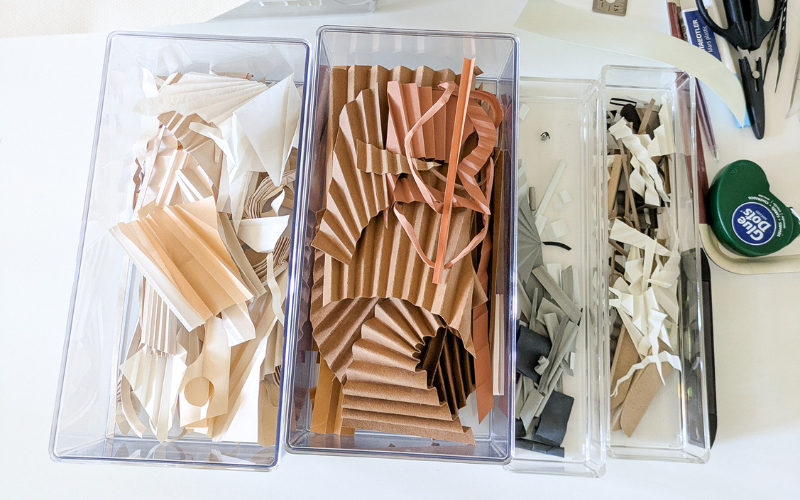
Her studio became her peaceful place, and in a conversation with her art coach, she discovered her chosen medium was the ironic, poetic center of it all. "While paper is ubiquitous as a form of household clutter, at the very same time, it's one of the easiest things to organize and present in a tidy way," she points out. Left to its own devices, paper creates chaos. It piles up on counters and hides in drawers. "It can be metaphorical for a lot of things in life," the artist goes on to say. "It has the unique ability to be both strong and soft, rigid and delicate, durable and ephemeral... It can be layered. It can be stacked. It can be light and it can be heavy—there's so much it can communicate."
"Paper lends itself to methodology and precision, all forms of order." Nyman takes a material notorious for causing domestic anxiety and uses it to build a sanctuary of clean lines and minimalist spaces. The mess and the masterpiece are made of the exact same substance. "So in a sort of poetic way," she says, "it becomes its own antidote, and it can always be both things."
The Real Life of a Working Artist: A 50/50 Split
People love to imagine the life of an artist as a world completely untethered from standard office hours and emails. They may picture the studio as a sanctuary, filled with art materials, stacks of beautiful paper, and a hot cup of tea. However, like many artists, Nyman splits her time right down the middle between art and the unglamorous logistics of running a small business. "Overall, it's probably 50% art-making and 50% everything else," she shares. Her days move between the tactile satisfaction of folding paper and the relentless checklist of business chores: putting application materials together, formatting newsletters, managing social media, packaging fragile shipments, and updating her website.
She often loses the early morning to scrolling through emails and art deadlines before she ever touches a sheet of paper. Once she's in her studio and in front of a work-in-progress, "it can take a few hours to get in a good groove." She stands over her work, letting her eyes trace the sharp folds and shadows from the day before, waiting for her hands to catch up with her thoughts. "I usually like to keep going until I feel like I've resolved something," she says. "Sometimes this happens, but other times I push for too long and things kind of get worse." When that happens, she's learned that the best tool is the ability to step away. "This is part of the process, and switching to something else or coming back with fresh eyes the next day always helps."
To protect her studio blocks from getting swallowed by administrative and ordinary life tasks, she plans her time backward from deadlines. "Deadlines, either external or internal, help me lay out my weeks, so that I keep a cycle of starting and finishing," she explains. Working backward from a deadline, she'll roughly figure out her focus by the week, then narrow it by the day. "When I do this correctly, it helps me feel less overwhelmed, like I'm working on the right things and I know what to do next."
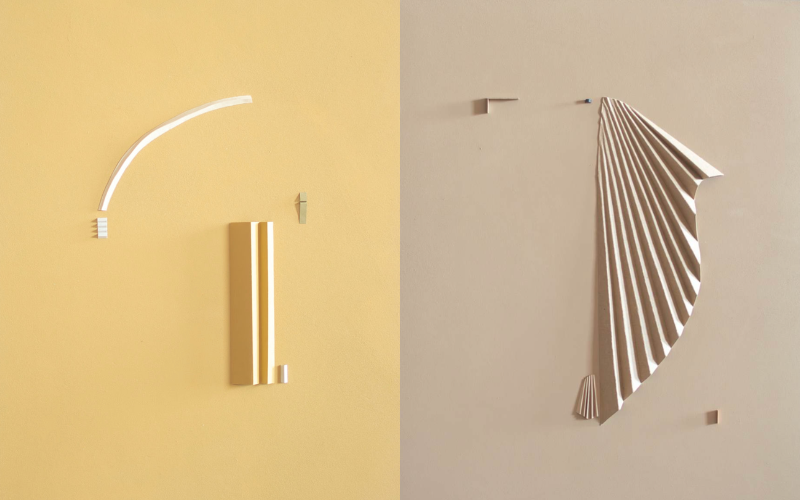
Kelli Nyman, After Storm No. 01, 2024, 16 x 12 x 2 in | Hopes Perches in the Soul, 2026, 20 x 16 x 1.5
Lessons From an Art Commission Gone Wrong
Time-blocking and calendar-mapping give Nyman a way to manage the competing demands of her art career. But some problems don't fit neatly into a schedule, and no carefully designed calendar can save an artist from a project built without the right boundaries in place.
Early in her commission career, she worked with a well-established art consulting firm with a clear process and contracts that defined how projects would proceed. "However, a later commission with a small firm was a bit less organized, and more rushed." Recalling what had worked well before, she offered the client material samples for approval before beginning two large pieces. The samples would give them a chance to see the paper's color and weight firsthand. "They declined [the samples], and said they were not necessary."
Nyman completed both works and delivered them on schedule. "Unfortunately, after they received them, they reached out to tell me that there was a problem," she remembers. The paper's weight and color weren't what they wanted. Both concerns, Nyman knew, would have been made clear in the samples she'd offered. Without a commission agreement of her own, she had no written terms to fall back on and no clear refund policy to guide what happened next.
She found herself under an enormous amount of pressure to "fix" the problem. "They actually shipped the pieces back to me to spray paint them, which was incredibly stressful because I risked ruining the finished work." Applying the paint evenly across the geometric forms was difficult, and every attempt carried the risk of damaging the pieces. She sent small samples showing how the painted paper would look, hoping to get approval before proceeding further. The client still wasn't satisfied.
"In the end, I offered to refund them and keep the pieces just to get out of the awful situation," she tells us. The commission cost her $1,000, hours of time and stress, and emotional baggage left tethered to the pieces. "I ended up giving them away."
The experience changed how she approaches custom work. Now, she includes material samples for clients who haven't seen her work in person. "If they do decline them, my agreement clearly states the non-refundability of custom work once it has been delivered."
💡 Get Your Commission Terms in Writing:
Did you know you can use Artwork Archive to keep every commission on track? Send your client a Proposal to lay out the details up front, from the artwork and pricing to terms like material approvals and refund policies. You can even set a "Valid Until" date so your offer doesn't stay open forever, and once your client says yes, the Proposal turns into an Invoice with a click. Save the signed agreement to their Contact record, and everything lives in one place if questions ever come up.
Why Kelli Nyman Stopped Doing It All Alone
Between making work, managing deadlines, and taking care of the business side of her career, Nyman spent years trying to figure everything out herself. Asking for help didn't come naturally, and neither did reaching out to other artists. "Personally, I tend to be overly self-reliant," she admits. "Keeping my head down, doing everything myself, and not asking for help." Without a formal fine art education, she didn't have an established group of artist peers in her circle. Most of her friends weren't artists, which meant she "often felt like I didn't have anyone to go to when I really needed help, advice, or just a buddy to do art things with."
Over time, self-reliance became exhausting. "I operated this way for several years, not realizing that I was making things so much harder and leading myself to burnout," she acknowledges. Eventually, she "hit a sort of internal breaking point," realizing that doing things completely alone was holding her back. So, she decided to do something about it.
"In the last year, I stopped waiting for permission to talk to or meet people, and started prioritizing getting to know more people in the arts." She began initiating conversations, building connections in the art industry, and strengthening existing relationships. "It made a dramatic difference," she reflects. "Internally, I felt so much better and was enjoying myself a lot more." Beyond that, she began to see the practical value of those connections. She found that other people could help her develop her work, offer support when things get difficult, and lead her to organic opportunities she might never have found otherwise.
Now, building her network has become part of the work itself. "Being a genuine and active member of a community is an incredibly valuable asset that you build over time," she adds, "and will support you in countless ways as long as you continue to invest in it."
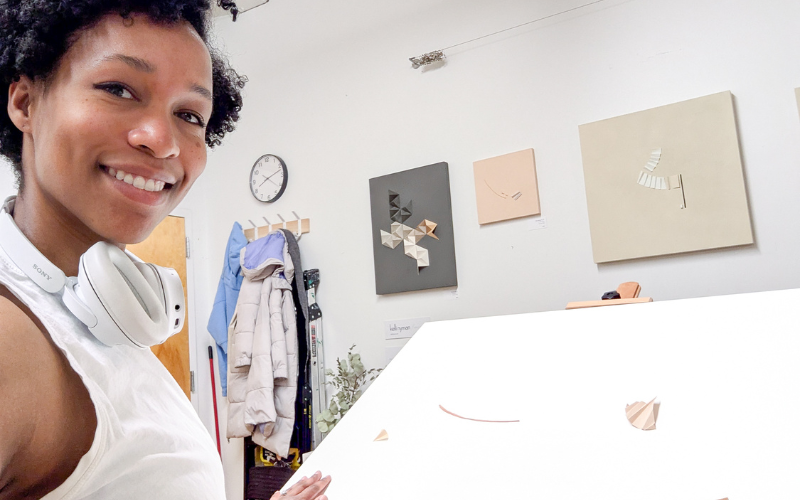
Less Paperwork, More Paper: How Artwork Archive Keeps Kelli Nyman Organized
As Nyman continued building relationships with those in the art world, new opportunities brought new demands on the business side of her career. "I started working with more art consultants and gallerists and my work was moving between different places," she recalls. When someone wanted to see which pieces were available, she had to pull together the information herself, manually creating the documents each time. "It was time-consuming and easy to make errors," and with more people asking about her work, keeping everything accurate and ready to share became increasingly important.
"I realized that Artwork Archive would streamline this process, and allow me to put together an accurate and professional document or viewing room for potential clients very easily and quickly. This was huge!" she explains.
One feature has become especially useful: Inventory Reports. "They're my favorite feature," she tells us. Now, when someone asks what's available, Nyman sends an Inventory Report built from the Piece Records she already has on the platform. "They're beautiful, and convey professionalism and quality," and come together without the copying, formatting, and triple-checking for errors that used to come with every request. Consultants aren't the only ones who get an Inventory Report. "I've also used them to send with my work when I deliver for exhibitions, which is really helpful for the gallery staff for keeping things organized when hanging a show."
With less time spent on the administrative paperwork, Nyman has more time to spend on the paper waiting to turn into artwork.
💡 There's a Report for That:
Inventory Reports are just one of the Reports you can create with Artwork Archive. Leaving pieces on consignment with a gallery? There's a Report for that. Wall Labels for an upcoming exhibition? A Certificate of Authenticity for a piece that just sold? Tear Sheets for your art fair booth? There's a Report for all of it, built from the artwork records already in your inventory.
Bonus: when you share a Report with a contact, a record of it is automatically saved to that contact's history, so you'll always know what you sent and when without digging through email threads.
Making Room for What Matters in an Art Career
So, what happens when we make room for the things that matter?
Kelli Nyman's artistic journey began at a solitary worktable, folding and pleating paper while negotiating with temporary tape, and making room for the sense of calm that she couldn't easily find as a child. She makes room for her art career and more time in the studio, letting Artwork Archive lift the administrative load that used to drag her down. And for the past year, she's been making room for people to support her, breaking a long cycle of exhausting self-reliance.
But one of the most critical things she makes room for is her own creative instincts, and she'd tell any emerging artist to do the same. "Try different things, but ultimately, listen to yourself," she urges. "As you identify your goals, let that lead where you put your efforts and how you craft your career." Do that, she says, and the rest follows. "If you follow what you're genuinely interested in, you'll find your place and your people."
Back at her worktable, the tape comes off, and each fold is fixed in place. Kelli Nyman's art career has come together in much the same way: clearing out the clutter, making room for what matters, adjusting and readjusting until it feels right, then settling into place. And, like the work itself, it keeps turning out better than she imagined.
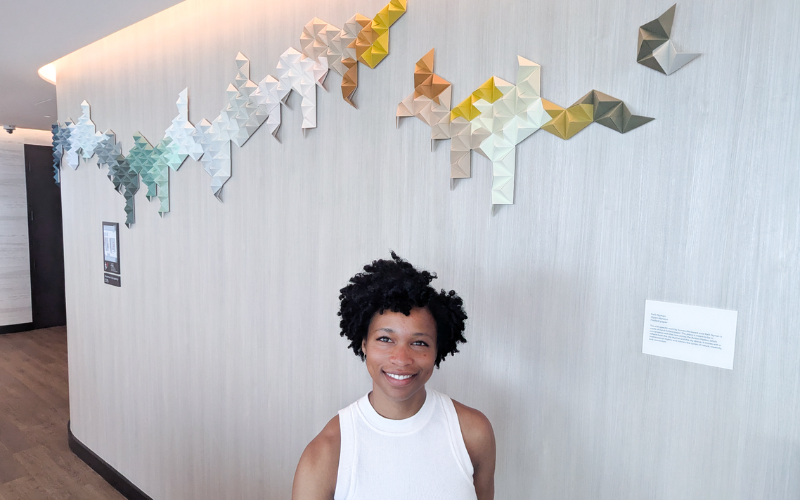
Artwork Archive gives you one place to organize your art inventory, sales records, professional artwork images, and more so you can spend more time making art. Try Artwork Archive free for 14 days.