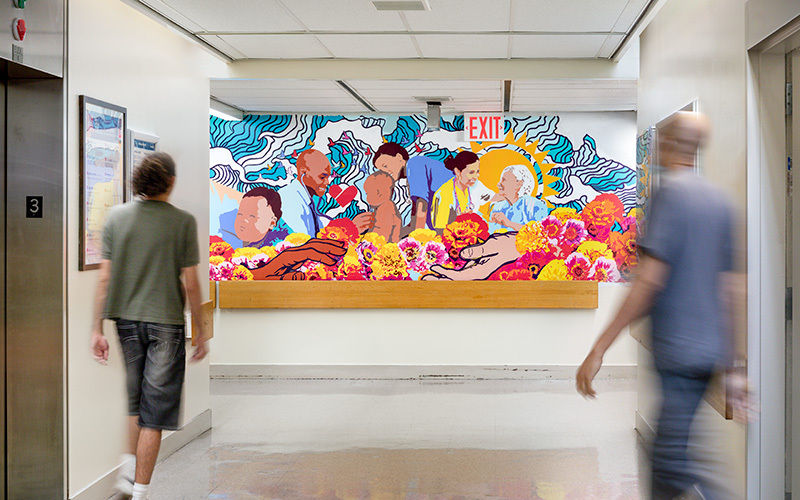
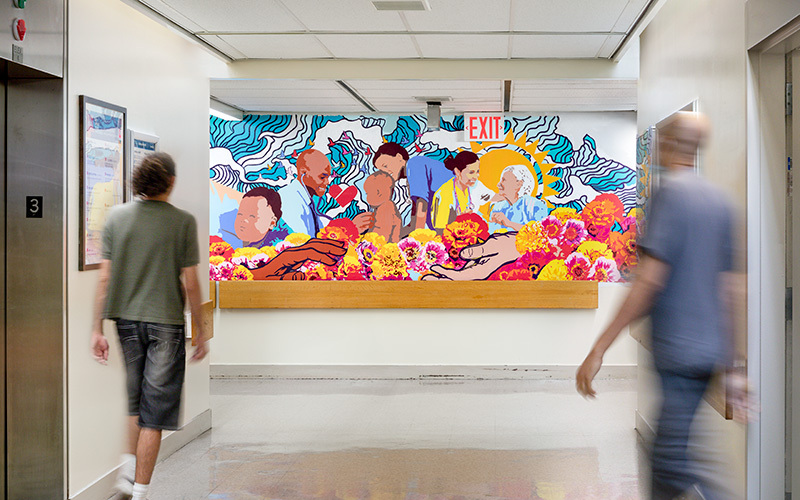
 Sophia Victor, Waves of Healing, Mural, 2024, at NYC Health + Hospitals/North Central Bronx. Image courtesy of Department of Arts in Medicine, NYC Health + Hospitals.
A visit to a hospital or health clinic can be an intense experience, whether it’s for a quick check-up or a longer stay. Tests, needles, surgeries, or more complex treatments all place difficult strains on patients, their families, and medical staff.
That’s where art comes in: more and more healthcare systems across the US are recognizing the calming and healing impact that art can have on their patients, and are working to incorporate artwork collections, music performances, and art therapy as part of the treatment process.
“Visitors to the hospital are a captive audience and tend to feel incredibly stressed about their upcoming procedures,” Antonia Dapena-Tretter, Art Curator at Stanford Children's Health, tells Artwork Archive. “Art has a role to play in helping to calm their nerves.”
Research shows that incorporating art into patient experiences can reduce the length of hospital stays, cut down on healthcare-related infections, and improve clinical outcomes. The arts can also have a tremendous impact on the patient’s overall mood and empowerment.
“The arts focus on the individual and not the illness,” Laura Mettam, Communications & Performing Arts Coordinator for Michigan Medicine's Gifts of Art Galleries, points out, “so for patients it helps them keep their sense of identity, feel seen, and provides clues to a time they felt safe and in control.”
Want to learn how hospitals and health systems are incorporating the arts into their facilities and programming?
These five arts and health programs understand how meaningful it can be for a patient to have engaging, stress-reducing art on the walls, and are working to incorporate the arts in their buildings in patient-centric ways. Read on to see all the ways that the arts play a role in their healing work.
Department of Arts in Medicine, NYC Health + Hospitals
Works In The Collection: 8,100+
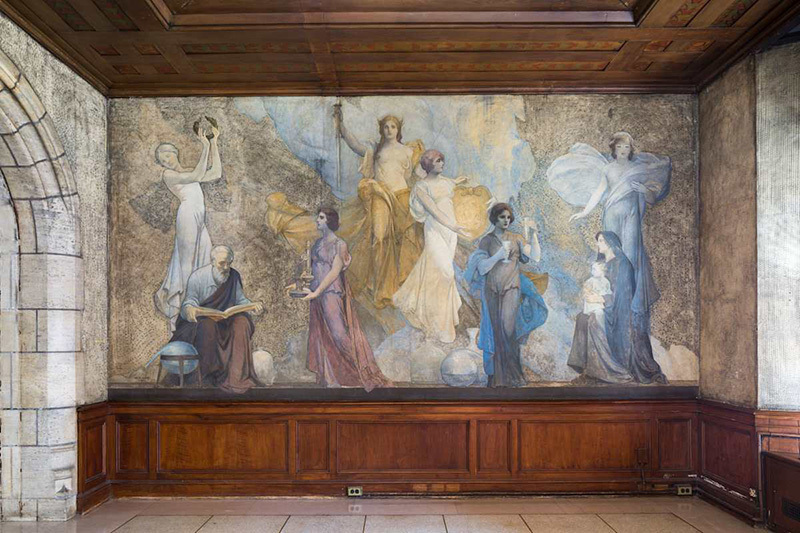 A WPA Mural in Kings County Hospital Center. Photo by Nicholas Knight, image courtesy of Department of Arts in Medicine, NYC Health + Hospitals.
With New York’s vibrant art scene at its doorstep, it’s no surprise that this health system boasts a robust arts and health program.
The Department of Arts in Medicine at NYC Health + Hospitals oversees more than 8,100 artworks across 11 acute care hospitals, 29 health clinics, and 5 long-term care facilities in all five of the city’s boroughs. The collection includes works by world-famous artists, including Andy Warhol, Keith Haring, Helen Frankenthaler, Romare Bearden, and Mickalene Thomas. Plus, the collection holds more Works Progress Administration murals than any health system in the country.
Part of what makes this program work so well, according to curator Ryan Patrick, is that The Department of Arts in Medicine treats the art collection as part of their clinical infrastructure, and evaluates its efficacy with the same rigor that they use with any other part of the health system.
“We select and place artwork in response to the needs of a specific clinical space and the people who use it,” he explains. “That includes patients, families, staff and the surrounding community, and we build those decisions through co-design.”
That means that a behavioral health unit might need work that steadies and orients a patient, whereas a pediatric waiting room would benefit from art that is energetic and playful.
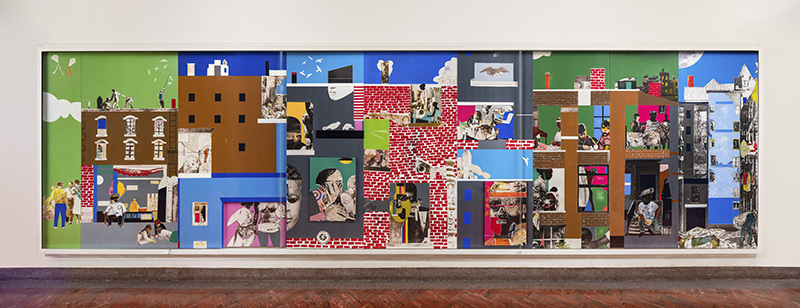 Romare Bearden, Cityscape, 1974, Bellevue Hospital. Image courtesy of Department of Arts in Medicine, NYC Health + Hospitals.
With so many pieces in their collection, Arts in Medicine at NYC Health + Hospitals uses Artwork Archive to track every one, along with its condition and location.
“Artwork Archive gives us one record for the full collection, with images, artist, title, medium, dimensions and location for each work, so our team can plan installations, exhibitions and conservation across the system,” Patrick shares. “We love the inventory report feature—it’s an efficient tool to pull together works for potential installations and share options with our communities through our collaborative curatorial process.”
Patients aren't the only ones who benefit. Doctors, nurses, and case managers spend long shifts in these spaces. Art gives them a moment to reset, and sometimes a way to start a difficult conversation.
“We believe that our patients and their families deserve a calm, peaceful and welcoming environment appropriate for the serious conversations we must have with them," says Dr. Alfred Astua, Chief of Pulmonology and Critical Care at Elmhurst Hospital, who helped select photographs by Robert Von Sternberg and Ellen Freeman Roth for the family waiting room in the Pulmonology department. "A lot of these conversations are with up to ten family members and having the art around truly helps to support the processing of complex information. The art can also be a wonderful icebreaker that allows us care providers to transition into the delivery of sometimes difficult news."
Art Is Healing at Hawaiʻi Island Community Health Center
Works In The Collection: 157
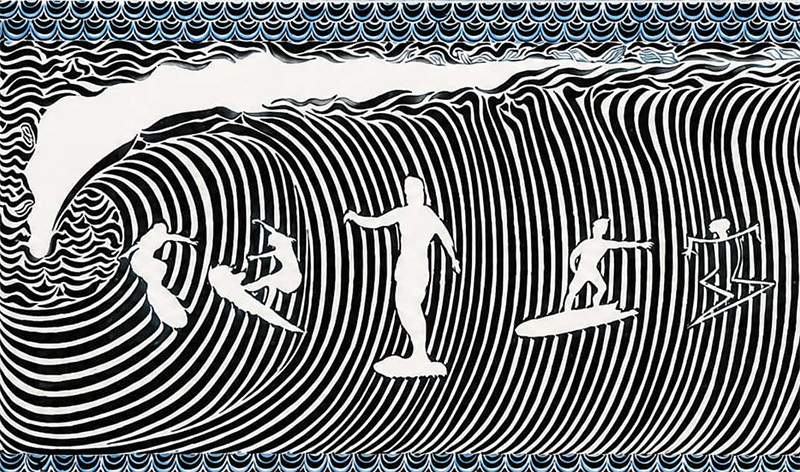
Rebecca Rosen Charon, Timeless Surfing, 2016, Ink & Colored Pencil, 16 x 22 in. Installed in Hawaiʻi Island Community Health Center - Waikoloa. Image courtesy of Hawaiʻi Island Community Health Center.
For Lauren Whittemore, Executive Director of the Hawaiʻi Island Community Health Foundation, the reason to run an arts and health program is simple: “People love seeing the artwork in our clinics.”
Through the Art Is Healing program, artists have been exhibiting work at the foundation’s clinics for over ten years. Here's how they make it work: At the end of each year, the program invites artists and other art professionals to be jurors for an open call. The blind selection process means that emerging artists, patients, and staff members all have the same opportunity to be included in the annual exhibition.
“Living on an island, especially in rural communities, means relying on one another,” Whittemore shares. “We see that every day in healthcare, and I believe that same responsibility extends to supporting creativity and local artists.”
Once the exhibition is up in the clinic’s spaces, community members can purchase pieces to donate to the program’s collection. The tradition began with a board member who bought work each year to donate; the Terri Toki Memorial Art Fund now carries her name, and gifts to the fund add new pieces to the permanent collection.
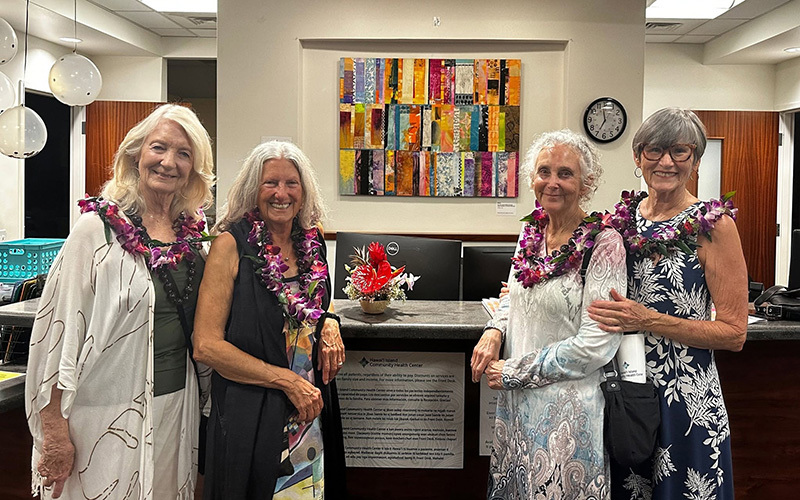 Stripes, an artwork by the art group PALS (Pat Hill, Alexis Wilson Russell, Libby Goehner, and Sandra McGrath) won the Jurors’ Choice Award in 2025 and was purchased and donated to program's permanent art collection. Image courtesy of Hawaiʻi Island Community Health Center.
There’s a real sense that artists contribute to the Art Is Healing program because they know that one day they may need care from one of these clinics.
One artist was undergoing cancer treatment when she submitted her piece to the juried exhibition selection. “Focusing on her artwork gave her a meaningful outlet during that experience,” Whittemore tells Artwork Archive. “Stories like hers remind us that the connection between art and healing extends beyond the people viewing the work—it matters to the people creating it, too.”
Tasked with tracking art over a dozen clinics spread across what locals call the Big Island, Whittemore uses Artwork Archive to organize artworks by location: “It makes it easier to track the artwork, move pieces between locations, and share the collection with more people while keeping our records organized.”
What makes the program special is how it connects local artists with healthcare providers and the larger community. For Whittemore, that makes it a true shared effort: “Even someone who has never been a patient can help create a more welcoming environment for those who receive care here.”
🏥 Why Arts and Health Programs Choose Artwork Archive
For years, Whittemore used multiple Excel spreadsheets, photographs, and pieces of paper to organize the collection, but she wanted one organized place to manage the entire inventory. “I had a specific vision: something easy for us to use internally, with an appealing way for patients, community members, and potential donors to see and enjoy the artwork online.”
She looked at five different programs before choosing Artwork Archive: “I was entering pieces on day one—it was incredibly intuitive.”
Michigan Medicine's Gifts of Art Galleries
Rotating Galleries: 9
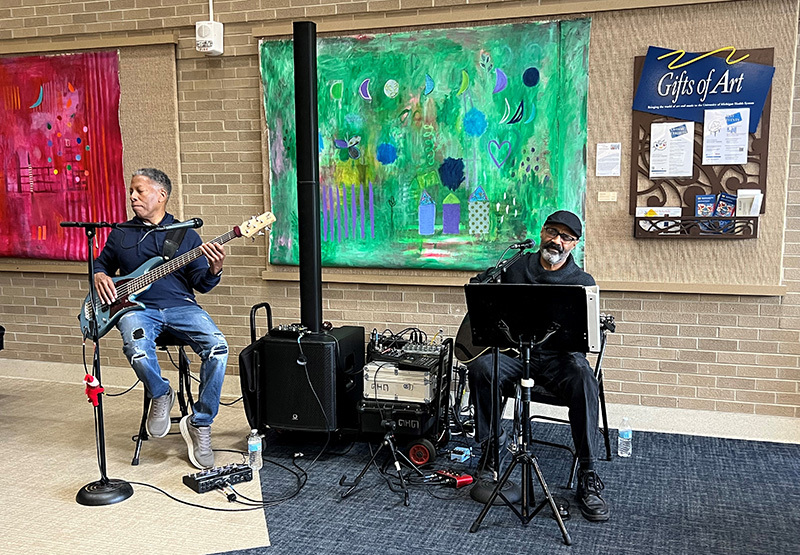 Musicians Dan Goree and Fred Robinson perform in one of Michigan Medicine’s art-filled spaces. Photo courtesy of the Gifts of Art program, Michigan Medicine.
One of the first arts and health programs in the country, Michigan Medicine’s Gifts of Art program has nine galleries that are changed regularly, always offering something new for patients and staff.
“We enjoy supporting emerging artists, showcasing our staff through our annual Employee Art Exhibition, and seeking artists with new and engaging worlds to share through their art,” says Laura Mettam, the program's Communications & Performing Arts Coordinator. "The exhibit gallery art plays a significant role in our hospitals and has become a beloved part of our environment of care. The changing nature keeps people engaged and adds interest, coaxing people to breathe a bit lighter for a bit.”
Alongside the regularly changing art exhibitions, the Gifts of Art program features regular live concerts, bedside art and music, and bedside storytelling. Whatever form of art a patient connects with most, whether intimate or communal, musical or visual, Gifts of Art wants to make it possible.
To keep the public informed of what's on view, once a new exhibition is installed in one of their galleries, Mettam and the rest of the Gifts of Art team create an Exhibition within Artwork Archive: “We are able to organize our exhibitions and share them publicly with anyone anywhere around the world. A bonus for our program as well as our exhibiting artists!”
Though the program accepts submissions from artists around the world, they particularly like to feature artists from Michigan: “By supporting these local artists, we are helping to highlight their work to our large Michigan Medicine audience. The artists are simultaneously helping Gifts of Art give back to the community by sharing their artwork in the hopes of comforting or inspiring others. It is a beautiful full circle relationship that we’re proud to coordinate.”
🖼️ Online Exhibitions Made Simple
Want to turn your on-site installation into an online exhibition? Artwork Archive makes it easy to create a publicly accessible Exhibition available to anyone on your Public Profile, expanding your reach and visibility far beyond your physical spaces.
The Healing Arts Program at TMC Health Foundation
Works In The Collection: 2,500+
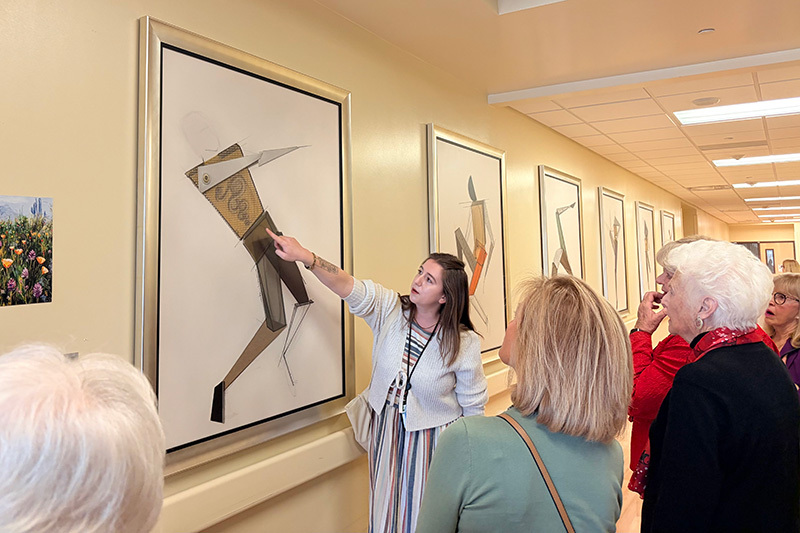 Program Manager Jenna S. Green leads a tour of a recent exhibition. Image courtesy of The Healing Arts Program at TMC Health Foundation.
The Healing Arts Program, which provides arts and health programming for Arizona’s Tucson Medical Center, is community-driven at its core. They seek out local artists, work with local collectors, and even have a program with photographers who generously donate their images to be printed and hung wherever a new splash of art is needed throughout the medical center.
“By building a rich collection of donated artwork from local artists and collectors, we enhance the healthcare experience for patients, staff, and visitors,” explains Jenna S. Green, the Program Manager for Healing Arts. “The artwork not only enriches our spaces but also fosters a sense of connection and familiarity, making the healing environment more meaningful and welcoming.”
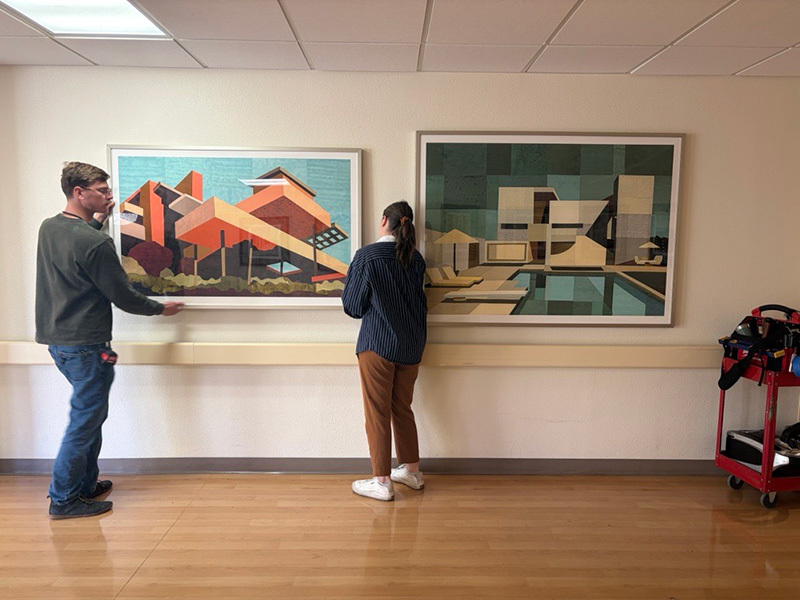 Installation in a hallway at Tucson Medical Center. Image courtesy of The Healing Arts Program at TMC Health Foundation.
With over 2,500 artworks in its collection—including paintings, collages, and photography—the Healing Arts Program has been improving the experiences of patients, family members, and staff since it was founded in 2014.
“Having art on our previously empty office walls has opened up a whole new world to escape into, even if only for a moment,” one Case Manager recently wrote. “It's made all the difference in our day."
Green points out that the program is serious about its commitment to the artists it works with, and has brought its entire collection online with Artwork Archive, so that anyone around the world can explore the artworks.
“Through dedicated artist profiles, visitors can learn more about the individuals behind the artwork, explore additional examples of their work, and connect with their creative journeys,” she offers. “In this way, Artwork Archive not only helps us share our collection, but also strengthens the connections between artists, our healthcare community, and the broader public.”
🎨 Give Every Artist a Spotlight
A donated collection is built on the generosity of local artists, and many programs want to give something back. Visibility is one of the most meaningful ways to do that.
Children's Hospital Colorado Art Collection
Works In The Collection: 3,000+
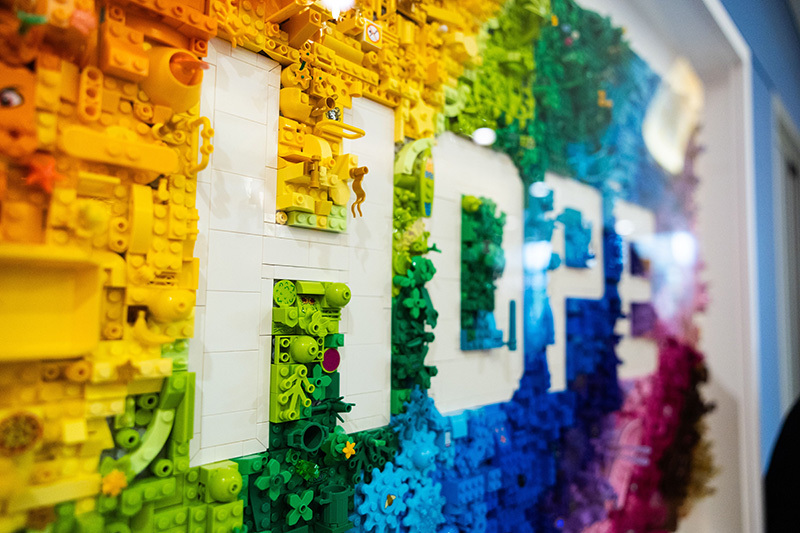 The Hope of Lego, 2025 by Makenna Rudolph is a Lego mural in the CHCO art collection that serves as a seek-and-find activity where medical professionals or family members can ask kids to find different things, such as two pink flowers or one yellow mug. Image courtesy of Children's Hospital Colorado.
“I am often stopped by patients and families, as well as staff, when installing in our gallery,” recounts Moira Casey, Arts Coordinator and Curator for the Children's Hospital Colorado Art Collection. “Most of them say that the hallway gallery is part of a regular walk that they take to help boost their mood and that they look forward to the change in exhibitions every 8-10 weeks.”
That’s how arts in health programs improve patient experiences in healthcare settings: by creating dependable, engaging moments in what can be a stressful space.
Casey tells Artwork Archive that Children’s Hospital Colorado thinks of child health in a holistic way that extends beyond their physical symptoms to include emotional, mental, social, spiritual, and environmental well-being.
“Community art plays a meaningful role in this approach by creating opportunities for connection, expression, belonging, and shared experience,” opportunities that she says are key components of the healing process. “In a pediatric hospital, art can help make an unfamiliar environment feel more welcoming and human, offer moments of comfort and inspiration, and create connections among patients, families, caregivers, staff, and the broader community.”
With over 3,000 artworks across 17 locations, Casey and her team are experts at maximizing resources to bring art into the heart of the health system. They are always working to tailor art installations to meet the needs of patients and their families, and take into account the latest clinical research when selecting and installing art.
Overall, she says, “our art program contributes to a sense that anyone walking through our doors gets, that ‘Here, it's different.’”
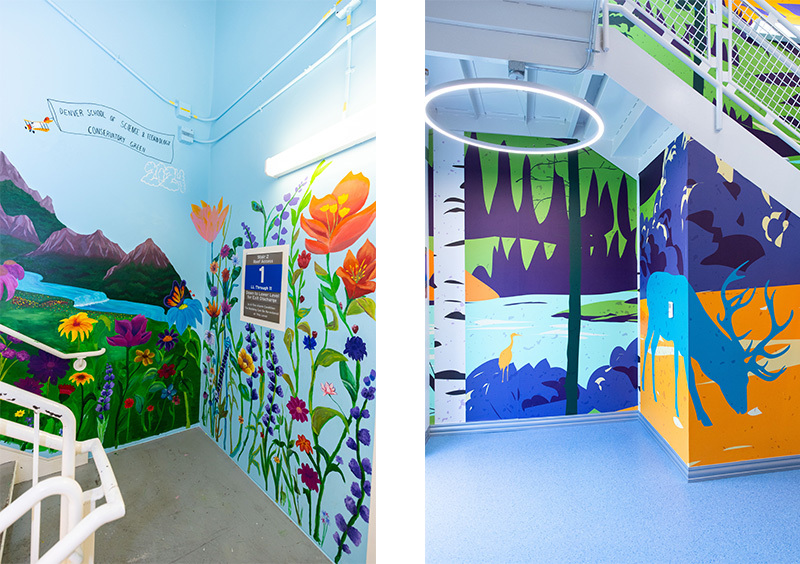 Left: Mural painted by students from Denver School of Science and Technology, Conservatory Green, in 2024. Located in the back inpatient stairwell of Children's Hospital Colorado's Main Hospital, Anschutz Medical Campus. Right: A colorful mural at Children's Hospital Colorado Southeast Aurora Outpatient and Urgent Care. Images courtesy of Children's Hospital Colorado.
How to Make Arts and Health Work Together For Your Organization
As these five arts in health programs prove, art can enliven any healthcare setting, and it doesn’t just have to hang on the walls, either. Antonia Dapena-Tretter of Stanford Children’s Health suggests that art can be a garden, a floor mosaic, or other architectural interventions that make patients feel welcome.
Depending on budget and space, incorporating art into the healing process can be as simple as a bedside reading program, or as elaborate as a site-specific installation in your building lobby.
But no matter your organization's resources, art is always a point of connection. A recent survey of patients and families at Dapena-Tretter's hospital found that "98% of the respondents noticed and appreciated the art,” she relates. “One family specifically wrote: ‘The art makes our visit feel like we are visiting a museum in a way that children are less anxious and look forward to coming to appointments.’ This kind of feedback tells us that the art is doing its job!”
A collection of murals, mosaics, and rotating exhibitions can stretch across buildings, floors, and sometimes entire islands. The programs in this roundup look very different from one another, but every one of them can find any artwork in its collection in minutes, because they keep it all in Artwork Archive.
Artwork Archive gives arts and health teams one organized place to store images, artist details, condition, and location, so you can spend less time hunting for information and more time putting the right art in front of the people who need it.
Start your free 14-day trial of Artwork Archive →