
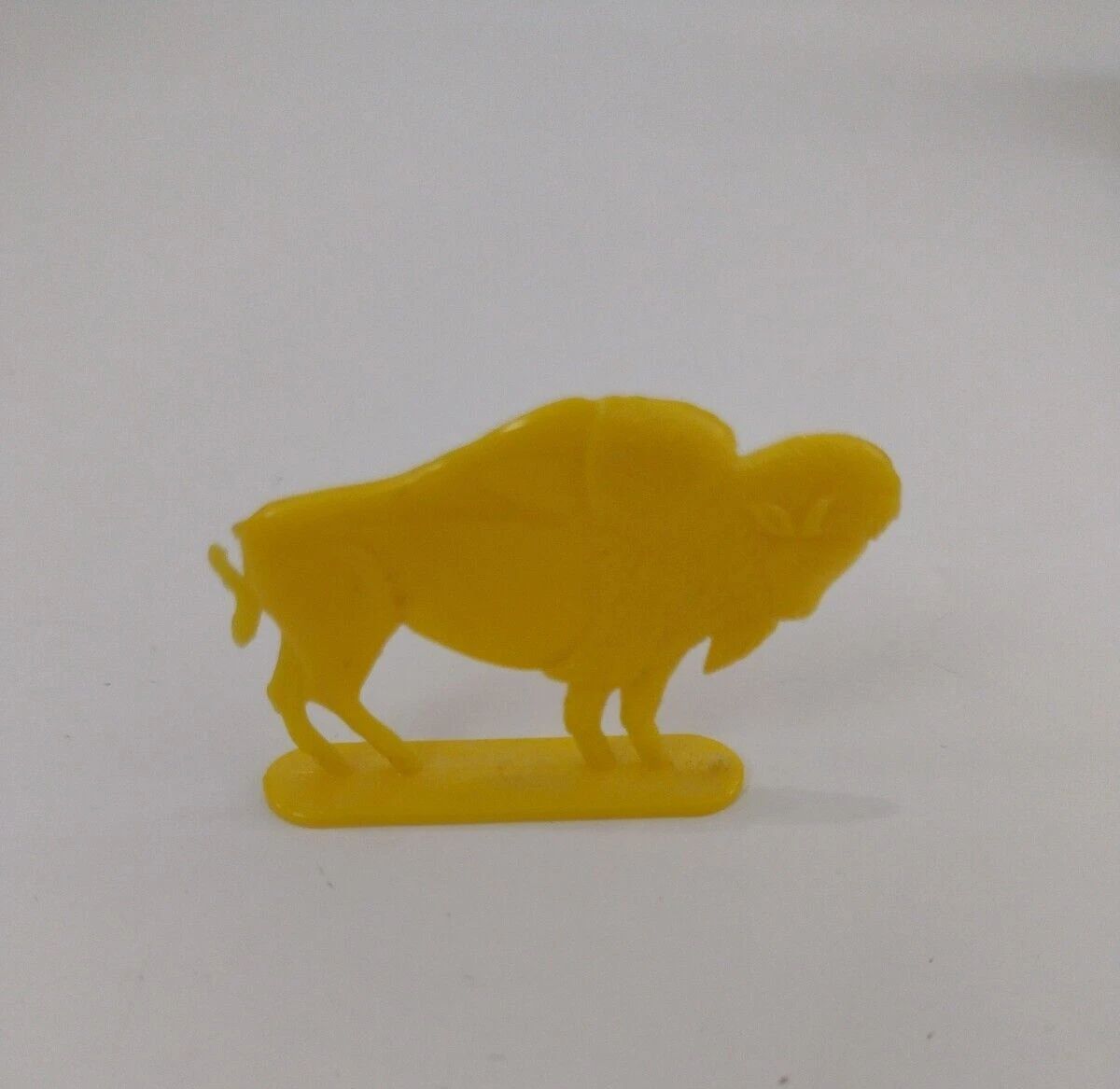
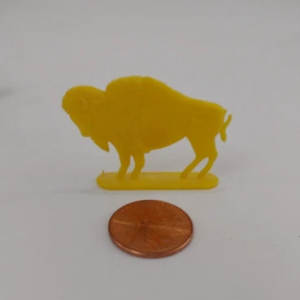
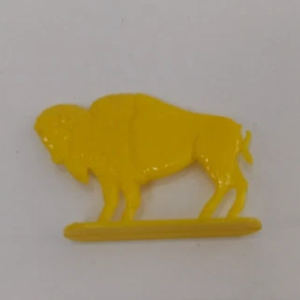
This tiny yellow plastic bison represents one of American popular culture's most beloved traditions—the Cracker Jack prize. Measuring barely larger than a penny and rendered as a flat silhouette with minimal detail, this humble little figure carries enormous cultural weight as an artifact of mid-century American childhood, mass production, throwaway consumer culture, and the democratization of collecting.
The bison is injection-molded from bright yellow plastic as a thin, flat silhouette with identical mirrored surfaces on both sides. The design captures essential bison characteristics—massive shoulder hump, lowered head, shaggy front quarters contrasting with smoother hindquarters, short tail, curved horns—but rendered with the absolute minimum detail necessary for recognition. The figure is designed to be lightweight, inexpensive to produce, and small enough to fit inside a box of caramel-coated popcorn. An integral oval base keeps the bison upright. The bright yellow coloring bears no relationship to actual bison appearance but instead reflects the cheerful, eye-catching palette typical of mid-century children's toys and prizes.
Cracker Jack: An American Institution:
Cracker Jack began in 1872 when German immigrant Frederick William Rueckheim arrived in Chicago with $200 and ambition. By 1893, he and his brother Louis were showcasing their molasses-glazed popcorn creation at the World's Columbian Exposition. The product got its name in 1896 when a salesman declared it "cracker-jack"—slang for excellent. In 1922, Rueckheim Bros. & Eckstein officially became The Cracker Jack Company, dropping all other confectionery production to focus exclusively on their hit snack.
But the prizes—those became legend. The company started including small gifts in every box around 1912, and "A Prize in Every Box" became one of America's most recognized advertising slogans. The appeal was universal and visceral. As one chronicler noted, children attacking a new box of Cracker Jack possess innate radar for locating that wrapped prize buried in caramel-coated popcorn. They can't even read the box, but they know it's there. Adults do it too—reaching, sometimes fighting, for the prize.
The Plastic Era (1950s-1960s):
This yellow bison dates to Cracker Jack's plastic prize heyday. From the late 1940s through the mid-1960s, the company produced a staggering variety of miniature plastic figures, purchasing prizes in orders of 200,000 to 5 million at a time. The 1950s brought series after series of flat, stylized plastic animals—exactly like this bison. There were champion dogs, circus performers, working people, stackable acrobats, Asian deities, and Western animals.
The Western theme dominated 1950s Cracker Jack prizes, reflecting American popular culture's obsession with cowboys, frontier mythology, and manifest destiny narratives. Television westerns like Gunsmoke, Bonanza, and Rawhide captivated audiences. Western imagery sold everything from cigarettes to cars. A plastic bison fit perfectly into this cultural moment—representing untamed wilderness, frontier adventure, and the American West that existed more powerfully in imagination than in living memory.
These prizes were typically produced by companies like NOSCO (Novelty Specialties Company), Cloud/Cloudcrest, TootsieToy, and Makatoy, with many also manufactured overseas in Germany, Japan, and Taiwan. The injection molding process allowed for rapid, low-cost production using two-part molds that created identical front and back surfaces. Manufacturers would create master molds, then run thousands of identical pieces in various colors. The bright yellow, red, blue, and green hues had practical purposes—making small prizes visible in the popcorn, appealing to children, and allowing for color-coding of different animal series.
Most prizes measured under 1.8 inches on their longest dimension to fit inside the box. The flat silhouette construction minimized material costs and weight while maintaining recognizable shapes. These weren't toys meant for elaborate play but rather miniature collectibles—charms, trading pieces, objects to accumulate and display.
Cultural Significance and Collecting:
Cracker Jack prizes hold a unique place in American material culture. They were among the first mass-produced collectibles designed specifically to be ephemeral yet desirable. Children didn't buy Cracker Jack primarily for the snack—they bought it for the prize, creating a marketing model that countless cereal companies and fast-food chains would later emulate.
The prizes also represented American abundance and technological prowess. Only a society with advanced manufacturing, sophisticated distribution networks, and disposable income could produce millions of tiny plastic trinkets to give away essentially for free. The Cracker Jack prize embodied postwar American prosperity—playful, colorful, disposable, optimistic.
For collectors today, Cracker Jack prizes evoke powerful nostalgia. They represent childhoods spent rooting through popcorn boxes, trading prizes with siblings and friends, losing pieces under couch cushions, and occasionally treasuring a particularly appealing figure. The 1930s is considered the "golden age" of Cracker Jack collecting—with prizes made from wood, porcelain, Bakelite, ceramics, tin lithograph, and paper—but the plastic prizes of the 1950s-1960s have their devoted followers. The Cracker Jack Collectors Association, founded by enthusiasts, preserves this history and maintains records of prize series, manufacturers, and distribution numbers.
Decline and Transformation:
Cracker Jack prizes declined precipitously after the 1960s. When Borden, Inc. acquired the company in 1964 and moved operations from Chicago to Columbus, Ohio, cost-cutting began in earnest. The 1970s brought cheaper paper prizes and simplified designs. By the 1980s-2000s, prizes had devolved to temporary tattoos, stickers, and paper games. In 2016, Frito-Lay eliminated physical prizes entirely, replacing them with scannable codes that unlocked mobile app experiences. The change was met with outrage from nostalgic consumers who recognized it as the end of an era.
This makes surviving plastic prizes from the 1950s-1960s—even tiny, simple pieces like this bison—genuine historical artifacts documenting a vanished aspect of American popular culture.
In The Collection:
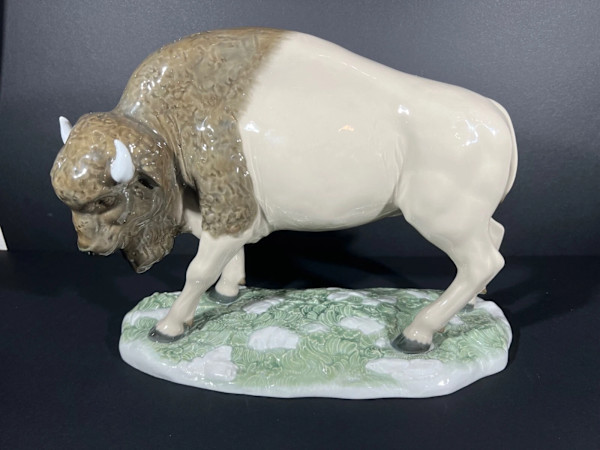
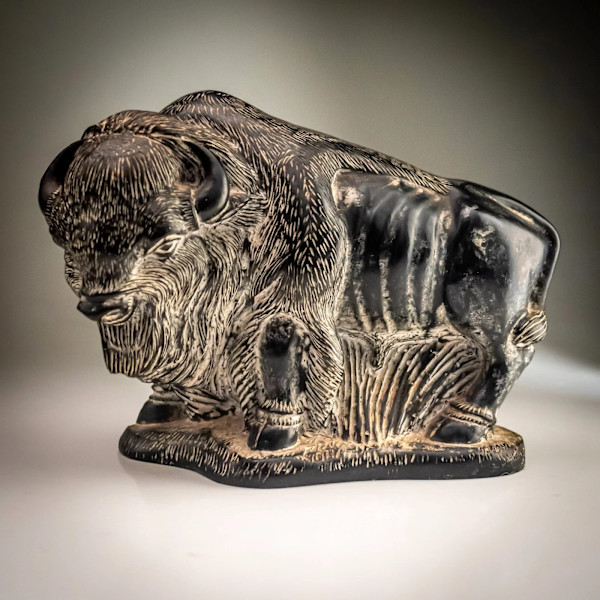
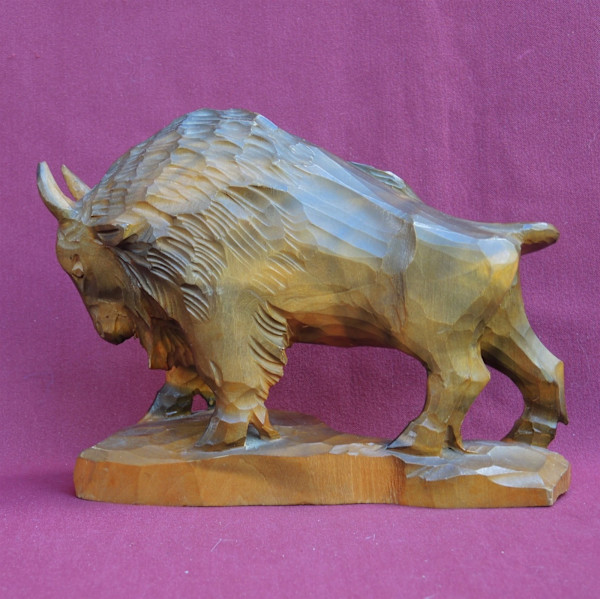
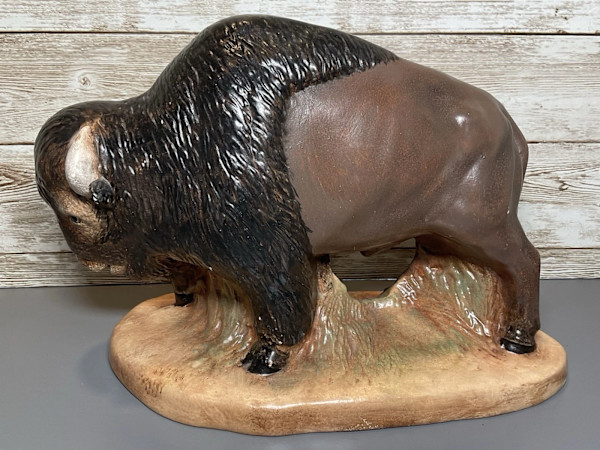
For the collection, this miniature Cracker Jack bison represents the absolute opposite end of the spectrum from the high-art porcelain, carefully carved wood, or sophisticated stone-composite pieces. It's democratic rather than exclusive, mass-produced rather than artisanal, disposable rather than precious, playful rather than serious. Yet it carries its own authenticity and historical importance.
This little yellow bison connected millions of American children to wildlife imagery, Western mythology, and the pleasure of small surprises. It cost virtually nothing to produce and was given away almost free, yet it sparked joy and fueled collecting passions. It represents industrial design at its most efficient, marketing at its most clever, and American consumer culture at its most exuberant and innocent.
That it survives at all—rather than being lost, broken, thrown away, or dissolved in a garbage disposal decades ago—makes it a small miracle of preservation. And that it joins the collection alongside Ukrainian folk art, Japanese ceramics, Canadian sculpture, and American studio pottery demonstrates how a single subject (the bison) can unite radically different materials, purposes, and cultural meanings across an extraordinary range of human creativity and commerce.
- Subject Matter: Bison
- Current Location: BLD 20 by R101
- Collections: Thomas Hill Bison Figurine Collection