
- Martin Zendron
- Swarovski Crystal "Tatanka" Bison, Circa 2003-2005
- Crystal
- Signature: Swarovski's swan logo on the base
Swarovski Crystal "Tatanka" Bison Model #624598, Crystal Symbols Collection, 2003 Designed by Martin Zendron, Retired 2005
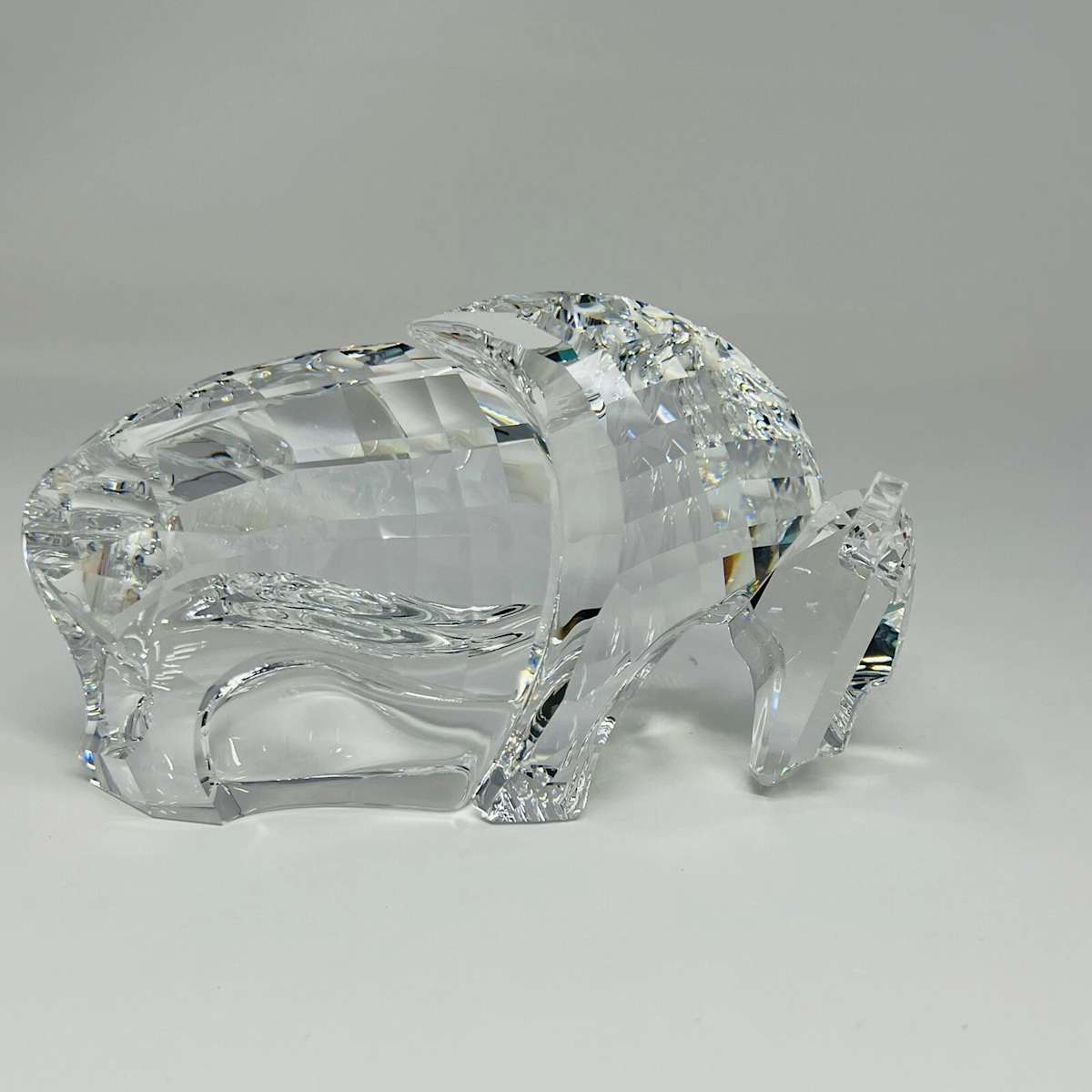
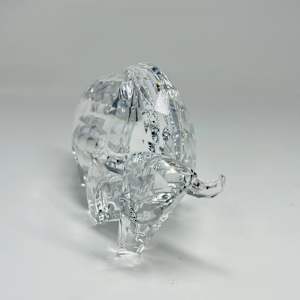
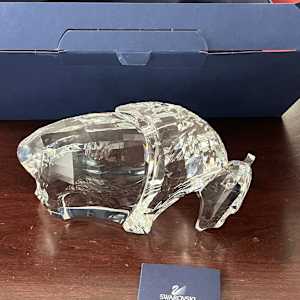
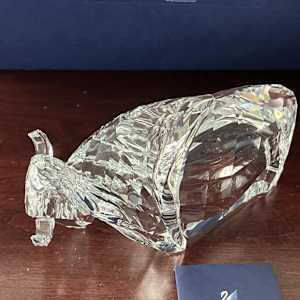
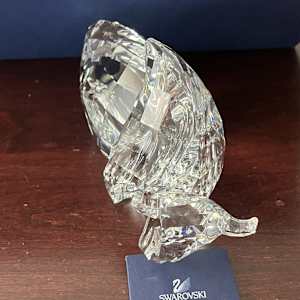
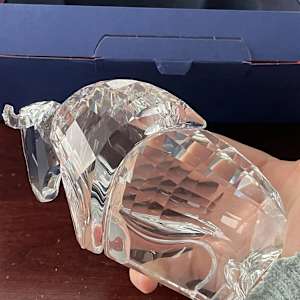
This spectacular crystal bison represents Swarovski at the height of their mastery—a period when the Austrian crystal manufacturer was producing some of their most ambitious wildlife sculptures. The piece is executed entirely in clear, faceted crystal using Swarovski's precision cutting techniques to create a sculpture that captures and refracts light through hundreds of carefully engineered facets. The result is a bison that seems to shimmer and glow with captured light, transforming from crystal-clear transparency to brilliant prismatic flashes depending on viewing angle and illumination.
The bison is rendered in a lowered-head, forward-moving stance that conveys both power and alert awareness. Every anatomical element has been translated into geometric facets—the massive shoulder hump rendered as large, bold planes that catch maximum light; the head lowered in characteristic bison posture with detailed facial features including defined eyes, nostrils, and curved horns; the legs carved as strong, columnar forms with articulated hooves; and the body showing the transition from massive forequarters to sloping hindquarters that defines bison silhouette.
The crystal work demonstrates Swarovski's technical sophistication. Rather than smooth, continuous surfaces, the entire sculpture is composed of precisely angled facets that function like miniature prisms, breaking white light into spectral colors and creating constantly shifting patterns of brilliance as the viewer moves around the piece. The mane and head feature smaller, more intricate faceting to suggest texture and detail, while the body uses larger geometric planes to emphasize mass and power. The base integrates seamlessly with the composition, providing stable display while maintaining the all-crystal aesthetic.
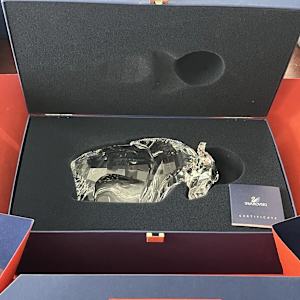
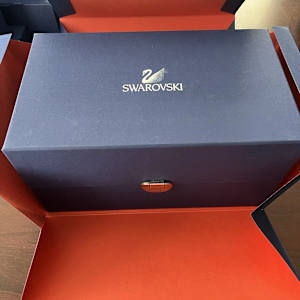
The piece is marked with Swarovski's swan logo on the base, indicating authentic Swarovski manufacture. It retains its original presentation box—a sophisticated foam-lined display case with magnetic closure in Swarovski's signature navy blue and orange color scheme—along with its Certificate of Authenticity.
Swarovski: Masters of Crystal:
Swarovski's story begins in 1895 when Daniel Swarovski (1862-1956), a glass-cutter's son from Bohemia (now Czech Republic), founded his company in Wattens, Tyrol, Austria. Daniel had patented an electric crystal-cutting machine in 1892 that revolutionized crystal production—allowing precision cuts previously impossible with manual methods and enabling mass production of perfect crystal stones at unprecedented speed.
The location choice was strategic: Wattens offered abundant hydroelectric power from alpine rivers essential for running the energy-intensive grinding machines, good transport connections to Paris (the fashion capital where crystal was in high demand), and distance from competitors who might steal proprietary technology.
What began as a supplier of precision-cut rhinestones for fashion and jewelry evolved into one of the world's most recognizable luxury brands. The company remained family-owned through five generations, growing to employ over 30,000 people worldwide with approximately 3,000 stores in 170 countries and annual revenues exceeding 2.7 billion euros.
Swarovski crystal became synonymous with Hollywood glamour—adorning Marilyn Monroe's famous dresses, the ruby slippers in "The Wizard of Oz," and countless stage costumes for performers from Liberace to modern pop stars. The company supplied the 550-pound crystal star atop the Rockefeller Center Christmas Tree, collaborated with fashion designers worldwide, and established crystal as a legitimate luxury material alongside precious stones.
The Silver Crystal Collection and Animal Figurines:
In 1976, Swarovski created crystal figurines as souvenirs for the Winter Olympics in Innsbruck. The response was so positive that in 1987, the company launched their "Silver Crystal" collection—a line of decorative crystal figurines that sparked a worldwide collecting phenomenon. The name came from Austrian craftsmen who, when holding finished pieces to the light, were awed by the silvery spectral brilliance created by the crystal.
The Silver Crystal collection and its related wildlife series transformed Swarovski from primarily an industrial supplier of components into a producer of finished collectible art. The Swarovski Collectors Society, founded in 1987, created a global community of enthusiasts who sought limited editions, tracked retirement dates, and built comprehensive collections.
Animal subjects—particularly wildlife—became core themes. Swarovski designers created swans (which became the company logo in 1989), eagles, dolphins, bears, big cats, and numerous other creatures. Each design balanced anatomical accuracy with the geometric requirements of faceted crystal cutting. The best pieces achieved remarkable life and movement despite being composed entirely of angular facets and crystalline planes.
The "Tatanka" Bison (Model #624598):
This bison was designed by Martin Zendron as part of Swarovski's "Crystal Symbols" collection and introduced in 2003. The piece carried the name "Tatanka"—the Lakota word for bison, acknowledging the animal's central importance in Plains Indian cultures and its status as North America's largest land mammal.
The model number 624598 (system number 7685 000 003) was assigned by Swarovski's internal tracking system. The piece measured approximately 6.5 inches long x 3.6 inches tall x 2.2 inches deep and weighed around 2.2 pounds—substantial heft that demonstrated the piece's solid crystal construction and premium quality.
The Tatanka was retired from production in the United States in 2004 and globally in 2005, giving it an extremely brief production window of only 1-2 years. This short availability makes it significantly rarer than long-running Swarovski designs that remained in production for decades.
Martin Zendron:
Martin Zendron was one of Swarovski's accomplished designers during the early 2000s, working during a period when the company was expanding its wildlife collection and experimenting with increasingly ambitious sculptural forms. Zendron's work demonstrated strong understanding of both animal anatomy and the optical properties of faceted crystal—knowing which planes would catch light dramatically, where to place smaller facets for detail, and how to balance geometric abstraction with recognizable form.
The bison represented particular technical challenges: capturing the massive, forward-heavy proportions; suggesting fur texture through faceting; creating a dynamic pose while maintaining stability; and engineering the piece so it could be produced consistently while maintaining Swarovski's exacting quality standards.
In The Collection:
For the collection, this Swarovski Tatanka represents the absolute pinnacle of crystal artistry applied to bison imagery. It joins pieces ranging from a Cracker Jack prize costing pennies to Lladró's unreleased prototype, demonstrating how the same subject inspired radically different interpretations across the full spectrum of materials, manufacturing methods, and market positioning.
The Tatanka is Austrian precision engineering, optical physics, luxury brand positioning, short-production-run collectability, and the transformation of an American icon into European decorative art. It shows how bison imagery transcended borders and cultures—a Plains Indian symbol rendered in Tyrolean crystal by Austrian craftspeople for a global market of affluent collectors who valued technical perfection and captured light above all else.
- Subject Matter: Bison
- Current Location: BLD 20 by R101
- Collections: Thomas Hill Bison Figurine Collection