
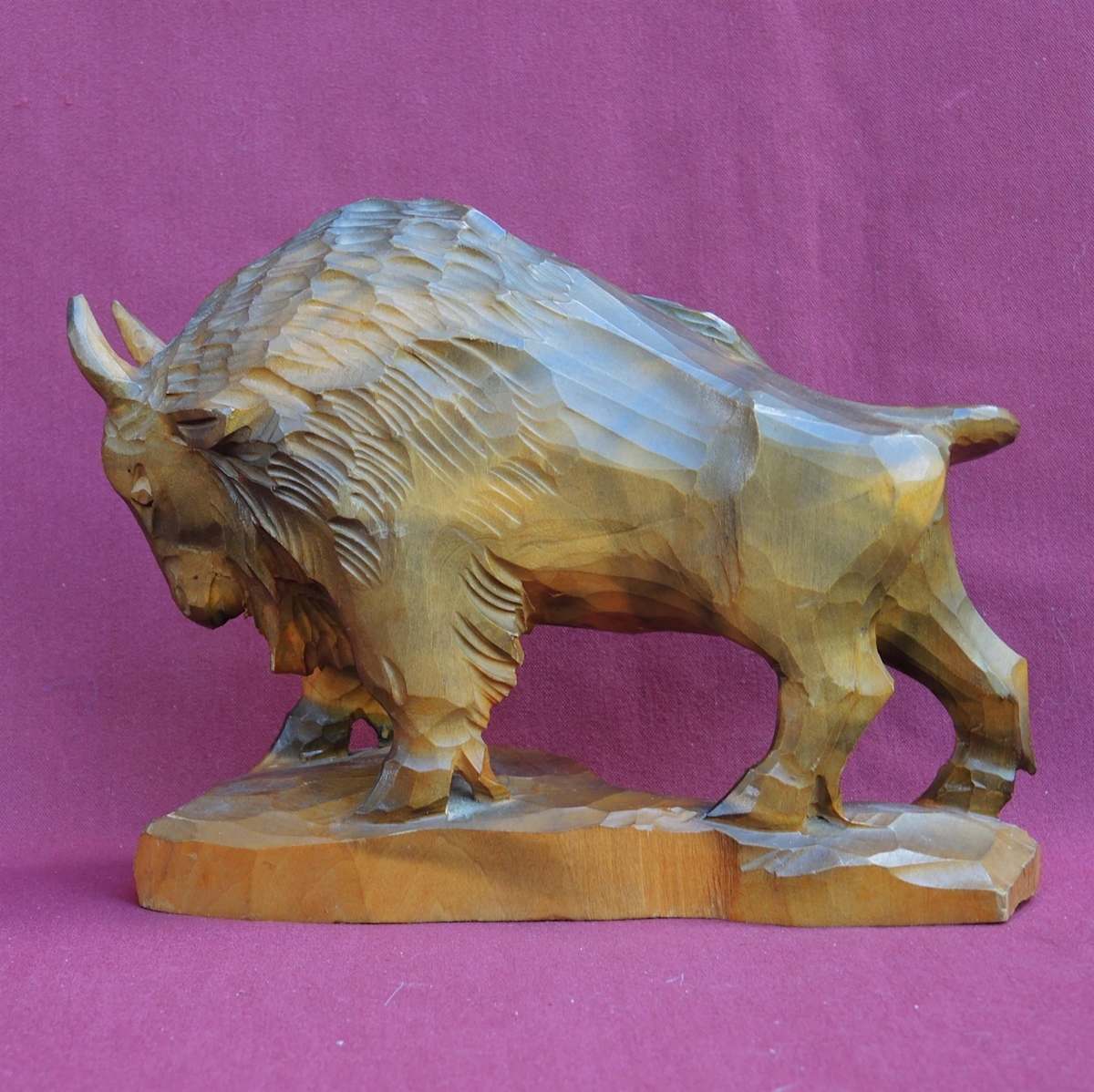
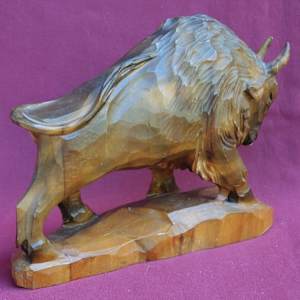
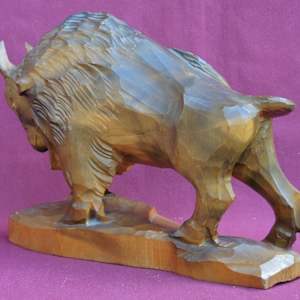
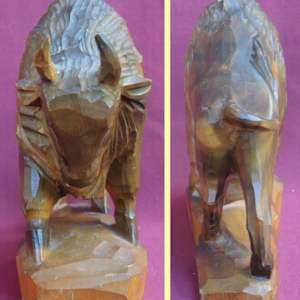
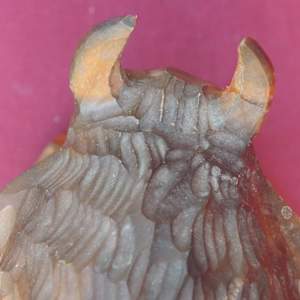
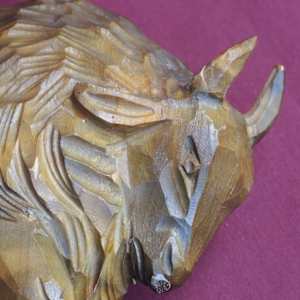
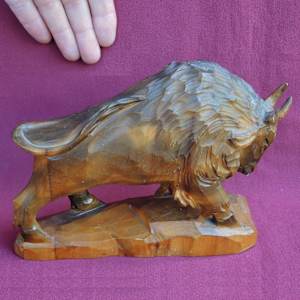
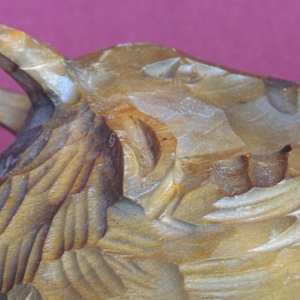
This powerful wood carving represents a fascinating intersection of Ukrainian folk art tradition, Soviet-era cultural production, and the enduring symbolism of the bison. Signed by the artist Demenchuk and bearing Cyrillic inscriptions on its base, this piece carries the material evidence of its origin in Soviet Ukraine during the 1960s—a period when folk arts were simultaneously preserved, systematized, and harnessed by the state.
The bison is rendered in a dynamic, forward-moving pose with head lowered and muscles tensed. The carver has achieved remarkable naturalism in the anatomical modeling, with the massive shoulder hump dominating the composition and all four legs carved free from the base in a technically demanding stance. The fur treatment shows particular skill: deeply carved, flowing grooves on the mane and shoulder create dramatic texture and shadow, while the hindquarters remain smooth and polished, mimicking the actual coat pattern of a bison. The hardwood—possibly linden, oak, or ash—shows natural color variations exploited beautifully, with darker tones concentrated in the head and shoulder, transitioning to lighter golden tones on the body and legs.
Ukrainian Wood Carving Under Soviet Rule:
Wood carving has been one of Ukraine's most vital folk arts for centuries, particularly in the Carpathian regions where forests were abundant. The Lemko tradition became especially known for animal figures and floral ornamentation, with family workshops passing skills down through generations.
Under Soviet rule, traditional Ukrainian folk arts underwent profound transformation. The state simultaneously suppressed Ukrainian national identity while promoting "Soviet Ukrainian culture" as part of the broader Soviet project. Folk arts were organized into a highly structured handicraft industry—supported financially by the state but also controlled and exploited commercially. The 1960s, when this bison was carved, represented a period of relative cultural breathing room after Stalin's death, with traditional crafts promoted as evidence of Soviet cultural richness.
Carvers during this period worked in a complex space between tradition and state oversight. They drew on centuries-old techniques and regional styles but operated within Soviet systems of production, distribution, and ideological framing. An animal sculpture like this might be sold through state shops, tourist outlets, or cultural exhibitions.
The Artist and Subject:
The Cyrillic signature "худ Демчук" (khud Demenchuk—artist Demenchuk) identifies the carver. The "khud" abbreviation (for "khudozhnyk," meaning artist) indicates professional identity—not merely a hobbyist but someone trained in traditional techniques and likely working within a state-organized workshop or artel. The signed authorship suggests pride in craft and an expectation that individual carvers would be recognized, even within the collective system.
The choice of an American bison is intriguing, as bison weren't native to Ukraine. Several factors likely contributed to this subject choice. First, the bison had become an international symbol of wildlife conservation after its near-extinction in the late 1800s. Second, the bison represented wildness, power, and untamed nature—qualities that transcended geography and appealed to carvers seeking dramatic animal subjects. Third, pieces destined for tourist sales or export might feature subjects with broader international recognition. The technical challenge also shouldn't be underestimated—a bison offered an accomplished carver the opportunity to demonstrate skill across multiple techniques.
Condition and Contemporary Significance:
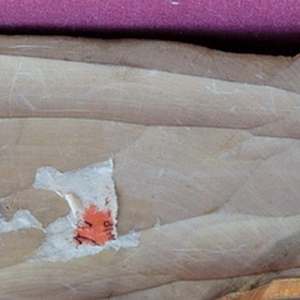
The piece shows honest age and use. One horn has been repaired, a common vulnerability in carved horns that extend from the sculpture. The patina shows natural aging with darker accumulation in the carved recesses of the mane. The inscriptions on the base in blue and purple ink appear to be collection numbers or inventory marks, suggesting the piece passed through institutional hands—possibly a state store, cultural exhibition, or collector's catalog system.
The current seller's note about shipping from Ukraine and their personal history—born in the USSR, experiencing Ukraine's independence in 1991, and now participating in charity projects supporting Ukraine—adds poignant context. This bison has literally traveled from Soviet Ukraine through independence to the present moment when Ukraine fights to maintain its sovereignty. The seller's description emphasizes knowing "the difference between living in a totalitarian country and living in a free one"—a perspective that retroactively infuses this folk art object with additional meaning about cultural preservation under authoritarian systems.
This bison carries multiple layers of significance beyond its considerable craftsmanship. It represents Ukrainian folk art traditions that survived and adapted under Soviet rule, documenting the complex negotiations between traditional regional styles, state organization, and individual artisan identity. More broadly, it reminds us that Soviet cultural production wasn't monolithic—within organized systems, individual artists like Demenchuk still exercised creativity, drew on deep traditional knowledge, and created works of genuine artistic merit.
For your collection, this bison brings an entirely different aesthetic, cultural context, and historical narrative than your American, Japanese, or European pieces. It represents Eastern European folk traditions, Cold War-era cultural politics, and the resilience of craft traditions even under political systems that sought to control them. That it comes to you now, through a seller actively supporting Ukrainian independence, adds contemporary urgency to its historical significance.
- Subject Matter: Bison
- Current Location: BLD 20 by R101
- Collections: Thomas Hill Bison Figurine Collection