
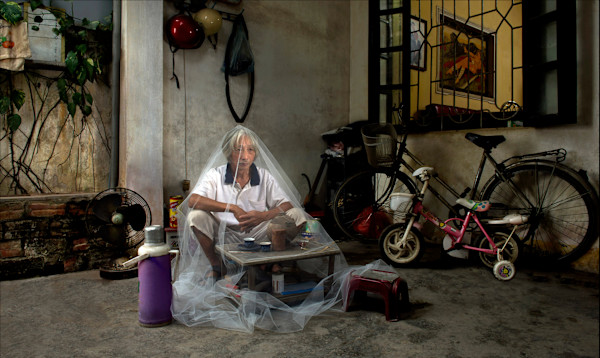


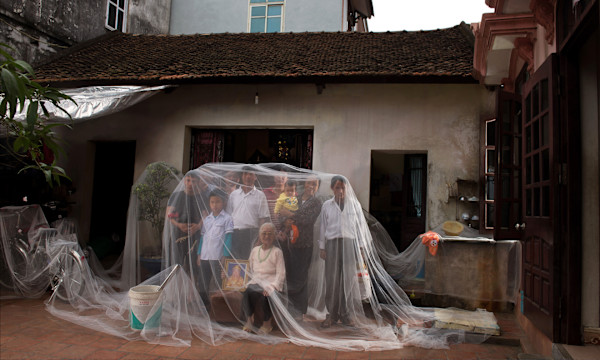


Re/cover (2011-2016) is rooted in the historical context of the Second World War and its aftermath in Vietnam, when Japanese troops occupied the country between the early 1940s and 1945, with some remaining until the mid-1950s. During this period, relationships formed between Vietnamese women and Japanese soldiers, giving rise to families whose existence would later be marginalized or erased from official histories shaped by nationalism and postwar reconstruction.
Against the backdrop of dominant narratives centered on war, occupation, and resistance, Phan Quang turns to what might be understood as a microhistory - the lived, intimate experiences that remain largely absent from historical accounts. Through extensive research conducted across Vietnam, he engages with women and families still marked by these relationships, revealing stories that complicate reductive historical frameworks: stories of absence and stigma, but also of attachment, resilience, and enduring emotional bonds.
The series is defined by a striking visual device: each subject is enveloped in a translucent white silk veil, sourced from a traditional Japanese textile workshop. This gesture carries multiple symbolic layers. The veil evokes marriage rituals, alluding to unions that were never formally recognized, while also recalling mourning and disappearance - pointing to the absence of fathers and the lingering shadows of war.
A decade after its creation, Re/cover remains a powerful reflection on the afterlife of the Second World War in Southeast Asia. By centering those who exist at the margins of official histories, the series offers a critical counterpoint to dominant narratives and foregrounds the role of images in shaping how history is remembered, transmitted, and transformed.