
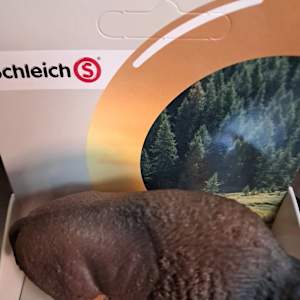

Schleich Bison Collection: Twenty-Five Years of German Precision in American Wildlife
When Friedrich Schleich founded his Schwäbisch Gmünd company in 1935, he could hardly have imagined that his plastic parts supplier would become one of Germany's premier toy manufacturers, selling 40 million hand-painted figurines annually across 60 countries. Yet by the turn of the millennium, Schleich had transformed itself from a producer of bendable Smurfs and comic characters into a leader in scientifically accurate wildlife replicas, consulting with zoologists and biologists to ensure anatomical precision. The company's bison figurines—spanning from 2000 to the present—document this evolution beautifully, tracing improvements in sculpting technology, paint application, and manufacturing philosophy while also revealing fascinating insights about how German manufacturers navigate the global market for distinctly American iconography. Each model represents a snapshot of Schleich's capabilities at that moment: from early PVC injection molding marked with the Schwäbisch Gmünd factory address to current production leveraging digital prototyping and internationally distributed hand-painting facilities. Together, these pieces form a remarkable archive of how one of Europe's most respected toy companies has approached, refined, and continuously reimagined North America's largest land mammal over a quarter-century of production.
Model 14714: The Masterwork (2014-2020)
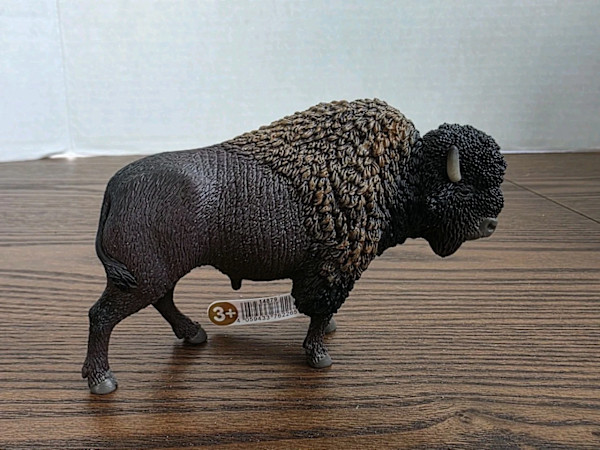
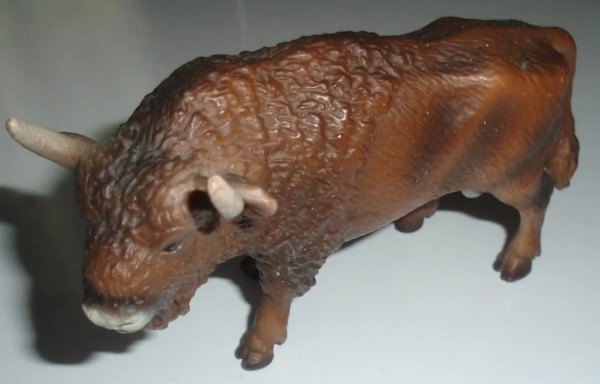
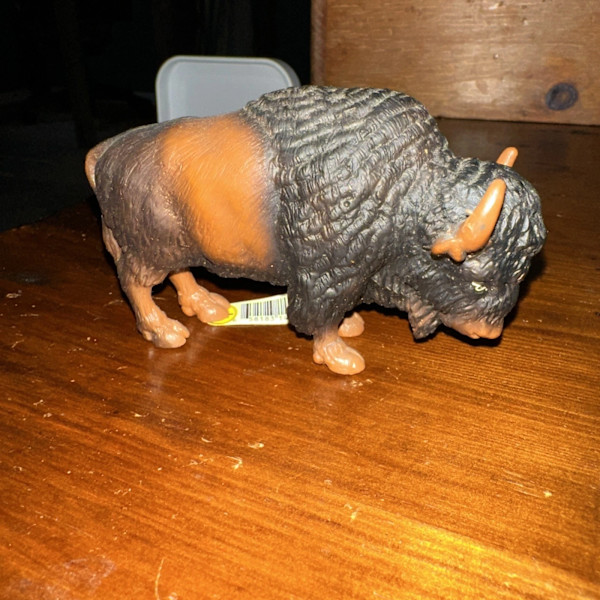
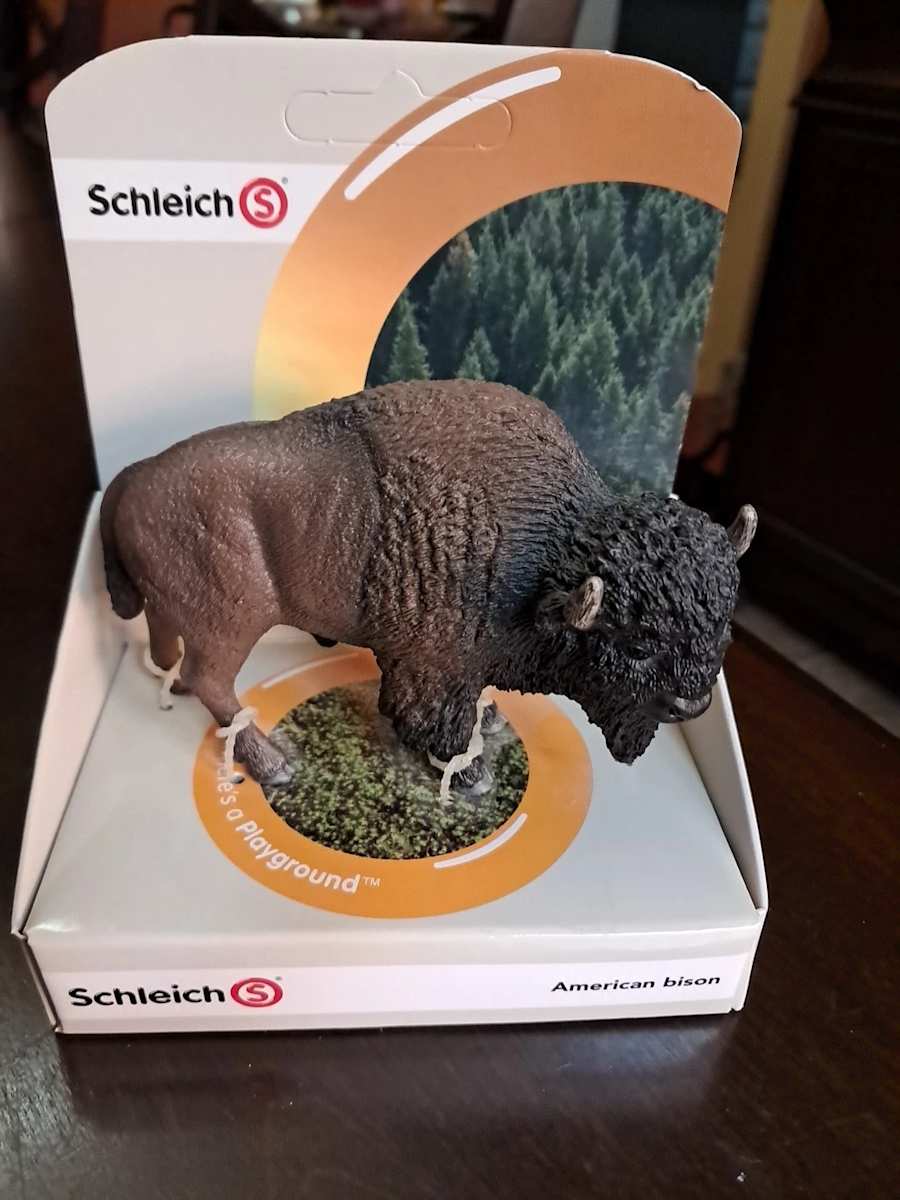
Model 14714, introduced in 2014 as the 14349 retired, represents Schleich at the height of its powers. Every aspect shows refinement: the fur texturing is extraordinarily detailed, with individual hair strands visible in the thick mane and beard; the paint application uses subtle gradations to create depth and dimension; the anatomical accuracy extends to features reviewers delightedly (or mortifyingly, for classroom teachers) noted as "anatomically correct." Measuring approximately 13 x 4 x 7 cm, the 14714 adopted a head-turned, alert pose that captures a specific behavioral moment—the Animal Toy Blog's description perfectly captures the narrative: "grazing with slow relish. Suddenly his head jerks up. Was it something he heard?" This storytelling approach reflects Schleich's evolving marketing strategy, positioning figurines not as static display pieces but as props for imaginative play scenarios. The 14714 also benefited from manufacturing advances: by 2014, Schleich had fully integrated digital prototyping into their design process, creating computer models before resin prototypes, allowing for precision unattainable in earlier hand-sculpted wax models. The six-year production run (2014-2020) coincided with Schleich's sale to Partners Group in 2019 and the company's renewed emphasis on sustainability—by retirement, Schleich had committed to making all figurines recyclable by 2027 and was researching recycled materials for future production. Notably, Schleich did not produce a companion calf for the 14714, suggesting the company had moved away from the family-grouping strategy of the mid-2000s and returned to focusing resources on increasingly sophisticated individual animal sculptures. Despite being retired only in 2020, the 14714 already commands premium prices in secondary markets, with collectors recognizing it as perhaps the finest American bison figurine Schleich has produced.
The Collection as Archive
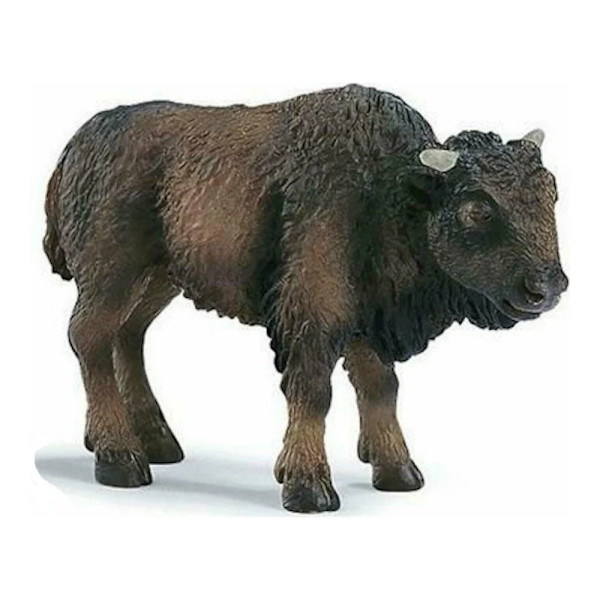
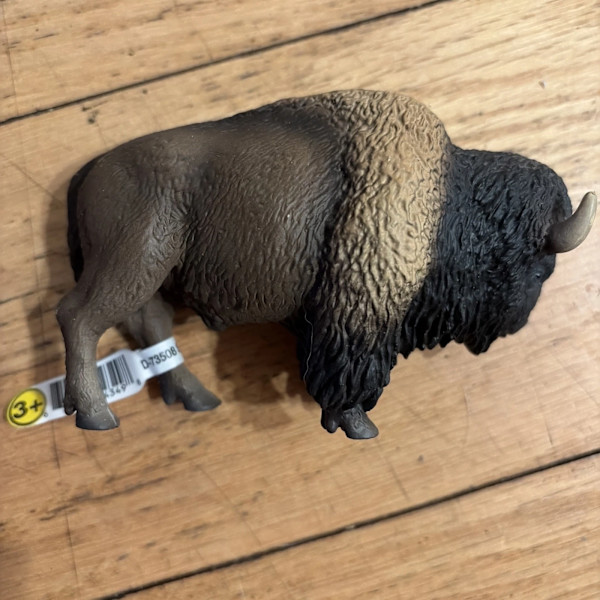
Together, these six Schleich bison models (with the European Wisent providing crucial comparative context) document far more than incremental improvements in toy manufacturing. They trace the trajectory of a German company navigating globalization, the evolution of play patterns from static display to narrative-driven storytelling to individualized imaginative scenarios, the increasing importance of conservation messaging in children's products, and the technological transformation of the toy industry from hand-sculpted wax to digital prototyping. They reveal how commercial pressures shape which animals get made and which get discontinued—the American bison thrives across four successive adult models spanning 25 years while the European Wisent disappears after two years, not because of inferior quality but because global markets care more about Yellowstone than Białowieża. The brief appearance of the 14350 calf (2005-2010) illuminates a particular moment when Schleich experimented with family groupings before returning to their core strength: exceptional individual animal sculptures. Most intriguingly, this collection captures the complete product lifecycle philosophy of a manufacturer committed to continuous improvement: rather than producing a single bison and leaving it unchanged for decades, Schleich revisited the species repeatedly, each time incorporating new capabilities, responding to evolving consumer preferences, and pushing toward ever-greater realism. From the foundational 14034 through the current 14879, these pieces show Schleich transforming from a regional German toy maker into an international powerhouse while never abandoning the hand-painted craftsmanship and zoological accuracy that defined their brand identity. For collectors of bison imagery, they represent German precision applied to American iconography—a cross-cultural conversation conducted in PVC and paint, documented across a quarter-century of manufacturing excellence.
- Subject Matter: Bison
- Current Location: BLD 20 by R101
- Collections: Thomas Hill Bison Figurine Collection