
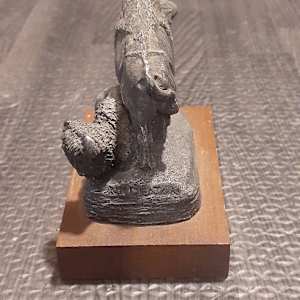
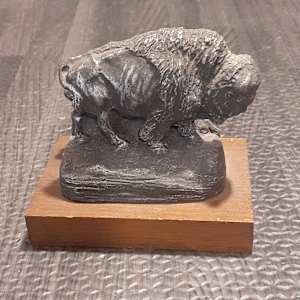
Deaton Museum Products Bison Herd Group
Educational Wildlife Series, circa late 1970s-early 1980s
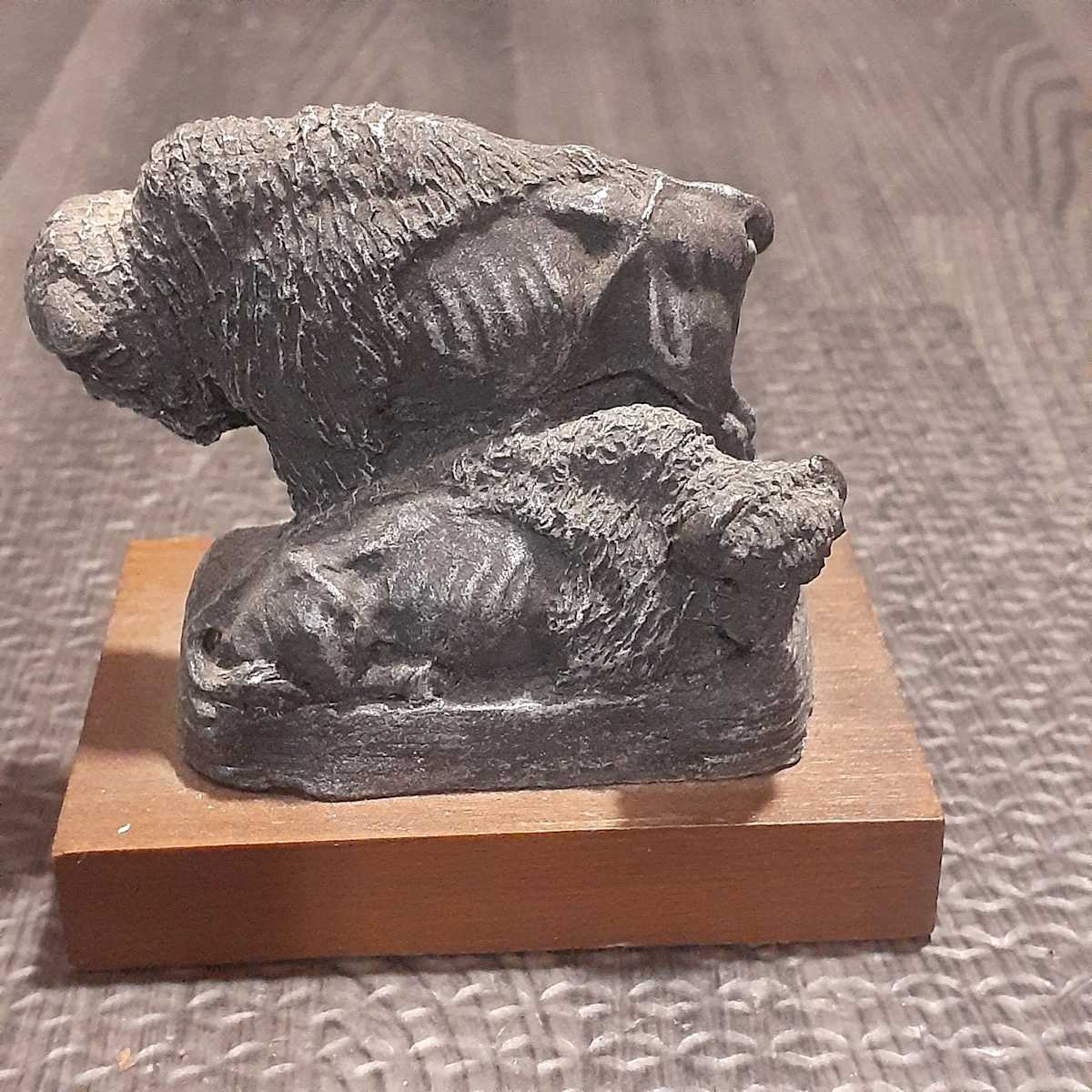
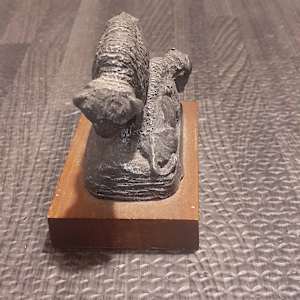
This dual-figure bison sculpture represents the convergence of museum exhibition artistry and accessible educational merchandise, created by the Deaton family's Newton, Iowa studio. The composition depicts two adult American bison—one standing alert, one reclining at rest—capturing the peaceful rhythms of herd life rather than dramatic action, reflecting 1970s educational philosophy of presenting wildlife in naturalistic contexts.
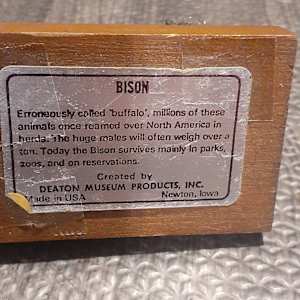
Standing approximately 2 inches tall, the sculpture features two fully-grown bison on a single integral textured base. The standing bison displays the characteristic massive shoulder hump and lowered head, while the reclining adult rests in typical herd posture, demonstrating social tolerance within bison groups. Both figures show detailed surface modeling suggesting fur texture and anatomical accuracy. The piece is mounted on a simple stained wood display base and retains its original educational label from Deaton Museum Products, Inc., Newton, Iowa.
Norman "Neal" Deaton (b. 1929) established his reputation at the Smithsonian Institution before returning to Newton, Iowa in 1959 to open an independent studio. His Smithsonian work included the famous 1963 Mesozoic dinosaur dioramas (displayed until 2014) and the iconic Fénykövi elephant still standing in the Natural History Museum rotunda. Brother Herman L. Deaton joined him, and together they created prestigious museum exhibitions nationwide while developing multiple lines of miniature wildlife sculptures for collectors and museum gift shops.
The family operated parallel product streams serving different markets: "The Bronze Menagerie" (Creative World, Ltd.) for collectibles dealers, "Hamilton Collection/Audubon Bronzes" for premium mail-order markets, and "Deaton Museum Products, Inc." specifically for natural history museum gift shops. Your bison belongs to this institutional line, designed as educational merchandise rather than home décor.
The two-adult grouping is particularly meaningful within natural history education. Rather than depicting dramatic moments, this composition shows bison in their most common state—one resting while another remains alert, realistic portrayal of herd vigilance patterns. This educational approach reflects 1970s shifts away from sensationalized predator-prey encounters toward everyday behaviors, emphasizing normal life cycles. The Deaton studio's museum diorama experience informed these naturalistic presentation choices, avoiding anthropomorphization while demonstrating species-typical postures.
The label text encapsulates how bison conservation was communicated to 1970s-80s museum visitors: "Erroneously called 'buffalo', millions of these animals once roamed over North America in herds. The huge males will often weigh over a ton. Today the Bison survives mainly in parks, zoos, and on reservations."
This dates the piece fairly precisely to the late 1970s or early 1980s, before significant expansion of private bison ranching. The mention of "reservations" reflects slowly emerging acknowledgment of Indigenous connections to bison, though still framed through non-Indigenous conservation management language. The phrasing presents bison recovery (from fewer than 1,000 individuals in the 1880s to over 30,000 by 1980) as conservation triumph, emphasizing managed survival in institutional settings.
This piece emerged when museum gift shops were professionalizing in the 1970s, transforming from novelty souvenirs to curated educational merchandise. As federal funding stagnated, earned income became crucial while visitor expectations shifted toward meaningful, educational purchases. The Deaton studio's dual expertise—creating both Smithsonian exhibitions and affordable souvenirs—made them ideal partners for institutions extending interpretive missions into retail spaces.
Bison subject matter connected to converging themes: conservation success narrative, National Parks tourism boom (Yellowstone's herds became iconic), Western heritage commercialization, and nascent Indigenous recognition. Museums presented bison recovery as vindication of scientific management, though this simplified narrative overlooked genetic bottlenecks and habitat loss complexities.
Newton's identity as "Washing Machine Capital of the World" (Maytag Corporation headquarters) provided unexpected advantages for sculpture production. The town's precision manufacturing infrastructure—tool and die makers, molding specialists, finishing experts—supported the technical requirements for scaling production beyond one-off masterpieces. Herman and Neal Deaton became local cultural figures, with works displayed at Jasper County Historical Museum alongside Maytag manufacturing exhibits, celebrating diverse craftsmanship traditions.
Deaton Museum Products pieces occupy an interesting niche—more substantial than generic tourist souvenirs, yet more accessible than fine art bronzes. The intact educational label is critically important, providing definitive attribution and historical context many owners removed as unsightly. The two-figure composition suggests a higher-end offering within the museum products line, as dual figures required more complex molds and materials than single sculptures.
Subject matter enhances interest—bison appear less frequently in the Deaton catalog than white-tailed deer, raccoons, or waterfowl (subjects more readily studied in Iowa). Unlike "Bronze Menagerie" pieces with specified 15,000-piece editions, museum products likely were produced to order based on institutional demand, potentially resulting in smaller, more dispersed production runs.
The educational labeling and museum studio provenance distinguish this from purely decorative figurines or Western heritage merchandise, positioning it within institutional conservation messaging. The dual-figure composition adds narrative richness rarely found in small souvenir sculptures, while the intact label provides invaluable documentation of how museums communicated bison stories during a pivotal period in American environmental consciousness.
- Subject Matter: Bison
- Current Location: BLD 20 by R101
- Collections: Thomas Hill Bison Figurine Collection