
Primitive Style Folk Art Bison
Carved Wood (light-density hardwood, unfinished)
Origin, maker, and date unknown
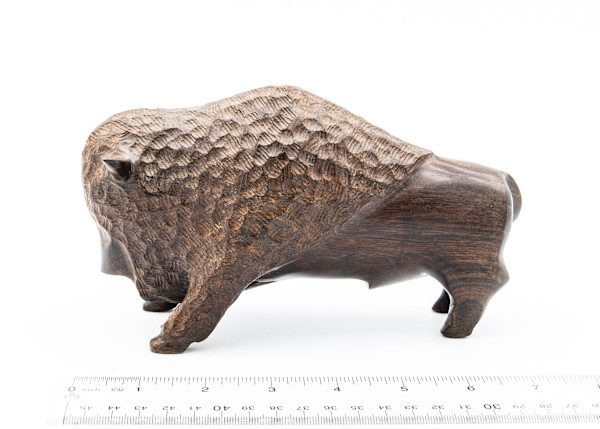
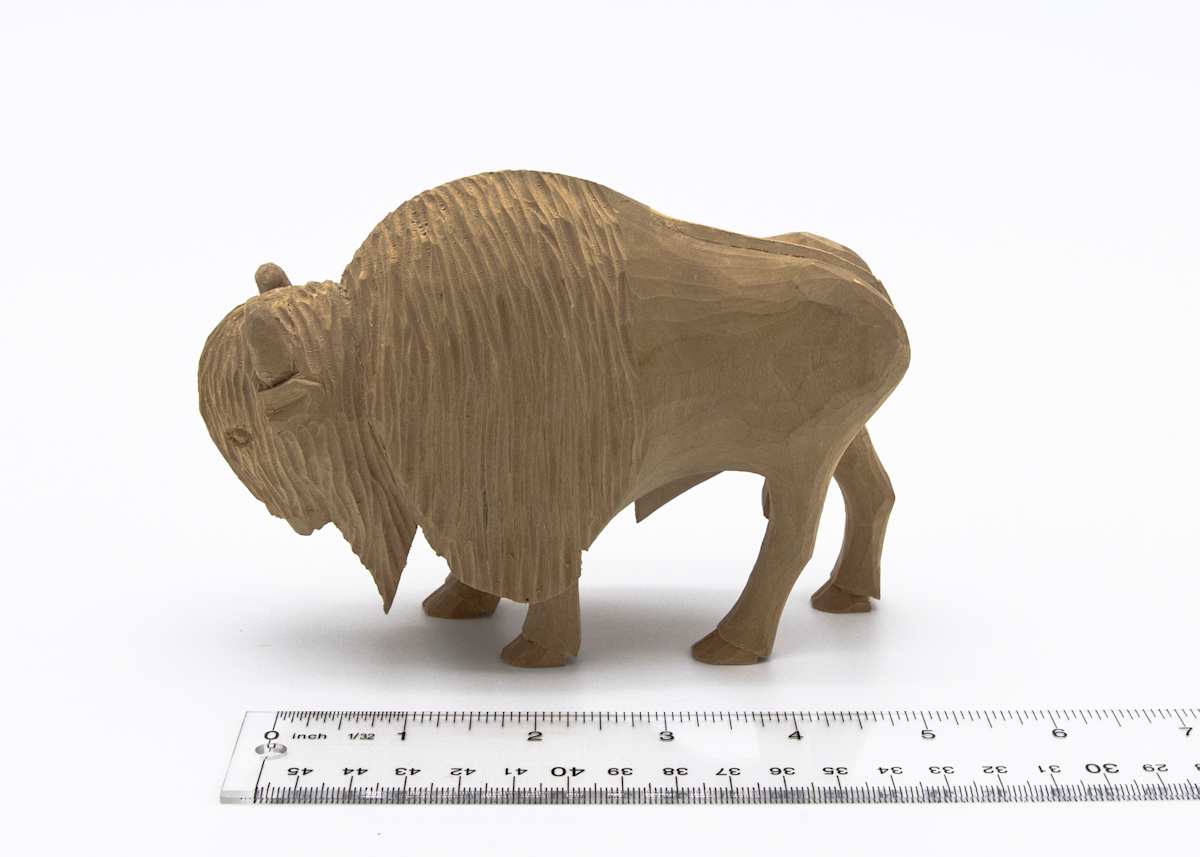
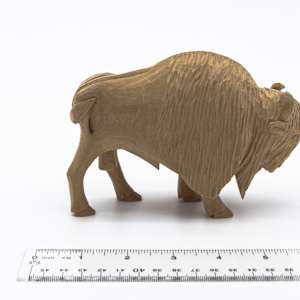
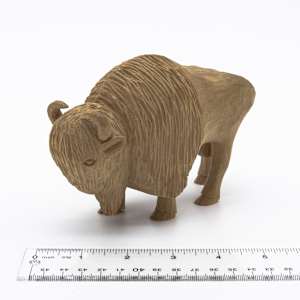
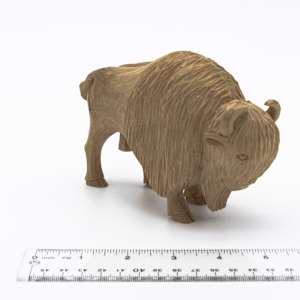
This hand-carved wood bison is an unattributed folk carving of genuine quality, its anonymity as much a part of its character as its naturalistic form. Measuring approximately six inches in length and four inches in height, the piece depicts a mature bull in a grazing posture — head lowered, weight forward, the massive shoulder hump at its most prominent — in a stance that bespeaks careful observation of the living animal rather than derivation from another artist's model.
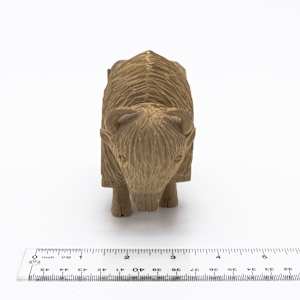
The carver's most distinctive technical decision is the systematic use of incised tool lines across the entire surface to simulate the bison's coat. Working with a gouge or narrow knife, the maker carved fine parallel lines into the wood in sweeping passes that follow the contours of the body — cascading down the hump, flowing through the heavy mane and beard, defining the haunches and legs. This is not a shortcut or a primitive simplification; it is a considered technique that requires planning, a controlled hand, and an understanding of how fur grows and lies across different parts of the animal's body. The effect is most fully realized across the broad back and hump, where the lines run in disciplined sweeps that read convincingly as the coarse outer coat of a plains bison. The mane and beard receive denser, more varied treatment, the lines crossing and deepening to suggest the matted thickness of the frontal fur. The wood itself — a light-density variety, likely basswood or a comparable soft-to-medium hardwood favored by folk carvers for its workability — is left unfinished or with only a minimal sealer, its close, even texture providing a neutral ground that keeps visual attention on the carved linework rather than the material itself.
The "primitive" in the piece's descriptive title requires some qualification. The carving shares stylistic DNA with the American folk carving tradition that flourished in rural communities throughout the nineteenth and twentieth centuries, particularly in regions where the bison carried cultural weight — the Great Plains states, the mountain West, areas adjacent to national parks where the animal's recovery was a living story. Carvers working in this tradition were rarely formally trained but often technically accomplished within their own idiom, developing personal vocabularies of form and texture through repetition rather than instruction. This piece's confident anatomy — the correctly proportioned hump, the accurate relationship of head to body, the characteristic forward lean of the grazing posture — suggests a maker who had looked at bison carefully, whether in person or through sustained engagement with photographic reference.
Unattributed and undated, the piece stands as an honest representative of a significant American craft tradition — anonymous, unmarketed, and none the worse for it.
- Subject Matter: Bison
- Collections: Thomas Hill Bison Figurine Collection