
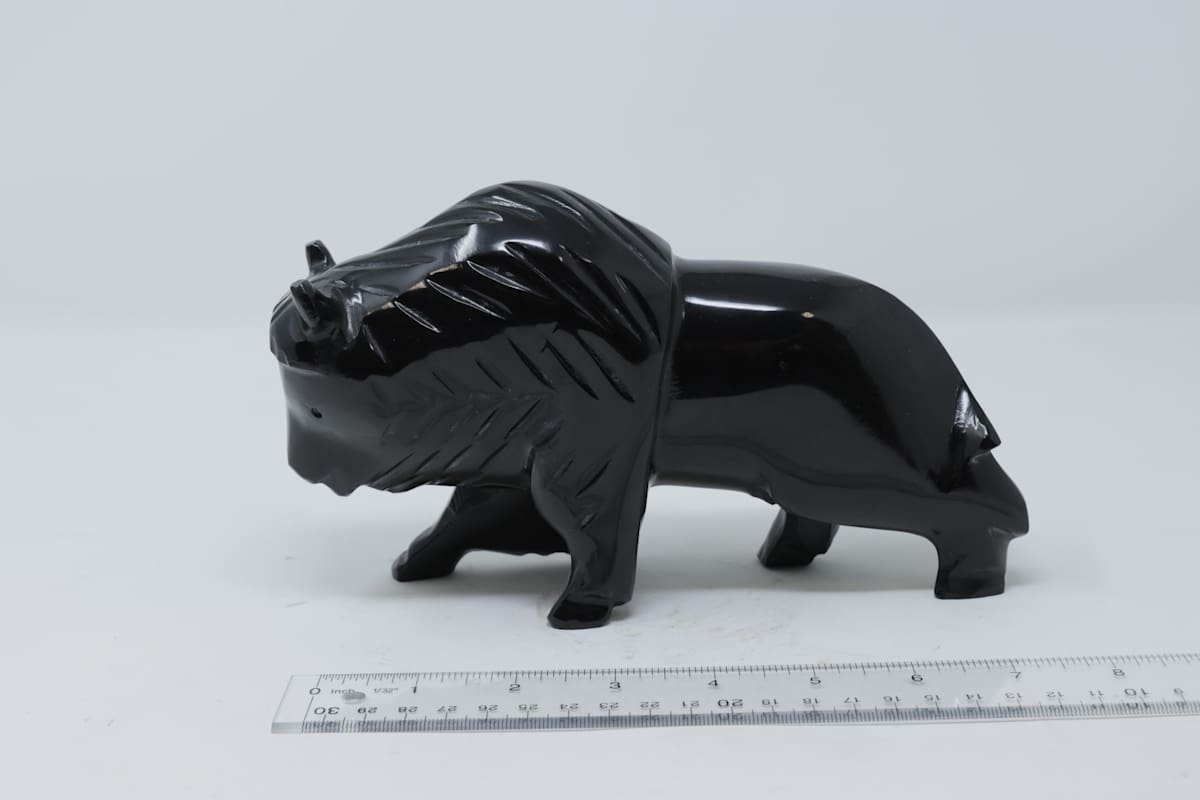
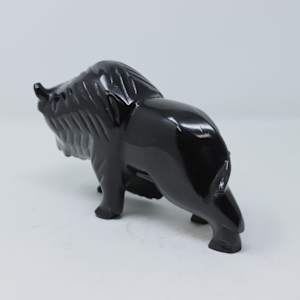
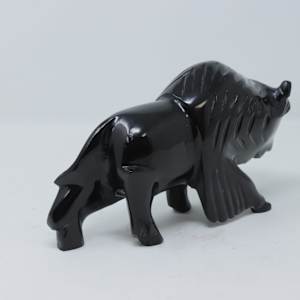
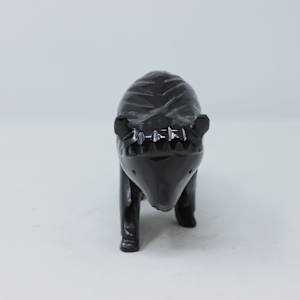
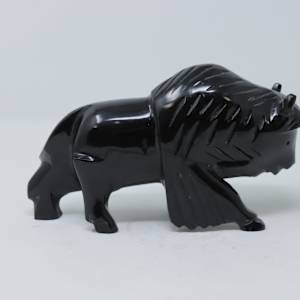
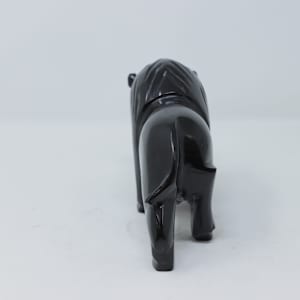
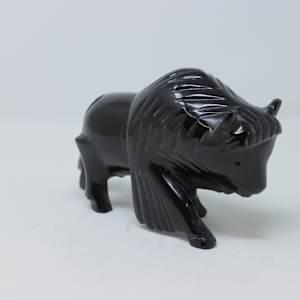
This glossy black stone bison occupies an interesting middle ground between authentic Native American fetish carvings and mass-market Southwestern tourist art. Carved from what's marketed as "black onyx"—though more likely a black marble, serpentine, or stained agate given its weight and uniform color—the piece demonstrates competent stone-carving technique while maintaining the simplified aesthetic that made Southwestern animal carvings accessible to the tourist and home décor markets from the 1970s onward.
The carving technique shows direct influence from Zuni and Navajo fetish traditions but has been scaled up and simplified for commercial appeal. Traditional Zuni fetish carvings typically measure 1-3 inches long and emphasize spiritual significance over decorative finish. This piece, at 7 inches, crosses into decorative sculpture territory—too large to be a pocket fetish, clearly intended for display on shelves or mantels. The high-gloss polish that covers every surface represents another departure from traditional practice, where stone was often left with a more natural, matte finish that emphasized the material's inherent qualities rather than reflective shine.
The sculptor has captured essential bison characteristics through economical means—the massive head with pronounced muzzle, the distinctive shoulder hump, the shaggy mane indicated by parallel incised lines, and sturdy legs positioned in a solid, four-square stance. The mane treatment is particularly telling: deep parallel grooves carved into both the head and neck create a rhythmic pattern that suggests flowing hair without attempting naturalistic detail. This same linear approach appears in the beard area under the chin and continues along parts of the body, creating visual interest through texture rather than sculptural modeling.
What's intriguing is how the carving navigates between symbolic representation and decorative object. In Zuni cosmology, buffalo represent strength, endurance, abundance, and the fulfillment of needs—powerful medicine. Although bison didn't historically range as far south as Zuni Pueblo in New Mexico, Zuni people traveled north to hunt them, and the animal held significant cultural importance. Buffalo fetishes were carved both for ceremonial use within the community and for trade with Plains tribes who valued Zuni spiritual craftsmanship for protecting their herds. This commercial carving borrows that iconography and carving style but strips away ceremonial context, transforming spiritual object into home décor.
The stone itself—whatever its actual mineralogical identity—has been selected and finished to maximum visual effect. The deep black color reads as sophisticated and dramatic, coordinating with various interior design schemes. The high polish creates reflective surfaces that catch and play with light, making the simple form more visually dynamic. This glossy finish required significant labor—progressive stages of grinding and polishing with increasingly fine abrasives to achieve the glasslike surface. The uniform blackness suggests either naturally dark stone or treatment through dyeing or heat, common practices in commercial stone carving where consistent aesthetic trumps natural variation.
The piece represents a specific market phenomenon that exploded in the American Southwest from the 1960s through the 1990s—the commercialization and adaptation of Native American artistic traditions for mainstream consumption. As interest in Native American culture and Southwestern aesthetics grew among Anglo collectors and decorators, demand for authentic Zuni fetishes far exceeded what individual carvers working in traditional modes could supply. This created opportunities for both Native and non-Native carvers to produce "Southwestern style" pieces that referenced authentic traditions while serving the gift shop and home décor markets.
These commercial carvings were produced in various contexts—by Native American carvers working outside ceremonial traditions to generate income, by Mexican carvers in border states who adopted Southwestern motifs, by artisan workshops in Puebla and other Mexican carving centers, and occasionally by Asian manufacturers who imported both stone and style. Without maker's marks or provenance, attribution remains speculative. What's certain is that this piece was never intended as a ceremonial fetish requiring cornmeal offerings or turquoise-encrusted fetish pots. It was designed to sit on a bookshelf in Scottsdale or Santa Fe, bringing a touch of Southwestern mystique into middle-class American homes.
The sizing is particularly strategic—at 7 inches, it's substantial enough to have presence and justify a higher retail price (likely $30-80 when new), while remaining affordable compared to authentic Zuni carvings from recognized carvers, which could command hundreds or thousands of dollars. It's large enough to be a focal point but not so large as to be impractical for most homes. The weight of solid stone adds perceived value—this feels like a "real" object, not a hollow resin cast.
For the collection, this black stone bison represents the commercialization and democratization of Native American artistic traditions—how ceremonial objects became decorative motifs, how regional carving techniques spread through tourist economies, and how "Southwestern style" became a marketable aesthetic category divorced from specific tribal origins or spiritual contexts. It sits in dialogue with the authentic Native American pieces while acknowledging the complex realities of cultural borrowing, economic necessity, and the tourist art trade that has both sustained and complicated Native American artistic traditions for over a century.
- Subject Matter: Bison
- Current Location: BLD 20 by R101
- Collections: Thomas Hill Bison Figurine Collection