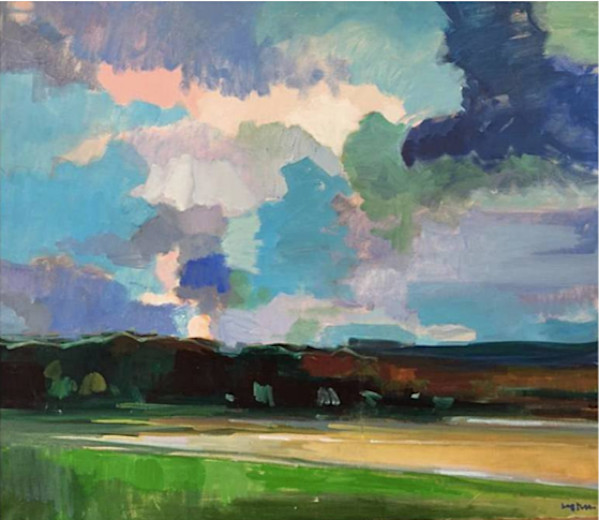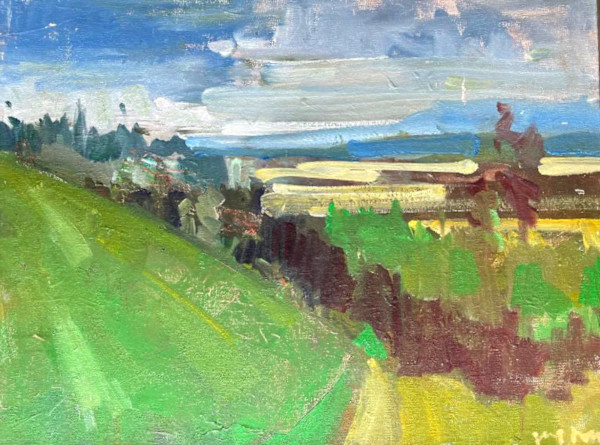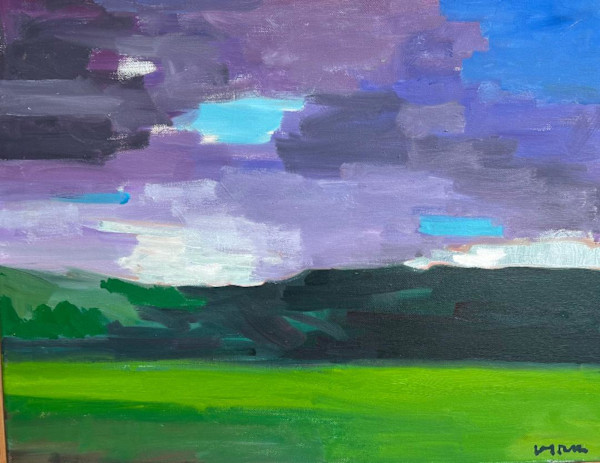


This smaller veduta of Mt. Baldy moves even further toward the language of pure mass macchia, where landscape dissolves into atmosphere, rhythm, and memory. Seen from high along the ridge, the Willamette Valley unfolds below in broad bands of dark green shadow, luminous pastureland, and distant light, all compressed into simplified tonal harmonies that hover between representation and abstraction. The painting feels less like a literal view than the lingering sensation of standing on the mountain itself, looking outward as weather and light continually reshape the valley beneath.
The strong descending diagonal anchors the composition while simultaneously suggesting the steep physicality of the terrain — the long slopes, hidden trails, and forested descents that characterize Mt. Baldy. Unlike more descriptive landscape traditions, this work embraces ambiguity and flattening. Trees become dark calligraphic masses, fields dissolve into patches of glowing color, and the distant horizon melts into soft atmospheric haze. The darker tonal structure gives the painting a contemplative gravity, evoking the mysterious quiet often felt at elevated viewpoints where civilization appears far away and transient beneath the immensity of land and sky.
In the spirit of American verismo, the painting values immediacy and emotional truth over finish. The quick, visible brushwork and abbreviated forms preserve the freshness of direct sensation, allowing the viewer to experience not only the landscape itself, but the act of seeing — the fleeting moment when mountain, weather, and memory briefly fuse into one unified vision.
- Subject Matter: landscape
- Collections: Jack Sprat