
- Jerry Ross
- Ciceruacchio, 2025
- 36 x 24 in
- $3,000
-
Available
Oil on canvas
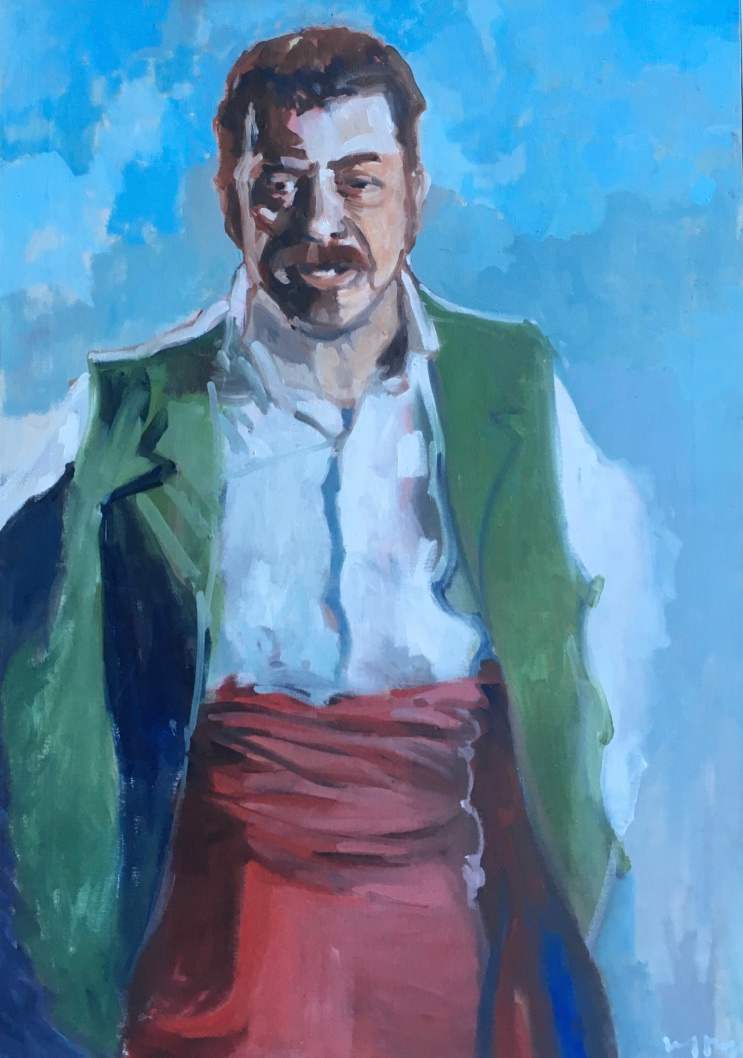
"Ciceruacchio" oil on canvas 36 x 24 x 2 inches is a portrait of Angelo Brunetti, known as Ciceruacchio (b. Rome, September 1800 in Porto Tolle, died August 10, 1849) was an innkeeper and an Italian patriot who fought for the second Roman Republic. He fled with Giuseppe Garibaldi to reach Venice. The Austrians captured Angelo and his 14-year old son. Although Angelo pleaded for the life if his son, the Austrians first shot his son and then murdered Angelo, showing their contempt for Italian patriotism.
I want viewers to identify with this Italian hero and to reflect in the sacrifices made for Italian unification. Perhaps they can relate the Italian struggle for freedom and democracy with the American Revolution or the current movement against the Trump administration that is moving this country towards authoritarian fascism. The courage shown by this Italian patriot is what we need now as an example of resistance.
I chose oils because it is my favorite medium for portraiture and allows me to make statements in my chosen style "American verismo" that are strong, bold, and colorful.
Angelo Brunetti and the American Reckoning
By Jerry Ross, painter
History has a way of offering mirrors. Sometimes the reflection
flatters; sometimes it shames. And sometimes, as in the case of
Angelo Brunetti— Ciceruacchio to the Romans—it reveals a
standard so bracing, so unpretending, that it forces us to confront how
far we’ve drifted from the civic courage that once defined a republic.
Brunetti was no aristocrat. He wasn’t a general, a scholar, or a man
carrying inherited power. He was a ferryman, a shopkeeper, a citizen
whose authority emerged from the streets themselves. In the Rome of
the 1840s, where poverty dug trenches between the fortunate and the
forgotten, Brunetti stepped across those divides with a generosity that
made him famous long before he ever hoisted a rifle. He fed the poor. He uplifted artisans. He inspired workers. In a city stratified by class and patronage, he was radical because he walked with, not above, ordinary people.
When the Roman Republic was proclaimed in 1849—an audacious, short-lived attempt to replace corrupt monarchy with a democratic republic—Brunetti became one of its loudest defenders and most steadfast guardians. He fought alongside Garibaldi and the artists, radicals, printers, and laborers who built the barricades. His courage was not abstractions or speeches. It was action. It was sacrifice. It was standing in the dust and smoke of street battles to defend the idea that ordinary citizens could govern themselves without tyrants.
Today, Americans find themselves in a moment that echoes the perils of that era. Our republic, though older and more structurally fortified than the Roman experiment, faces a corrosive internal threat: a movement built upon resentment, white grievance, manufactured persecution complexes, and the cult of personality surrounding a man whose contempt for democratic norms is barely disguised. The threat is not merely political; it is moral. It seeks to replace civic virtue with spectacle, truth with propaganda, and shared citizenship with the poisonous psychology of enemies and loyalists.
This movement thrives by hollowing out the core of the American Revolution while cloaking itself in its imagery. It claims the Founders but rejects the spirit that animated them: resistance to tyranny, suspicion of concentrated wealth, and the belief that liberty must serve the common people, not a ruling
elite. And here is where Brunetti’s example becomes a beacon. His life reminds us that republics are defended not by slogans or flags, but by people willing to stand up against power when it turns predatory. He reminds us that patriotism is not performative outrage or furious allegiance to a single man. Patriotism is commitment to one another—to neighbors, workers,
the poor, the vulnerable. It is a refusal to surrender dignity or democratic agency to the whims of the ambitious.
Angelo Brunetti
Brunetti did not posture as a martyr. He did not claim victimhood. He chose responsibility. When foreign forces marched into Rome to crush the republic, he did not retreat. He fought alongside his sons. He walked toward danger because he understood what was at stake: not land, not prestige, but the
possibility of a free and egalitarian society.
What, then, does this mean for Americans living under the shadow of a rising authoritarian movement? It means that the fight for the republic will not be won by elites, television personalities, or political celebrities. It will be carried by teachers refusing censorship, by workers organizing unions, by clergy speaking truth against cruelty, by artists refusing to sanitize the moment, by neighbors refusing to look away. It will be shaped by an ethic of solidarity that Brunetti lived intuitively: that democracy survives only when ordinary people defend one another. The American Revolution was not the work of an aristocracy. It was carried by farmers, craftsmen, printers, shipbuilders, women who sustained communities under siege, enslaved people seeking their liberation, Indigenous nations fighting for sovereignty. It was the messy, unglamorous labor of people who believed tyranny must be resisted wherever it appears.
Brunetti stands as a reminder—and a warning—of what is demanded of us. A republic is not inherited; it is maintained. It does not endure because we revere it, but because we act in its defense. His courage does not belong to Italy alone. It is part of the universal grammar of resistance, a model available to every people who find themselves confronting the slow creep of tyranny.
If Americans wish to reclaim the true values of their Revolution, they must embrace the spirit Brunetti embodied: the courage to fight for one another, the refusal to bend to injustice, and the determination to protect the fragile, extraordinary experiment of self-government. In our age of disinformation, violence threatened against political opponents, and a movement actively
seeking to install minority rule through fear, apathy is complicity. Brunetti’s life asserts an uncompromising truth: the republic belongs to those who defend it, not those who exploit it. And the hour is late.
But the Italian patriot’s legacy still stands—unyielding, unpretentious, unbroken—offering this simple challenge to every American who can still recognize tyranny when they see it:
Stand up.
Do your part.
The republic depends on you!
An essay for “The Second American Revolution” – New Committees of Correspondence