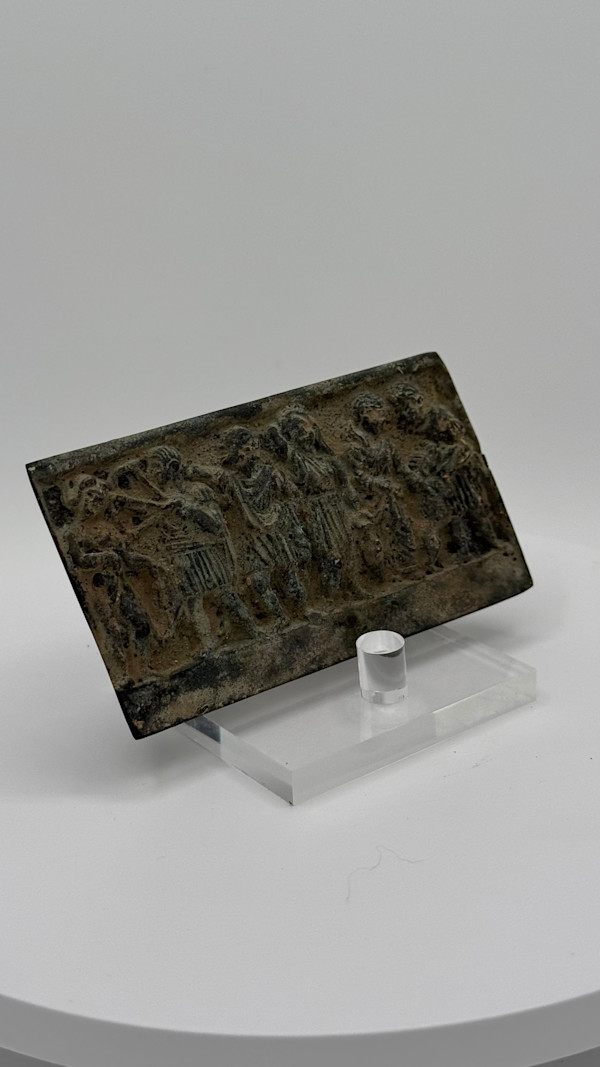


This specimen was excavated in 1887 by a British archaeological team under the direction of Paul Wolters Second Secretary of the DAI Athens in the ancient city of Thebes in modern Boeotia, central Greece
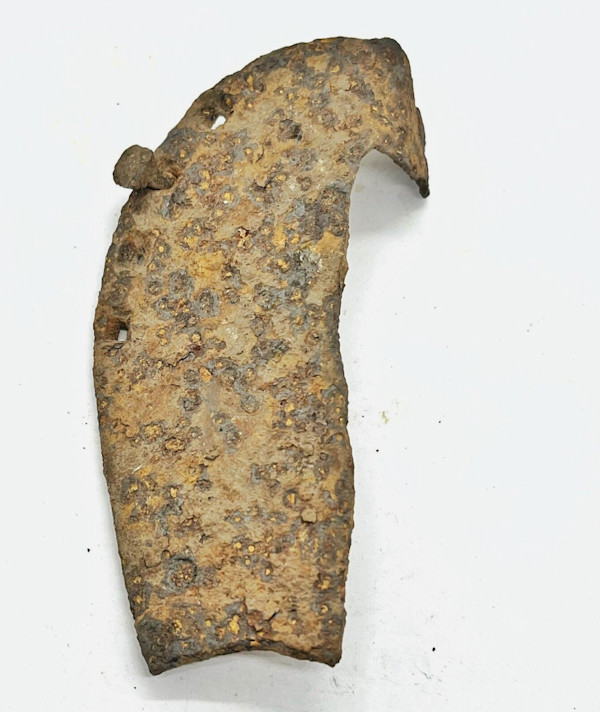
The Sarrisa made Alexander the Great the superpower of the ancient world. This genuine socketed iron lance is a SARISSA phalanx pike spearhead from the ancient Greek Macedonian Empire, ruled by Phillip II of Macedon and later his son, Alexander the Great.
The socket is narrower than the neck, and this was likely attached to the wooden pole with an embedded iron rod, and then lashed over the socket up to the solid neck, for the greatest strength against breakage.
THIS was the weapon that made the Macedonian army the most powerful military of ALL the ancient world, in their day!
The Ancient Macedonian phalanx carried primary pike spears tipped with spearheads like this, on conquests by noted commanders such as Phillip II and his son, Alexander the Great, as they expanded their empire from the Adriatic Sea to the Indus River.
This excellent specimen is complete which is rare for ancient iron. Weapons of this ancient empire are uncommon especially with the provenance of this unique specimen l
The sarissa (sarisa) was a long spear or pike about 4–6 metres (13–20 ft) in length. It was conceived by Philip II of Macedon and was used in his Macedonian phalanxes as a replacement for the earlier dory, which was considerably shorter. These longer spears improved the strength of the phalanx by extending the rows of overlapping weapons projecting towards the enemy. The sarissa was very heavy for a spear, weighing approximately 5.5 kg (12 lb) to 6.5 kg (14 lb). It had a sharp iron head shaped like a leaf and a bronze butt-spike which could be anchored to the ground to stop charges by the enemy.
This specimen has been properly cleaned, inspected and conserved in our museum conservation lab prior to being placed in the collection.
The invention of the sarissa is credited to Philip II, father of Alexander the Great. Philip drilled his soldiers, whose morale was at first low, to use these formidable pikes with two hands. The new tactic was unstoppable, and by the end of Philip's reign the previously fragile northern Greek kingdom of Macedon controlled the whole of Greece and Thrace.
His son, Alexander, used the new tactic across Asia, conquering Egypt, Persia and the Pauravas (northwest India), victorious all the way. The sarissa-wielding phalanxes were vital in every early battle, including the pivotal Battle of Gaugamela where the Persian king's scythe chariots were utterly destroyed by the phalanx, supported by the combined use of companion cavalry and peltasts (javelineers).
During his later campaigning, Alexander gradually reduced the importance of the phalanx and the sarissa, as he modified his combined use of arms to incorporate 'Asian' weapons and troops, not specifically trained in Hellenistic battle tactics.
The sarissa, however, remained the backbone for every subsequent Hellenistic, and especially Diadochi army. The Battle of Raphia between the Seleucids and Ptolemy IV may represent the pinnacle of sarissa tactics, when only an elephant charge seemed able to disrupt the opposing phalanx.
The Successor Kingdoms of Macedon's empire tried expanding upon the design, creating pikes as long as 6.75 m (22.1 ft), but all of these ideas were eventually abandoned in favor of the battle-tried Philippine-Alexandrian sarissa. Battles often ended up stalemated in what Oliver Cromwell later described as "the terrible business of push of pike".
Macedonia, or Macedon, was an ancient kingdom on the periphery of Archaic and Classical Greece, and later the dominant state of Hellenistic Greece. Home to the ancient Macedonians, the earliest kingdom was centered on the northeastern part of the Greek peninsula, and bordered by Epirus to the west, Paeonia to the north, Thrace to the east and Thessaly to the south.
Before the 4th century BC, Macedonia was a small kingdom outside of the area dominated by the great city-states of Athens, Sparta, and Thebes, and briefly subordinate to Achaemenid Persia. During the reign of the Argead king Philip II (359–336 BC), Macedonia subdued mainland Greece and Thrace through conquest and diplomacy. With a reformed army containing phalanxes wielding the sarissa pike, Philip II defeated the old powers of Athens and Thebes in the Battle of Chaeronea in 338 BC. Philip II's son, Alexander the Great, leading a federation of Greek states, accomplished his father's objective of commanding the whole of Greece when he destroyed Thebes after the city revolted. During Alexander's subsequent campaign of conquest, he overthrew the Achaemenid Empire and conquered territory that stretched as far as the Indus River. For a brief period, his empire was the most powerful in the world – the definitive Hellenistic state, inaugurating the transition to a new period of Ancient Greek civilization. Greek arts and literature flourished in the new conquered lands and advances in philosophy, engineering, and science spread throughout much of the ancient world. Of particular importance were the contributions of Aristotle, tutor to Alexander, whose writings became a keystone of Western philosophy.
- Subject Matter: Antiquity Weapons
- Collections: Von Schmidt Family Trust Antiquities Collection