Dining Room
DINING ROOM
Installation with social practice component of community engagement and participation
Description of Work
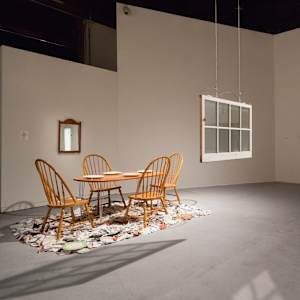
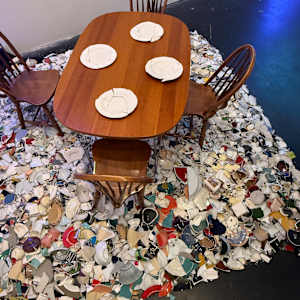
Viewed from a distance, Dining Room is pleasant and unremarkable — a diorama of domesticity. A window hangs in midair. Beyond it: a dining table set for four, white plates, four chairs. A vintage mirror faces the viewer, placing her inside the scene.
On closer approach, the plates reveal themselves: broken long ago and glued back together, carefully and imperfectly. Once broken, never made whole again. Below the table, what appears to be a deep shag rug is, in fact, shattered crockery piled ankle-deep.
The installation is completed through a facilitated public event called the Shatter Party, held the night before each installation. Attendees — wearing safety masks — break ceramic dishes one by one into a pit, as many times as they wish. They may bring their own dishes. The fragments collected from this event become the material from which the final work is constructed. On one occasion, a participant arrived with her mother's wedding china from a disastrous first marriage; she said she found relief in unloading the bad memory, and in transforming wreckage into truthful art.
Each iteration of Dining Room is co-created with the public — shaped by the action, energy, grief, and emotion participants bring to the moment. The Shatter Party reliably produces an unexpected social effect: attendees leave exhilarated and begin to speak freely with friends and strangers. At the installation itself, visitors frequently share unsolicited, deeply personal stories about their families of origin.
The work addresses intergenerational and cultural trauma, the burden of domestic silence, and the possibility — imperfect and visible — of repair. The broken-and-reglued plates are not restored; they are evidence. The rug of shards is not decorative; it is accumulation.
When the installation closes, the ceramic fragments are donated to local artists, designers, and landscapers for reuse — extending the material life of the work beyond the gallery and keeping it out of landfill. Destruction becomes creation. The cycle continues.
Dining Room is a living archaeological site. Each presentation builds on the emotional residue of the last.
Exhibition History
2011 — Building Our Own Picket Fences: Queer Community Arts Project, Michelle O'Connor Gallery / Femina Potens, San Francisco, CA
2013 — All Good Things…, SoMArts Cultural Center, San Francisco, CA
2016 — MFA Never, Root Division, San Francisco, CA
2025 — 465 Collective Residency, 465 Collective, San Francisco, CA
2025 Iteration: 465 Collective
The 2025 residency at 465 Collective marked the most expansive realization of Dining Room to date, expanding from a single sculptural focal point into a total domestic environment occupying the full two-room gallery.
The natural division of the space suggested its own spatial logic: front room as living room, back room as the installation proper. The front was furnished with sofas and activated through a rotating series of domestic social experiences — a yard sale, a fiber craft and coffee gathering, holiday portrait sessions — collapsing the boundary between art space and lived domestic life.
A Family Portrait wall ran floor to ceiling, dense with frames in the manner of old portrait galleries. The wall reflects the artist's long fascination with the family photographs found in so many homes — full of smiles both genuine and performative, testifying to what families choose to show and what they agree not to say. The frames contained works by queer and BIPOC artist colleagues, the artist's own interpretations of family, and mirrored mylar panels — placing viewers inside the frames alongside distorted reflections of themselves, implicated in the very dynamic the work examines.
Elsewhere in the gallery, a tree was woven and tangled with rope, threading the organic into the constructed domestic space.
~ Artist's Note ~
After the first Shatter Party, the artist and both facilitating volunteers independently woke the following day feeling drained, sad, and depleted — as if hit by a truck, without chemical cause. They had absorbed the collective emotional outpouring of the participants. In subsequent iterations, facilitators are briefed on what to expect and how to prepare for self-care and reorientation afterward.
Installation with social practice component of community engagement and participation
Description of Work
Viewed from a distance, Dining Room is pleasant and unremarkable — a diorama of domesticity. A window hangs in midair. Beyond it: a dining table set for four, white plates, four chairs. A vintage mirror faces the viewer, placing her inside the scene.
On closer approach, the plates reveal themselves: broken long ago and glued back together, carefully and imperfectly. Once broken, never made whole again. Below the table, what appears to be a deep shag rug is, in fact, shattered crockery piled ankle-deep.
The installation is completed through a facilitated public event called the Shatter Party, held the night before each installation. Attendees — wearing safety masks — break ceramic dishes one by one into a pit, as many times as they wish. They may bring their own dishes. The fragments collected from this event become the material from which the final work is constructed. On one occasion, a participant arrived with her mother's wedding china from a disastrous first marriage; she said she found relief in unloading the bad memory, and in transforming wreckage into truthful art.
Each iteration of Dining Room is co-created with the public — shaped by the action, energy, grief, and emotion participants bring to the moment. The Shatter Party reliably produces an unexpected social effect: attendees leave exhilarated and begin to speak freely with friends and strangers. At the installation itself, visitors frequently share unsolicited, deeply personal stories about their families of origin.
The work addresses intergenerational and cultural trauma, the burden of domestic silence, and the possibility — imperfect and visible — of repair. The broken-and-reglued plates are not restored; they are evidence. The rug of shards is not decorative; it is accumulation.
When the installation closes, the ceramic fragments are donated to local artists, designers, and landscapers for reuse — extending the material life of the work beyond the gallery and keeping it out of landfill. Destruction becomes creation. The cycle continues.
Dining Room is a living archaeological site. Each presentation builds on the emotional residue of the last.
Exhibition History
2011 — Building Our Own Picket Fences: Queer Community Arts Project, Michelle O'Connor Gallery / Femina Potens, San Francisco, CA
2013 — All Good Things…, SoMArts Cultural Center, San Francisco, CA
2016 — MFA Never, Root Division, San Francisco, CA
2025 — 465 Collective Residency, 465 Collective, San Francisco, CA
2025 Iteration: 465 Collective
The 2025 residency at 465 Collective marked the most expansive realization of Dining Room to date, expanding from a single sculptural focal point into a total domestic environment occupying the full two-room gallery.
The natural division of the space suggested its own spatial logic: front room as living room, back room as the installation proper. The front was furnished with sofas and activated through a rotating series of domestic social experiences — a yard sale, a fiber craft and coffee gathering, holiday portrait sessions — collapsing the boundary between art space and lived domestic life.
A Family Portrait wall ran floor to ceiling, dense with frames in the manner of old portrait galleries. The wall reflects the artist's long fascination with the family photographs found in so many homes — full of smiles both genuine and performative, testifying to what families choose to show and what they agree not to say. The frames contained works by queer and BIPOC artist colleagues, the artist's own interpretations of family, and mirrored mylar panels — placing viewers inside the frames alongside distorted reflections of themselves, implicated in the very dynamic the work examines.
Elsewhere in the gallery, a tree was woven and tangled with rope, threading the organic into the constructed domestic space.
~ Artist's Note ~
After the first Shatter Party, the artist and both facilitating volunteers independently woke the following day feeling drained, sad, and depleted — as if hit by a truck, without chemical cause. They had absorbed the collective emotional outpouring of the participants. In subsequent iterations, facilitators are briefed on what to expect and how to prepare for self-care and reorientation afterward.
Evoco Project
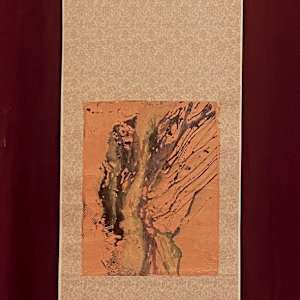
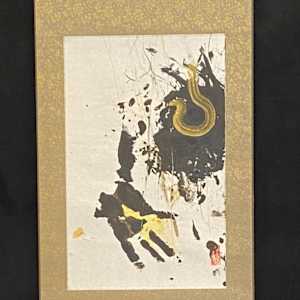
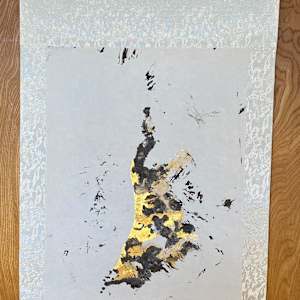
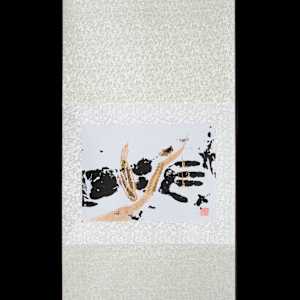
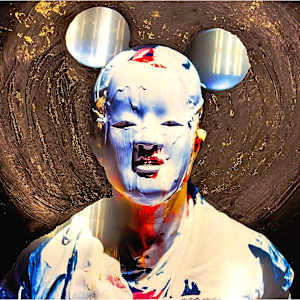
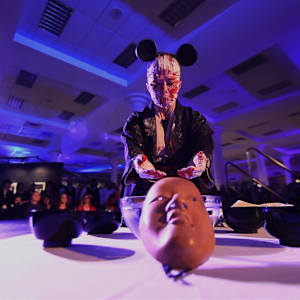
Evoco Project is a multi-stage performance and painting practice ongoing since 2011, rooted in the transmutation of memory.
The process begins with a body. Midori binds a participant in rope — shifting their proprioceptive awareness, their felt sense of body in space — then washes sumi ink over them and presses paper upon the form. Sometimes this occurs within a larger performance; often the participant is simply someone wishing to be documented in the here and now. Chance determines the result: an abstract imprint more truthful to the moment than any photograph, a real mark of a body in time.
Months later, she returns to the imprints and selects one. She sits in deep meditative absorption with it — unmoving, staring — until images surface from that sustained attention. She paints from those visions.
Each scroll is mounted in the tradition of kakemono — the hanging paintings of traditional Japanese homes, intended to reflect seasonality, philosophy, and invite contemplation. It becomes an object of ongoing reflection, holding the gap between moment and recollection. The Evoco Project spans multiple cities; each scroll holds the coordinates of its making.
Gravid - Mothers of Monsters
Gravid: Mothers of Monsters
Ongoing series, 2023–present
Series Overview
Gravid: Mothers of Monsters is an ongoing sculpture series rooted in the physical and creative sensation of gestation — the fullness of an idea not yet nameable, the dark churning of something growing within. “Gravid” means heavy with potential, full to the point of transformation. Done. The line now reads: The word arrived through conversation with a fellow artist as Midori was trying to articulate a sensation she could not yet name: a mass of creative force building inside, profound and not yet speakable. Each work in this series is an answer to that unnamed pressure.
The series draws on mythological figures — specifically, feminine and maternal beings across cultures who have been framed as the origin point of monsters. The artist reclaims these figures not as cautionary tales but as archetypes of fierce generative power. In this body of work, monstrousness is not pathology. It is that which is unknown to the average, that which possesses unusual or excessive power, that which is therefore feared, othered, and mythologized. The “monsters” these mothers birth are not evil — they are enormous, unknown, and transformative.
Each sculpture conceals an object within its body — partially visible, never fully revealed. This interior hiddenness is structural to the work: these pieces are about what is held inside, the power that accumulates before it is shown to the world, the creative potential that exists before it has a name. Materials are consistently reclaimed and repurposed: industrial rope, cast aluminum rings salvaged from a former retail space, fur scraps, and objects with personal or ecological significance. The studio itself is located in the former dressing rooms of a Dress Barn in the Tanforan Shopping Mall, South San Francisco — a space of transformation embedded in the discarded infrastructure of commerce.
Works in the series are named for mythological mothers of monsters, though they are not literal portraits of these figures. Each name is a lens, a provocation, an entry point into the larger question the series asks: what does it mean to be the source of something so powerful it frightens the world?
Works in the Series
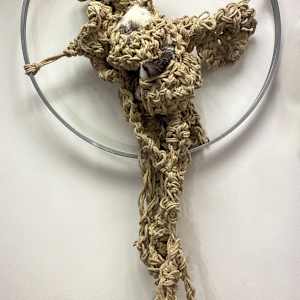
Echidna – Mothers of Monsters
- Medium: Mixed Media — rescued industrial rope, aluminum ring (discarded clothing store display table), fur scraps
- Dimensions: 36 × 36 × 12 in.
- Created: 2023
- Price: $1,500
Named for the Greek mythological figure known as the “Mother of All Monsters,” Echidna reclaims the legacy of a creature long cast in shadow. Half-woman, half-serpent, she embodies a threshold existence — liminal, layered, and powerfully misunderstood. Among her offspring: Cerberus, the Lernaean Hydra, the Chimera. Rather than warning or villain, this work frames her as a generative force of ferocity, care, and deep creative potential.
Constructed from rescued industrial rope, fur scraps, and an aluminum ring repurposed from a discarded retail display table, Echidna is dense with complexity while compact in form. Fur elements nestle within thick, knotted textures — partially hidden, partially revealed — offering both invitation and enigma. The coiled softness and tightly wrought mass evoke gestational potency, concealment, and the primal ambiguity of transformation.
This piece asks viewers to reconsider their own monstrousness as a site of creative force, unsettling beauty, and fierce, embodied wisdom.
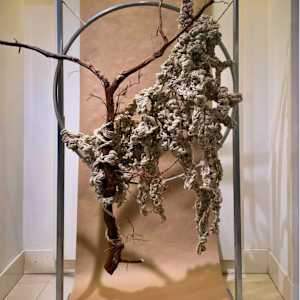
Aglæcwif – Mothers of Monsters
- Medium: Mixed Media — rescued industrial rope, aluminum frame and ring, manzanita root
- Dimensions: 45 × 60 × 12 in. (free-standing)
- Created: 2023
- Price: $5,500
Rooted in the legendary figure of Grendel’s mother from the Old English epic Beowulf, Aglæcwif reimagines this maligned “monster” as a potent symbol of nature and untamed power. Her Old English epithet — aglæcwif — has been translated variously as “wretch” and as “valiant warrior woman,” a scholarly debate that itself reveals the stakes of naming. She is never given a proper name in the text. She is defined entirely by her relationship to her son and to the violence done to him.
Grendel, her son, was a creature of the land, and Beowulf and his warriors were colonizing the territory where Grendel lived. Grendel’s mother fought to avenge his death. This work honors her as a fierce, generative presence connected to the land, vilified through the lens of conquest. She is also called “merewif” in the poem — water woman of the mere. This piece holds both: warrior and wilderness, mother and elemental force.
At the center of the sculpture, a manzanita root — native to California, gifted by Dr. Robert Lawrence — is woven into the rope structure upside down. A tree growing inverted is considered, in many traditions, a thing not of this world, possessed of other powers. The root arrived from a tree felled in a California storm, and carries with it the weight of land, loss, and transformation. It stands here as a monument to the wild and the wrongly named.
Tiamat – Mothers of Monsters
- Medium: Mixed Media — rescued industrial rope, aluminum ring (discarded clothing store display table), fur scraps
- Dimensions: 68 × 36 × 8 in.
- Created: 2023
- Price: $5,500
Inspired by the ancient Mesopotamian primordial goddess of the sea, Tiamat is simultaneously creator and destroyer — or rather, she is creator, and destruction is the name others gave her generative chaos. In the Babylonian epic Enuma Elish, she births the first generation of gods from her union with Absu, the god of groundwater. When her husband is slain, she raises monsters as warriors in his name. She is killed by the storm god Marduk, who then builds the heavens and earth from her body.
She is described in some sources as a peaceful creator; in others, as a monstrous embodiment of primordial chaos. The difference is perspective. She is the same force, seen from different sides of power. The first dragons were hers, their bodies filled with poison instead of blood.
This sculpture holds that duality: the roiling, tidal generativity of a being who contains the world before the world is built. Fur is concealed within the work’s body — soft, warm, hidden — the interior life beneath the surface of a figure history chose to call catastrophic.
Series Note
Gravid: Mothers of Monsters is an ongoing series. Future works will continue to draw on mythological figures from diverse traditions — feminine, maternal, or otherwise generative presences whose power was recast as monstrosity by the cultures that recorded them. The artist welcomes suggestions of figures from underrepresented mythological traditions.
All works in the series share common formal elements: cast aluminum rings salvaged from discarded retail furniture, reclaimed rope, and concealed interior objects — materials that carry histories of use, abandonment, and repurposing. The studio is located in a former Dress Barn dressing room, Tanforan Shopping Mall, South San Francisco.
Series begun 2023. Ongoing.
InVocation
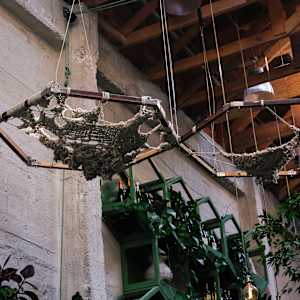
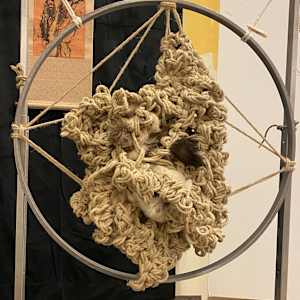
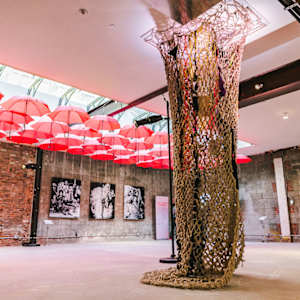
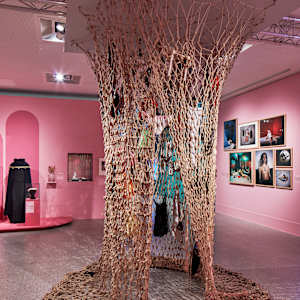
InVocation is an immersive sculptural installation in hand-woven hemp and jute rope. A curtain-like monument, it divides space the way a backstage curtain divides a theater — one world visible, one world just out of reach. Visitors are invited to enter, to touch the rope and the objects woven into it, to smell the hemp and jute, to read the books and personal writings held within. Tactility and scent are not incidental — they are central to the work.
Woven throughout the rope are personal objects donated by current and former sex workers — everyday, intimate things that accompanied real people through their working lives, sent specifically to be held inside this piece. They are not props or symbols chosen by the artist. They are memory made material.
The rope moves between worlds: the same material used in theater rigging and in Shibari, the Japanese erotic pleasure craft at the center of Midori's decades of teaching and writing. That convergence is intentional — blurring the boundary between sacred and profane, labor and ritual, the seen and the hidden.
InVocation draws on Japanese memorial ceremonies in which worn tools — broken needles, spent combs — are honored and released rather than discarded. Here, the donated objects have been similarly retired: released by the people who carried them, woven into a collective monument, transformed into what the artist calls a moment of labor. Part shrine, part dressing room, part invocation — the work is a call to witness histories too often hidden, dismissed, or erased.
InVocation: North America Originally commissioned by the Leslie Lohman Museum of Art, New York, in 2018, the American iteration of InVocation carries objects contributed by sex workers in the United States and United Kingdom. Its exhibitions have included the Leslie Lohman Museum of Art (New York), the Sex Workers' Pop-Up in conjunction with the UN Commission on the Status of Women (New York, 2020), Root Division (San Francisco), and the Handwerker Gallery (Ithaca, New York).
InVocation: Europe In 2025, the Bundeskunsthalle Bonn commissioned a new and distinct European iteration of InVocation, incorporating objects contributed specifically by sex workers across Europe. Presented as part of Sex Work — A Cultural History, this version marks the work's first major European museum presentation and its first body of European contributors — a new chapter in an evolving collective memorial.
Placemat: Where is Sam Wo?
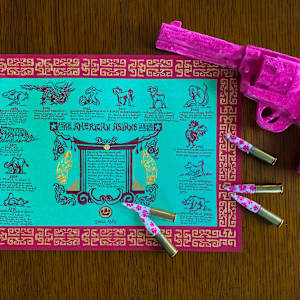
Placemat: Where is Sam Wo? Mixed media collection, 2022
- Original Installation Mixed media: gouache and gold leaf on paper, flocked revolver, acrylic-tipped bullets 14 × 18 × 2 in (35.56 × 45.72 × 5.08 cm) Unique work, 2022 $2,500
- Archival Limited Edition Giclée print on archival paper, presented unframed in archival backing and archival sleeve 12.5 × 18 in Edition of 25, signed and numbered $250
- Usable Edition Commercial inkjet print on uncoated stock 11 × 17 in Open edition $5
======
Artist Statement
Artist Statement
Using gouache and gold leaf, this work reimagines the paper placemats once ubiquitous in Chinese American restaurants designed for white diners. In place of zodiac animals: anti-Asian and broader discriminatory legislation spanning 1882 to 2017. In place of personality traits: slurs and hate speech collected through a public social media call, a flood of lived experience and accumulated fury. At the center, the U.S. government's official definition of "Asian."
Resting on the placemat is a Colt "Peacemaker" revolver, flocked in glittery Hello Kitty pink. Five bullets lie nearby, their rounds tipped with hand-painted acrylic nails.
The work reclaims and subverts the Kung Fu and Samurai films I grew up loving—those same films where white saviors vanquished the sinister Chinese restaurant opium den, or humbly received wisdom from the secret-ninja-sushi-master, always accompanied by the sultry Asian femme. These narratives shaped how others saw us, and how we learned to see ourselves. The pink velvet gun is campy, feminine, and unambiguous: this time, we're the hero.
When I immigrated from Japan to rural Washington in 1979, the only culturally proximate food was the Golden Wheel Chinese Buffet—neon sauces, thickly breaded meats, pupu platters. Not Chinese food, not really. But it had soy sauce, so we made do. I remember studying those placemats, which purported to teach white diners about "the Orient." To access anything resembling home, I had to absorb this exoticized reflection of my own culture.
Power—its presence, its absence, its negotiation—structures everything. As an Asian American queer femme immigrant, I move through these dynamics daily. Anti-Asian violence and discrimination have always existed; the current moment makes them harder to ignore. The well-intentioned slogan Stop Anti-Asian Hate still reads to me as rooted in respectability politics—a plea for permission. This work refuses that posture.
P.S. If you're an old-school San Franciscan, you'll recognize the title. Consider it a love note.