Collection: Dining Room
DINING ROOM
Installation with social practice component of community engagement and participation
Description of Work
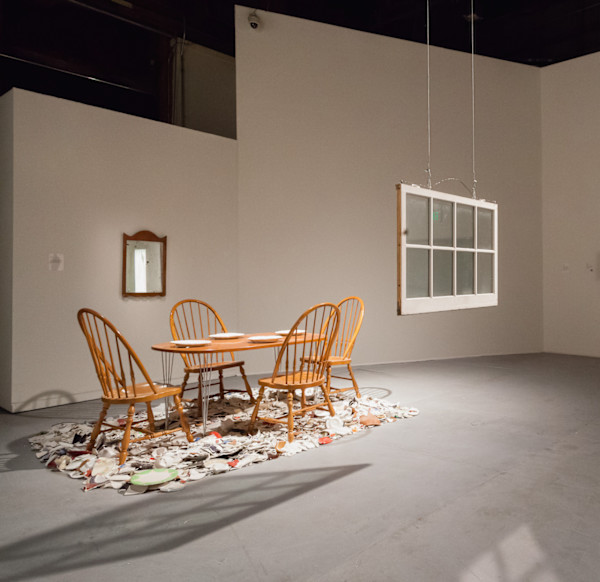
Viewed from a distance, Dining Room is pleasant and unremarkable — a diorama of domesticity. A window hangs in midair. Beyond it: a dining table set for four, white plates, four chairs. A vintage mirror faces the viewer, placing her inside the scene.
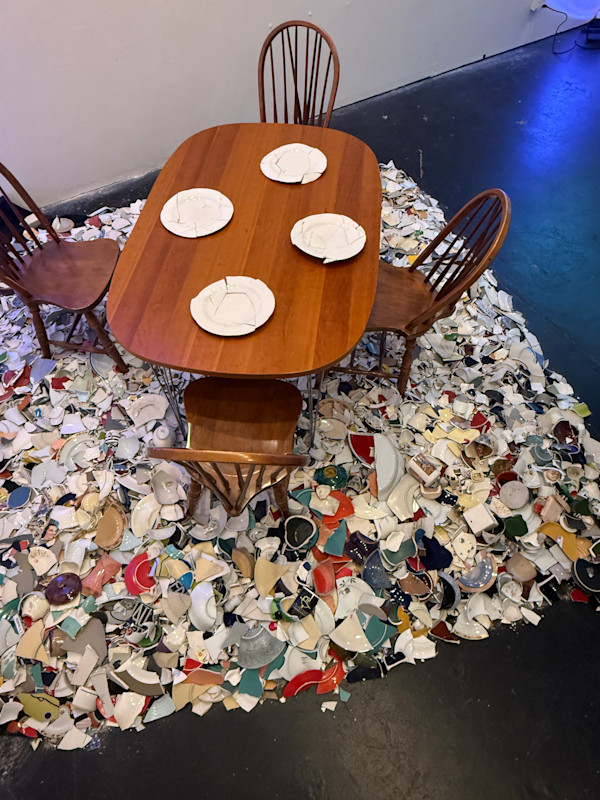
On closer approach, the plates reveal themselves: broken long ago and glued back together, carefully and imperfectly. Once broken, never made whole again. Below the table, what appears to be a deep shag rug is, in fact, shattered crockery piled ankle-deep.
The installation is completed through a facilitated public event called the Shatter Party, held the night before each installation. Attendees — wearing safety masks — break ceramic dishes one by one into a pit, as many times as they wish. They may bring their own dishes. The fragments collected from this event become the material from which the final work is constructed. On one occasion, a participant arrived with her mother's wedding china from a disastrous first marriage; she said she found relief in unloading the bad memory, and in transforming wreckage into truthful art.
Each iteration of Dining Room is co-created with the public — shaped by the action, energy, grief, and emotion participants bring to the moment. The Shatter Party reliably produces an unexpected social effect: attendees leave exhilarated and begin to speak freely with friends and strangers. At the installation itself, visitors frequently share unsolicited, deeply personal stories about their families of origin.
The work addresses intergenerational and cultural trauma, the burden of domestic silence, and the possibility — imperfect and visible — of repair. The broken-and-reglued plates are not restored; they are evidence. The rug of shards is not decorative; it is accumulation.
When the installation closes, the ceramic fragments are donated to local artists, designers, and landscapers for reuse — extending the material life of the work beyond the gallery and keeping it out of landfill. Destruction becomes creation. The cycle continues.
Dining Room is a living archaeological site. Each presentation builds on the emotional residue of the last.
Exhibition History
2011 — Building Our Own Picket Fences: Queer Community Arts Project, Michelle O'Connor Gallery / Femina Potens, San Francisco, CA
2013 — All Good Things…, SoMArts Cultural Center, San Francisco, CA
2016 — MFA Never, Root Division, San Francisco, CA
2025 — 465 Collective Residency, 465 Collective, San Francisco, CA
2025 Iteration: 465 Collective
The 2025 residency at 465 Collective marked the most expansive realization of Dining Room to date, expanding from a single sculptural focal point into a total domestic environment occupying the full two-room gallery.
The natural division of the space suggested its own spatial logic: front room as living room, back room as the installation proper. The front was furnished with sofas and activated through a rotating series of domestic social experiences — a yard sale, a fiber craft and coffee gathering, holiday portrait sessions — collapsing the boundary between art space and lived domestic life.
A Family Portrait wall ran floor to ceiling, dense with frames in the manner of old portrait galleries. The wall reflects the artist's long fascination with the family photographs found in so many homes — full of smiles both genuine and performative, testifying to what families choose to show and what they agree not to say. The frames contained works by queer and BIPOC artist colleagues, the artist's own interpretations of family, and mirrored mylar panels — placing viewers inside the frames alongside distorted reflections of themselves, implicated in the very dynamic the work examines.
Elsewhere in the gallery, a tree was woven and tangled with rope, threading the organic into the constructed domestic space.
~ Artist's Note ~
After the first Shatter Party, the artist and both facilitating volunteers independently woke the following day feeling drained, sad, and depleted — as if hit by a truck, without chemical cause. They had absorbed the collective emotional outpouring of the participants. In subsequent iterations, facilitators are briefed on what to expect and how to prepare for self-care and reorientation afterward.
Installation with social practice component of community engagement and participation
Description of Work
Viewed from a distance, Dining Room is pleasant and unremarkable — a diorama of domesticity. A window hangs in midair. Beyond it: a dining table set for four, white plates, four chairs. A vintage mirror faces the viewer, placing her inside the scene.
On closer approach, the plates reveal themselves: broken long ago and glued back together, carefully and imperfectly. Once broken, never made whole again. Below the table, what appears to be a deep shag rug is, in fact, shattered crockery piled ankle-deep.
The installation is completed through a facilitated public event called the Shatter Party, held the night before each installation. Attendees — wearing safety masks — break ceramic dishes one by one into a pit, as many times as they wish. They may bring their own dishes. The fragments collected from this event become the material from which the final work is constructed. On one occasion, a participant arrived with her mother's wedding china from a disastrous first marriage; she said she found relief in unloading the bad memory, and in transforming wreckage into truthful art.
Each iteration of Dining Room is co-created with the public — shaped by the action, energy, grief, and emotion participants bring to the moment. The Shatter Party reliably produces an unexpected social effect: attendees leave exhilarated and begin to speak freely with friends and strangers. At the installation itself, visitors frequently share unsolicited, deeply personal stories about their families of origin.
The work addresses intergenerational and cultural trauma, the burden of domestic silence, and the possibility — imperfect and visible — of repair. The broken-and-reglued plates are not restored; they are evidence. The rug of shards is not decorative; it is accumulation.
When the installation closes, the ceramic fragments are donated to local artists, designers, and landscapers for reuse — extending the material life of the work beyond the gallery and keeping it out of landfill. Destruction becomes creation. The cycle continues.
Dining Room is a living archaeological site. Each presentation builds on the emotional residue of the last.
Exhibition History
2011 — Building Our Own Picket Fences: Queer Community Arts Project, Michelle O'Connor Gallery / Femina Potens, San Francisco, CA
2013 — All Good Things…, SoMArts Cultural Center, San Francisco, CA
2016 — MFA Never, Root Division, San Francisco, CA
2025 — 465 Collective Residency, 465 Collective, San Francisco, CA
2025 Iteration: 465 Collective
The 2025 residency at 465 Collective marked the most expansive realization of Dining Room to date, expanding from a single sculptural focal point into a total domestic environment occupying the full two-room gallery.
The natural division of the space suggested its own spatial logic: front room as living room, back room as the installation proper. The front was furnished with sofas and activated through a rotating series of domestic social experiences — a yard sale, a fiber craft and coffee gathering, holiday portrait sessions — collapsing the boundary between art space and lived domestic life.
A Family Portrait wall ran floor to ceiling, dense with frames in the manner of old portrait galleries. The wall reflects the artist's long fascination with the family photographs found in so many homes — full of smiles both genuine and performative, testifying to what families choose to show and what they agree not to say. The frames contained works by queer and BIPOC artist colleagues, the artist's own interpretations of family, and mirrored mylar panels — placing viewers inside the frames alongside distorted reflections of themselves, implicated in the very dynamic the work examines.
Elsewhere in the gallery, a tree was woven and tangled with rope, threading the organic into the constructed domestic space.
~ Artist's Note ~
After the first Shatter Party, the artist and both facilitating volunteers independently woke the following day feeling drained, sad, and depleted — as if hit by a truck, without chemical cause. They had absorbed the collective emotional outpouring of the participants. In subsequent iterations, facilitators are briefed on what to expect and how to prepare for self-care and reorientation afterward.