
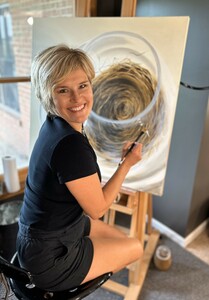
Lindsey Kiser
Union, KY
Lindsey Kiser is an American artist, whose studio is located in her home in Union, Kentucky, which is within the Greater Cincinnati Metropolitan Area.
Message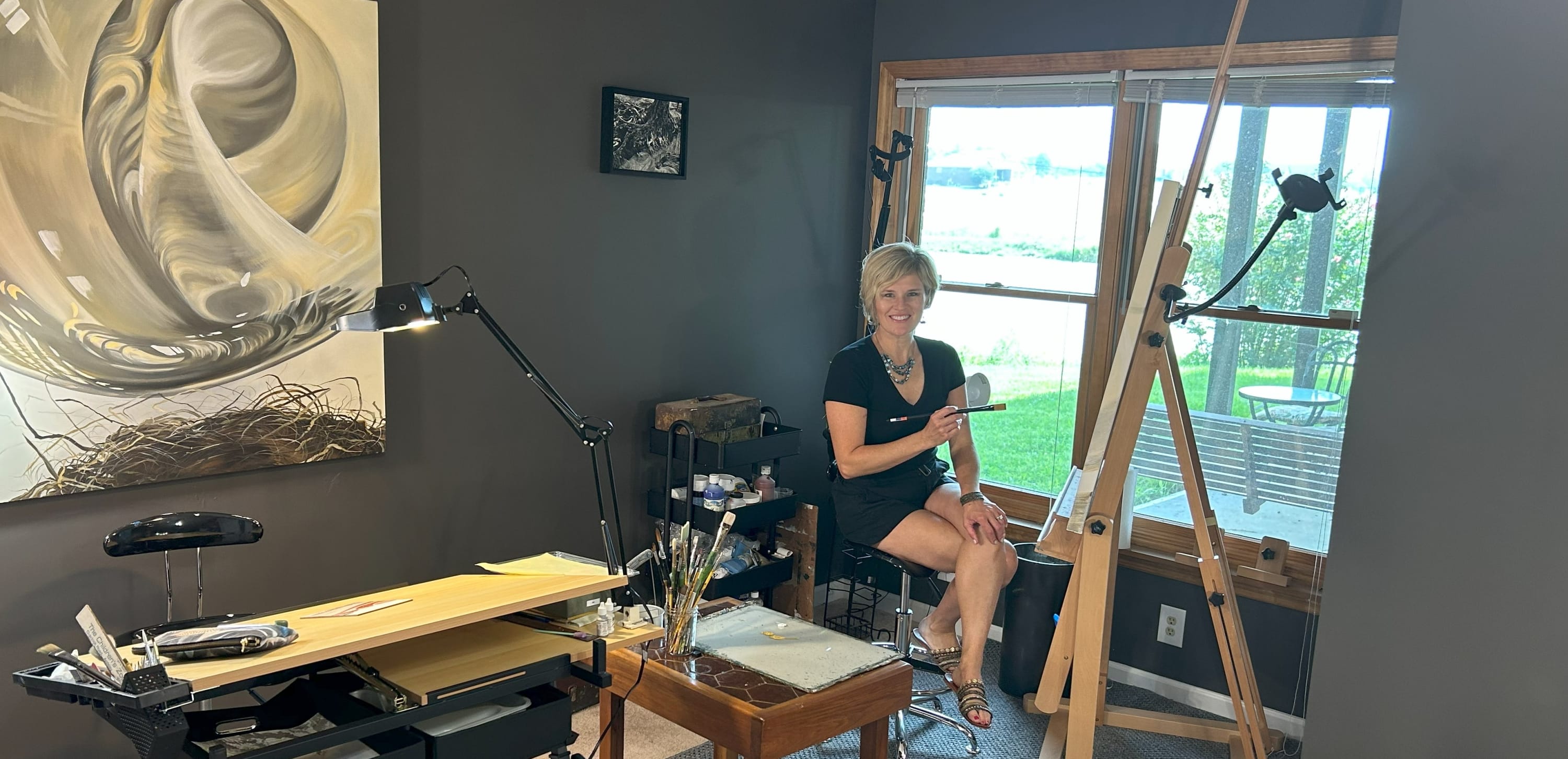
Lindsey Kiser is an American artist, whose studio is located in her home in Union, Kentucky, which is within the Greater Cincinnati Metropolitan Area.
The lines and unusual forms in native plants and pollinators (birds, bees, and butterflies) observed on her family farm and while traveling inspire her to create paintings, scratchboards, and mixed media on panel.
The artist may be commissioned for any size site-specific installation for institutional or commercial interiors, because she works on panels that may be installed in a mosaic format in large spaces, such as a lobby. Having experience in many styles and materials, Lindsey enjoys collaborating with organizations to make their specific visual goals into a reality. She develops her surfaces by applying a concoction of earth-based pigments and inks. The finished result, often includes the removal of portions of the prepared surface with various blades and needles to expose the white clay surface beneath to achieve a balanced array of graduations of textures and forms. Her selective and refined use of gold leaf, which is enduring and catches light, is purposeful in its contrast with the organic layers of powdered charcoal, ink, and soft white clay.
Over the last six years, Lindsey has had solo art exhibitions across Kentucky in an art museum, a performing arts center, a university art gallery, libraries, a non-profit center, and a medical spa. She has won international art awards and exhibited in juried group shows from New York to Laguna Beach, California to Rhode Island.
In May 2022, ComposeArts honored Lindsey Kiser as the organization’s inaugural Featured Visual Artist. In 2016, the governor of Kentucky appointed Lindsey to serve on the board of the Kentucky Arts Council on which she served until November 2022.
Currently, the artist's work may be found at ADC Fine Art in Ft. Thomas, Kentucky; the permanent collection of US Bank in Bowling Green, Kentucky; and Jackie Barnes’s Interior Design Studio in Cincinnati, Ohio.
Kiser earned her undergraduate degree in fine art with minors in biology and chemistry from Georgetown College. She studied 19th Century British art history under the late Ilaria Bignamini, a curator for the Tate, and drawing at the Ruskin School of Drawing and Fine Art at the University of Oxford in Oxford, England. Buying into the myth of the starving artist, Lindsey earned her juris doctor (J.D.) at night from Salmon P. Chase College of Law at Northern Kentucky University, while, ironically, supporting herself by painting murals by day.
Statement
Living just down the road from Big Bone Lick Historic Site, the source of the fossils that inspired President Thomas Jefferson to send Lewis and Clark on their great expedition that opened the west, has had a profound impact on Lindsey Kiser's worldview. At an early age Lindsey began to study the life of Thomas Jefferson, who was a classicist and a Renaissance Man. She heralded him a hero of thought, culture, and history. His example showed her that one does not have to choose one path in life. Instead, curiosity can lead the way to build a beautiful, inspired life.
Like Jefferson, Lindsey draws inspiration from found natural objects (nature's "readymades"), such as fossils, birds’ nests, and acorns. Instead of sending out scientists and adventurers on a quest across the continental divide to bring back evidence of mastodons, Lindsey cradles her found natural objects in man-made, highly reflective goblets and vases, photographs her compositions hundreds of times, paints from the photographs, and then exhibits each new series of artwork for you to acquire and treasure. The beautiful man-made vessel is one of her regular motifs in order to elevate the common, everyday "readymade" natural object and to visually contrast the geometric, man-made object with the organic forms of the found natural object. The reflections shown on the exterior of the vessel prove that we cannot view and connect with any readymade found natural object as it really is once we have placed it within the context of our human condition, because the reflection of ourselves in our current place and time obscures our field of view.