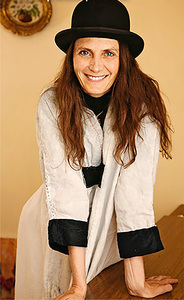
Kiki Klimt
Brusnice
I am always looking for changes and little things, because changes are the source of life and the beauty is hidden in details.
MessageGreat white roses
The Great White Roses series of paintings is dedicated to the authentic Slovenian rose ”Snežniška gartroža.” They were made for the event on Castle Snežnik in collaboration with the National Museum of Slovenia. The paintings are made in the advanced Leonardo da Vinci sfumato technique. The number of layers and the composition geometry are determined by ancient knowledge of the structure of the material world.


Visual Analysis of the Myth of Psyche and Eros through Hegelian Dialectics
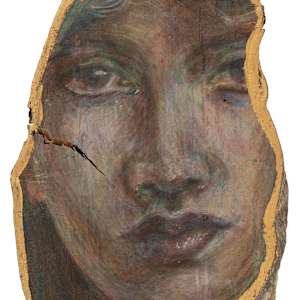
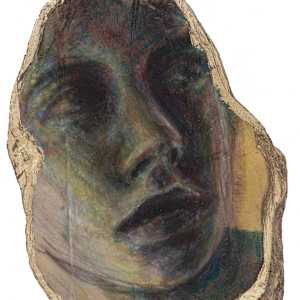
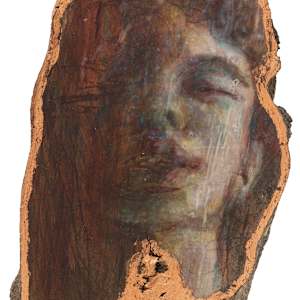
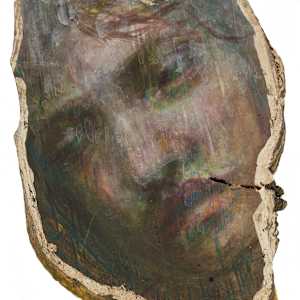
This is a holistic, conceptual, and methodologically original research project — one in which I treat myth not as a decorative motif or narrative illustration, but as a living, complex field where philosophy, psychoanalysis, mythology, feminism, and the theory of visual language intertwine and challenge one another. To navigate this complexity, I drew on the Hegelian triad of thesis, antithesis, and synthesis. In this structure, the thesis presents an idea, the antithesis challenges or contradicts it, and the synthesis resolves the tension into something new — a higher understanding that contains both. Applied to the myth of Psyche and Eros, this allowed me to gradually unfold both the content and the form, and to explore the dynamic tension between the ancient and the contemporary, the personal and the universal.
The project comprises 108 paintings on wood, three books explaining the creative process, and an extensive corpus of sketches that address the viewer on multiple levels – from intuitive to intellectual.
The project began during an artist residency in Kefalonia — a place of extraordinary light and ancient myth, where something in me opened. There, I began to develop a reinterpretation of the female archetype in a contemporary context. But the work quickly became something more personal and more demanding: a dialogue with my own experiences, my own wounds and inheritances. This led to important substantive shifts, including a deep reckoning with historical gender roles and the stories women have been told about themselves. The end result is not a linear narrative but a complex visual synthesis — one that does not offer resolution, but opens space for reflection on women's identity, imperfection, and position in contemporary society. It is, in many ways, the most honest work I have ever made.
The project comprises 108 paintings on wood, three books explaining the creative process, and an extensive corpus of sketches that address the viewer on multiple levels – from intuitive to intellectual.
The project began during an artist residency in Kefalonia — a place of extraordinary light and ancient myth, where something in me opened. There, I began to develop a reinterpretation of the female archetype in a contemporary context. But the work quickly became something more personal and more demanding: a dialogue with my own experiences, my own wounds and inheritances. This led to important substantive shifts, including a deep reckoning with historical gender roles and the stories women have been told about themselves. The end result is not a linear narrative but a complex visual synthesis — one that does not offer resolution, but opens space for reflection on women's identity, imperfection, and position in contemporary society. It is, in many ways, the most honest work I have ever made.