
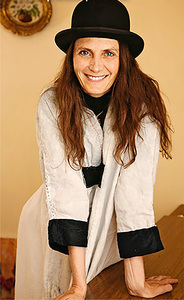
Kiki Klimt
Brusnice
I am always looking for changes and little things, because changes are the source of life and the beauty is hidden in details.
Message
Kiki Klimt, a freelance artist and professor at Arthouse Ljubljana, was born in 1971 in Bačka Palanka (Serbia). She began her education at the Academy of Fine Arts in Ljubljana, graduating in painting in 1998 and completing her master's degree in sculpture in 2000. Following her studies, she embarked on her career as a freelance artist, working across various media, and as a professor at the Faculties in Slovenia, Sofija, Zagreb, and Istanbul. Over the years, her work has been exhibited in cities including Ljubljana, Zagreb, Berlin, and New York. She is currently based in Novo mesto (Slovenia), where she is active and creative as an artist, a professor and pro-dean at Arthouse Slovenia, the president of the local art society, and a PhD student in philosophy at the Faculty of Arts in Ljubljana.
Statement
My artistic practice centres on three elements: content, form, and technique. Through them, I explore the boundaries of artistic language and through them, my own relationships with everything in this world; as a woman, artist, and researcher. In my art and in my life I focus on overlooked details that carry meaning. My art is a conversation with the world, revealing the enduring beauty of nature amid perceptions of decline.
For me, artistic language holds the same weight and complexity as any other language — it has its own vocabulary, grammar, and logic; its own ways of being spoken and heard. The difference is that it speaks directly to the senses before it reaches the mind. Within it, I can express what words alone cannot reach: grief that has no name, joy too fragile to pin down, longing that outlasts its object. I can be precise, nuanced, even contradictory — just as one can speak clearly only when one has first learned to think clearly, as Ludwig Wittgenstein once wrote.
I have always been fascinated by technique—not as a means to an end, but as inquiry itself. This led me to invent my own method, which I call “painting with light.” It is rooted in sfumato, a Renaissance technique of soft, invisible transitions between tones. It requires tens to hundreds of transparent paint layers, with each one affecting the layer below. I spent seven years developing and refining this process. The result is surprising: paint behaves like light. For example, when I apply yellow over blue, I get white, not green. Pigment absorbs and mixes, but light adds. The rules of pigment do not apply. Something more like luminosity takes over.