
Julie Peterson Shea
Phillipsburg, KS
Julie Peterson Shea is an artist working predominantly in black and white who explores expressing ideas through images.
Message
Travel has a way of layering the unexpected — a face encountered in one city, a symbol discovered in another, a meaning assembled only in retrospect.
Devotion is that kind of layering made visible.
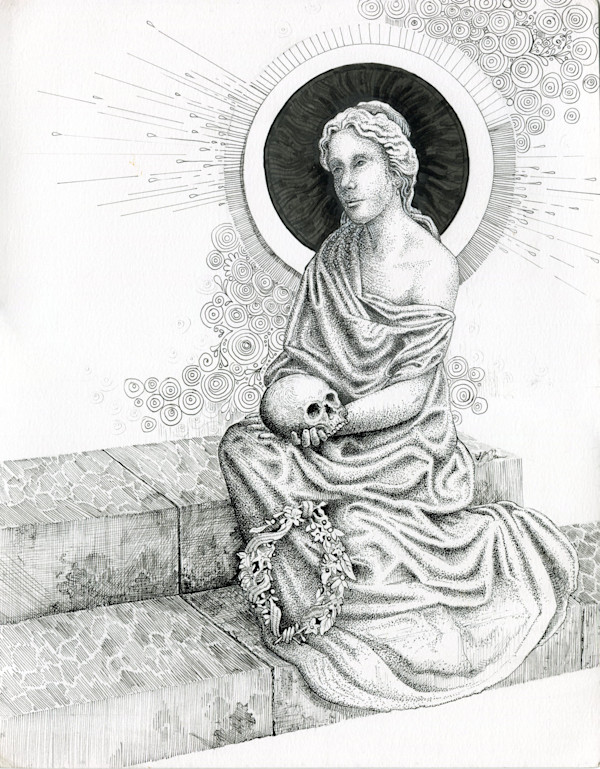
Rendered in pen and ink the subject is a woman drawn from the plaster casts housed in Florence's Galleria dell'Accademia — figures originally crafted not as finished works of art, but as teaching tools, humble and purposeful, ghosts of Renaissance sculpture preserved in white. There is something quietly powerful about them: art made to serve learning, stripped of grandeur, yet no less beautiful for it.
Her upper torso and face emerge from the composition with the stillness of devotion itself. From her head radiate bold rays of light, and a arc of graphic circles frames one side of her face — halos reimagined, geometry standing in for the sacred, the divine rendered as pattern rather than gold leaf.
Before her: thistles and skulls. The thistles drawn from the rich language of Victorian flower symbolism — representing resilience, pain borne with dignity, the beauty that survives hardship. The skulls echo the profound and humbling art of Rome's Capuchin Crypt, where mortality is not hidden but displayed, not feared but honored, woven into devotion as naturally as prayer.
Together, these elements ask the same quiet question that sacred art has always asked — what do we venerate, what do we endure, and what, in the end, do we leave behind?
- Subject Matter: Female sculpture, Skulls