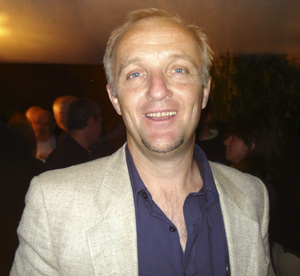
Ignacio Klindworth

BMM Serie Biológicas Micro Mundos

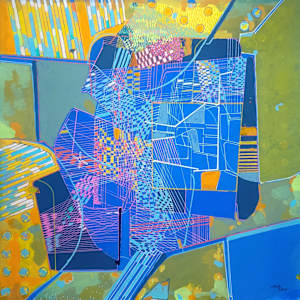
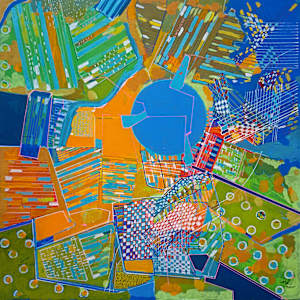
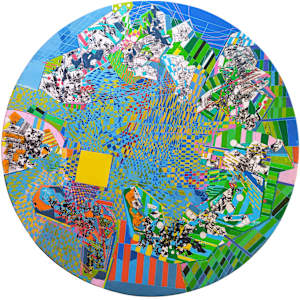
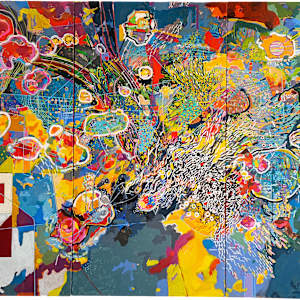
BMM Series 2023/1 Biological Series Micro-worlds. Triptych. 
Mixed media on board. 116X180cm
Three bodies. Birth. Life. Death. Three processes in constant interaction.

Biology and architecture. Philosophy of biology. Visible and invisible micro-worlds. Intuited micro-worlds. Expansion of meanings. New biological identities. New territories of exploration for artists.
The human being as a model that interacts between several simultaneous worlds. The human being as an ecosystem.

What would happen if we could navigate the micro-worlds that surround us and are invisible to the naked eye? What conceptual problems would arise for the artist if he were involved in an immersive experience like this?
Are there links between biological and cultural evolution?
If nature is visible, manipulable, and developable, can nature that is not visible also be so?

Three stages, three processes, three states: birth, life, and death. Closed or open biological cycles in a permanent process. Survival, colonization, and hosts that form collective identities. Living beings that accompany you or that you accompany. Living beings that shape your identity. Intelligence.

The emergence of a new world brings with it new concepts, ideas, and processes. Something new opens up uncharted territory. This is usually a process of colonization. Later, we come to understand the countless processes in which survival as a species is always present. 

The new frontiers of art are expanding into parallel worlds that are not visible. 
And yet, we need to see in order to compose.


BMM 1/2023 Serie Biológicas Micro Mundos by Ignacio Klindworth

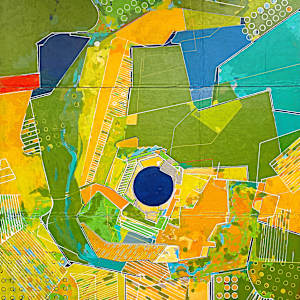
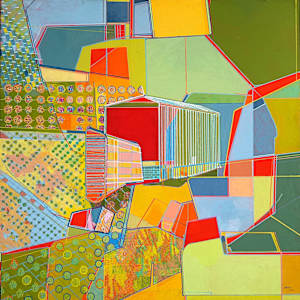
SAT Serie Agricultura y Tecnología 2025

Serie Agricultura y Tecnología, SAT 2025
An aerial view on landscape, urbanism and technology applied to agriculture

The Agriculture and Technology Series, SAT 2025, is a research project in which I combine different layers of meaning with a pictorial language.

The main objective of the project is the construction of an aerial view that allows the viewer to discover these layers of meaning. A secondary goal and one of those layers is the rapid transformation that the Spanish countryside has undergone in recent years.

The floods due to a cut-off low —or DANA—, that occurred in 2024 in Spain —especially in the Valencian Community—, the energy crisis, the recurrent droughts, and the import of agricultural products from countries with few phytosanitary controls, reinforce the need for Spain, a country with a strong agricultural sector, to design a balanced technological transformation of the countryside. Turning Spain into a huge alternative energy industrial area would drastically limit our potential and our independence.

An intelligent approach to agriculture, in which technological advances would be very present, would reduce our dependence on energy and water. It is essential to develop an urban planning model with future capacity, in which, among other things, agriculture and urban areas could be integrated.

With this new series, I am looking for a visual representation of these approaches, in which non-invasive aesthetics would also play an important role.

Painting a picture is a metaphorical activity. My main tool is drawing and the main element of a drawing is the line. Drawing is the link that can give form to what is in itself diffuse or intangible: ideas and metaphors. Color is also drawing. When I draw, metaphors and their many meanings take shape and become real.

I allow myself to create new and different models of urbanism, agriculture and technology, both of landscape and construction. New grids that organize spaces, balance contrasts and lay the foundation for new perceptions. Contact with these planes of color and form influences the conceptual search for a different, more airy and balanced space in which to live and work.

The aerial view does not only involve the observation of the surface of landscapes seen from above. It also involves getting the sense of the plates, the structures and the forces that shape the skin of landscape. In general, when we contemplate a landscape, what we see is the result of the forces in tension of the structures that make up the crust of earth.

Only art —whether it wants to or not— is capable of making these territories or their contemplation self-organized, that is, of restoring their spiritual value.

Ignacio Klindworth 2025

Series Ciudades/Cities

Ciudades/Cities Research and creative processes on memory and creativity. 
Painting without direct observation. Memory as a creative process that allows the visual recreation of the constructed. 

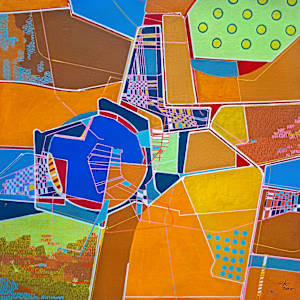
The series Ciudades could well be a set of postcards. There are cities in which I have lived for a long time. Others I have only been there for a season. It is inevitable that when I live in them, when I pass through them or when I return, my senses accumulate data. This data may be cartographic data. 
However, they are also data related to orientation and emotion. All of this data is eventually converted into images. 
The retrieval of this data requires the use of memory. Memory is not simply an accumulation of data that is labelled and organised according to acquired or inherited patterns. I believe that memory, like any other aspect of the human being, is extremely complex. At the same time, it has a clear utilitarian aspect and therefore possesses a complete beauty. The process of creating a memory is a creative, organic and composite one that requires several simultaneous systems of thought. In order to compose a memory, it is necessary to properly dose these three ways of thinking or processing in order to create something tangible, useful and coherent, or what is the same, beautiful. 
My cities are the result of these creative processes that make up the memory. 
The Ciudades series comprises two-dimensional compositions that aspire to be spherical. The compositions are two-dimensional and flat, and they are generated by forms, models, patterns, and human and technological processes. These processes result in an architectural warp. 

A number of my pictorial approaches can be attributed to two key influences: 
• firstly, a visit to the Prado museum, where I encountered the remarkable work of the Flemish master, Joachim Patinir. His exceptional atmospheric perspectives left a profound impact on me. Patinir's compositions bring the viewer close to a foreground, which is in turn connected to a relationship of secondary planes. This relationship ultimately leads back to the foreground, creating a circular path that returns the viewer to the beginning of the work. 
• During a stay in Australia, I was intrigued by the hallucinatory works of pure aerial abstraction created by the painter Daniel Walbidi and by the similarly aerial works of the painter Dorothy Napangardi, which resemble the seams that form a Zen kesa. 
The Ciudades/Cities series is open in time and depends on the new environments it maps. 
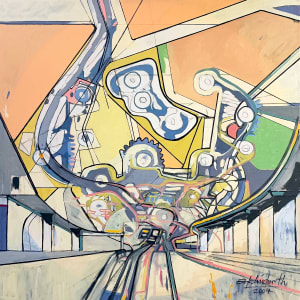
Badajoz by Ignacio Klindworth
Madrid entrada Sur by Ignacio Klindworth

Series Landscapes from my studio

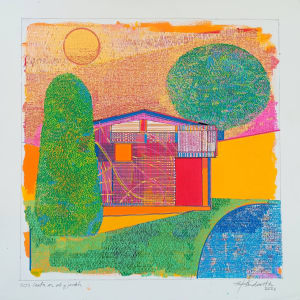
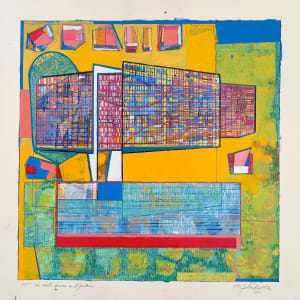
The series Landscapes from my studio presents a visual and pictorial key to the processes that organize the vision and contemplation of surrounding landscapes, both internal and external. As I contemplate these landscapes, I trace maps, while I search for and build lines of composition, rhythm, and time. 
This process allows me to identify the form, its structure, and the relationship of both to the performing subject. I view the landscape as an exterior scenery that develops the mapping and settling of emotions. 
The measurement of the current world is closely linked to my pictorial work. Painting is my cartographic tool. I believe that the structure of landscapes is formed by modeling networks and connections, structures and sequences of time. 
When I die, landscapes disappear. The world disappears. All this brings so much information and uncertainty that it is necessary for the eyes to know how to touch and the fingers to know how to see. 
The series Landscapes from my studio is a series projected along an extensive timeline. 
The scenographies change, as do the workshops and workplaces, the countries and places of residence, and personal relationships. The different layers that shape identity, or the emergence of new identities, influence the composition and execution of the works. The voice and colors may also change.

Series MOP Models Thought Organizer 2021

Series MOP Models Thought Organizer 2021 40x40cm Acrylic gouache and acrylic ink on patterned cloth mounted on wooden board 
Creative processes and the creation of thought-organizing models. Decoding thought-organizing models. 
This work is part of a series of 10 pieces I have titled MOP Organizing Models of Thought. 
The theory of Thought Organizing Models studies the functioning of the human psyche from a perspective that simultaneously encompasses cognitive, emotional, and social aspects. 
I have used a pattern of upholstery fabric onto which I have applied new graphics and color compositions. By intervening in something that has already been elaborated by others, I can develop two constructive ways of thinking, adding my own to the one already elaborated.