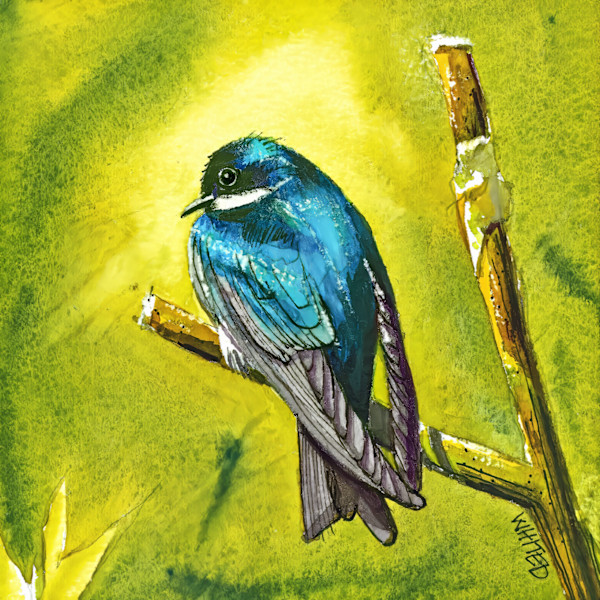


The Tree Swallow (*Tachycineta bicolor*) is a sleek, agile, and highly familiar swallow of North America, breeding across a vast range from Alaska and Canada south through much of the United States and wintering along the southern coastal United States, Central America, and the Caribbean. Adults are strikingly handsome birds, with males displaying brilliant iridescent blue-green upperparts that can shift in hue from deep teal to vivid turquoise depending on the angle of light, contrasting sharply with their clean, bright white underparts and slightly notched tail — females are similar but duller, with browner tones that especially affect younger birds, which can take a couple of years to attain full adult plumage. They are aerial insectivores of remarkable skill, spending much of their time on the wing in swift, graceful, swooping flight, capturing small flying insects with precision, though they are notably more flexible in their diet than most swallows and will readily eat berries — particularly bayberries and wax myrtles — during cold snaps when insects are unavailable, a trait that allows them to winter farther north than other swallow species. Tree Swallows are cavity nesters, relying on old woodpecker holes in dead trees or readily accepting nest boxes, which has made them a favorite subject of long-term scientific study and a beneficiary of nest box programs across North America. They are highly gregarious outside of the breeding season, forming enormous migratory and wintering flocks that can number in the hundreds of thousands, creating spectacular aerial murmurations over marshes at dusk. Common, widespread, and adaptable, the Tree Swallow is considered a species of least concern and a beloved harbinger of spring across much of the continent.
- Subject Matter: Wildlife, birds
- Collections: Birds, Digital photography , Mixed Media , Wildlife