
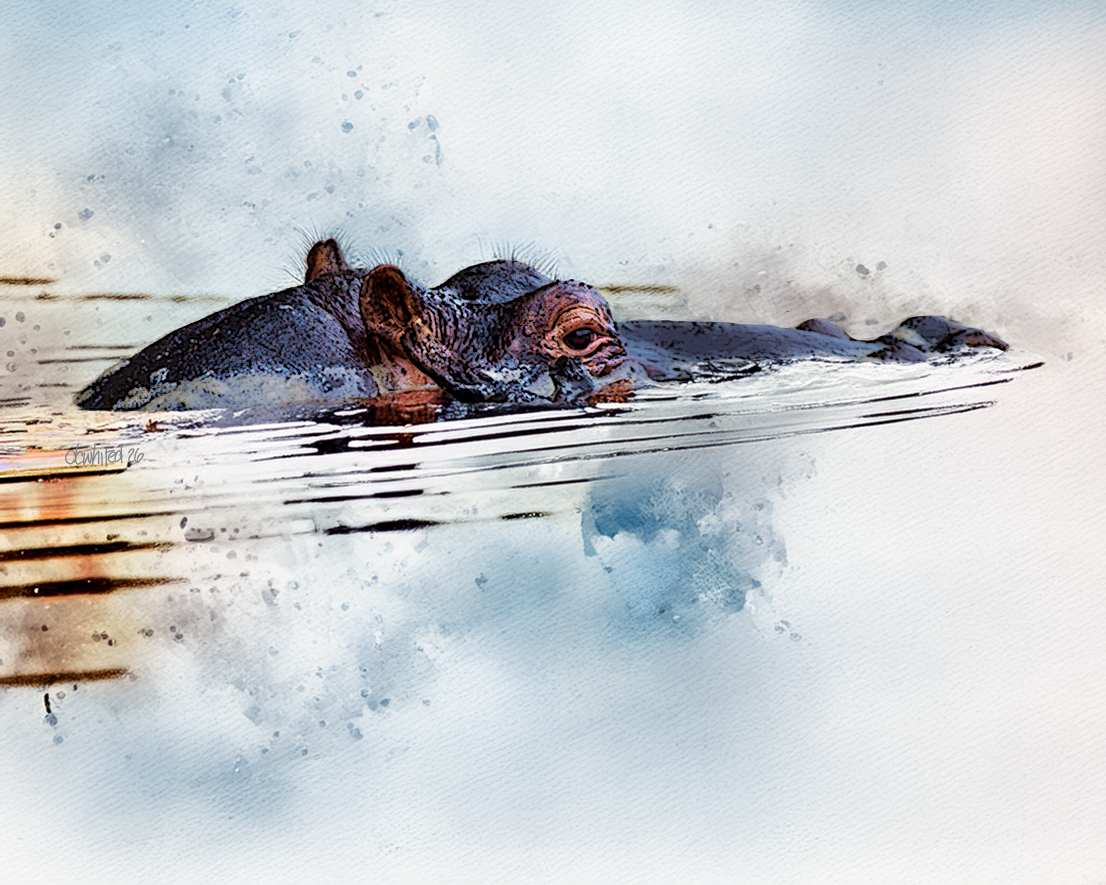
The Hippopotamus (*Hippopotamus amphibius*) is one of the largest and most formidable land animals on Earth, a massive, barrel-bodied megafaunal giant native to sub-Saharan Africa that despite its lumbering, almost comically rotund appearance is widely regarded by wildlife experts as one of the most dangerous and unpredictable animals on the continent, responsible for a significant number of human fatalities each year. Adult males, called bulls, are enormous animals typically weighing between 3,000 and 4,000 pounds — though exceptional individuals can exceed 7,000 pounds — with stocky, pillar-like legs supporting a vast, nearly hairless body of dark greyish-brown to purplish skin that can measure up to 16 feet in length, and their most formidable feature is a cavernous, pink-lined mouth that can gape to an angle of nearly 180 degrees to reveal massive, self-sharpening canine tusks that can exceed 20 inches in length in dominant bulls, weapons capable of bisecting a crocodile or capsizing a small boat with a single lunge. Despite their almost wholly herbivorous diet — emerging from the water at dusk to graze on grasses for several hours each night and consuming up to 80 pounds of vegetation in a single nocturnal feeding session — hippos are fiercely territorial and extraordinarily aggressive, particularly bulls defending their stretch of river and females protecting their calves, and their deceptively fast charge, which can reach speeds of up to 19 miles per hour on land, makes them far more dangerous than their placid, wallowing daytime demeanor would suggest. Hippos are semi-aquatic animals exquisitely adapted to a life divided between water and land, spending the majority of their daylight hours submerged or floating in rivers, lakes, and wallows to escape the fierce African sun and regulate their body temperature, and their remarkable physiology includes the ability to hold their breath for up to five minutes, to sleep underwater while reflexively surfacing to breathe without waking, and to secrete from their skin a reddish, oily fluid that was once thought to be blood-sweat but is now understood to function as a combined sunscreen, moisturizer, and antimicrobial agent — one of the most extraordinary and uniquely evolved biochemical adaptations in the animal kingdom. Highly social animals, hippos congregate in groups called bloats or pods of anywhere from 10 to 100 or more individuals presided over by a dominant bull who vigorously defends his reproductive rights and territorial boundaries through thunderous vocalizations — including the iconic wheeze-honk call that carries over great distances — as well as through spectacular and often bloody confrontations with rival males, while females form the stable core of the group and are devoted, protective mothers who give birth to single calves underwater and nurse them both in and out of the water, the young calves riding on their mothers' backs when swimming in deeper water. Once ranging across all of Africa and even into Europe and Asia in prehistoric times, hippos are now classified as vulnerable on the IUCN Red List, their populations having declined sharply due to habitat loss, competition with human agriculture for grazing land, poaching for their ivory tusks and meat, and the draining and degradation of the wetland ecosystems upon which they depend — a sobering diminishment of an animal that has roamed the African waterways for millions of years and that plays a crucial and irreplaceable ecological role as an ecosystem engineer, fertilizing aquatic habitats with its nutrient-rich dung and sculpting the physical landscape of rivers and lakes through its constant movement and grazing.
- Subject Matter: Wildlife
- Collections: Digital photography , Mixed Media , South Africa, Wildlife