
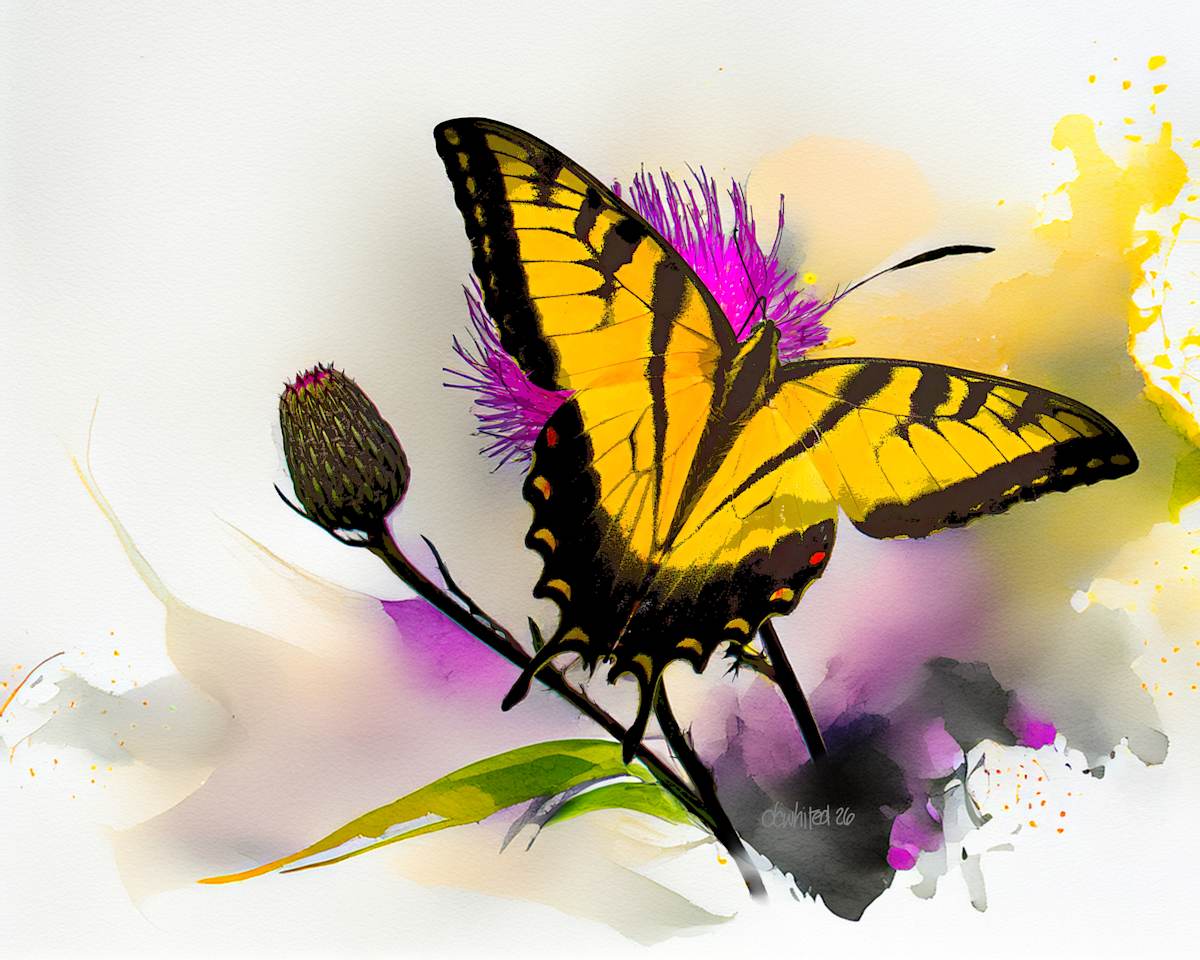
The Eastern Tiger Swallowtail (*Papilio glaucus*) is one of the most beloved and recognizable butterflies in North America, a large and graceful species whose widespread presence across the eastern United States — from the Great Lakes and New England down through Florida and west to the Great Plains — makes it a familiar and cherished sight in gardens, meadows, forest edges, and roadsides throughout much of the continent. Adults are impressively sized, with wingspans ranging from 3 to 5.5 inches, and the typical form is instantly identifiable by its brilliant canary-yellow wings boldly striped with parallel black tiger-like bands, accented along the wing edges with iridescent blue scaling and delicate orange and blue spots near the tail, while the hindwings each bear the elegant, elongated tail projections that give swallowtail butterflies their evocative name. One of the most fascinating aspects of the species is its striking sexual dimorphism — while males are almost always yellow, females occur in two distinct forms, a yellow form similar to the male and a dark form in which the wings are predominantly black with blue scaling, a remarkable example of mimicry in which the dark females resemble the toxic Pipevine Swallowtail (*Battus philenor*), gaining protection from predators who have learned to avoid that unpalatable species. Eastern Tiger Swallowtails are powerful and buoyant fliers, often seen gliding effortlessly between flowering plants where they feed on nectar using their long, coiled proboscis, showing a particular fondness for milkweed, Joe-Pye weed, ironweed, and garden flowers like lilac and butterfly bush. Their caterpillars are equally remarkable, starting life as bird-dropping mimics before molting into plump, bright green larvae adorned with large, false eyespots on the thorax that give them a convincingly snake-like appearance to deter predators, and they feed on the leaves of a wide variety of host trees including wild cherry, tulip poplar, birch, and ash. As a species that thrives across diverse habitats, tolerates human-modified landscapes with ease, and graces gardens and wild places alike with its luminous beauty, the Eastern Tiger Swallowtail holds a special place in North American natural history — fittingly, it serves as the state butterfly or state insect of several states, including Virginia, where it was the first state to bestow that honor upon it.
- Subject Matter: Wildlife
- Collections: Digital photography , Landscapes, Mixed Media , Wildlife