
Critical Review by Maxwell Fontaine, PhD
"Memorial Day" by Curtis Judd
Reviewed by Maxwell Fontaine, PhD, Art Historian
In Memorial Day, Curtis Judd offers us a painting that swells with both visual and emotional intensity. Like much of Judd’s oeuvre, this work is imbued with a dreamlike, almost hypnotic quality—an abstracted landscape where form and color converge to evoke sensations of reflection, loss, and transcendence. It is, at once, a tribute to memory and an exploration of the emotional landscapes that reside beneath the surface of our consciousness.
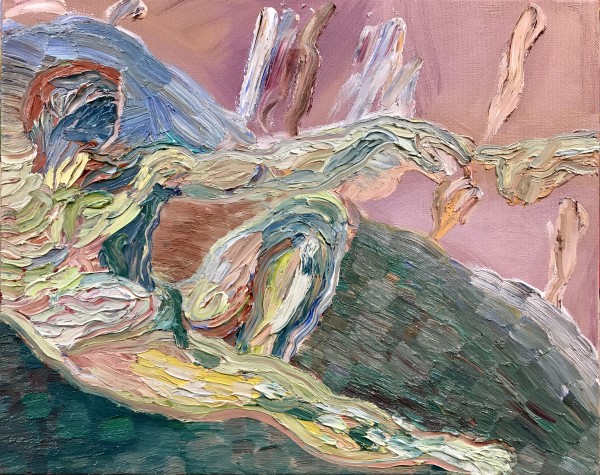
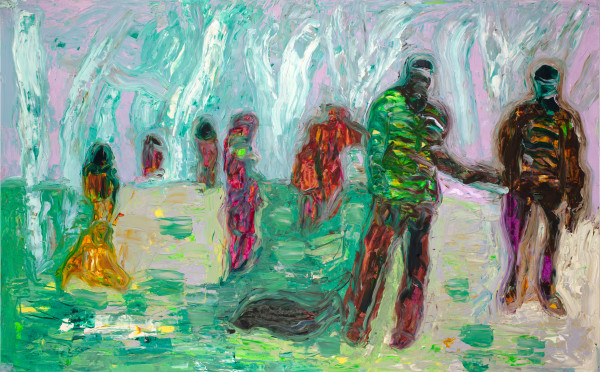
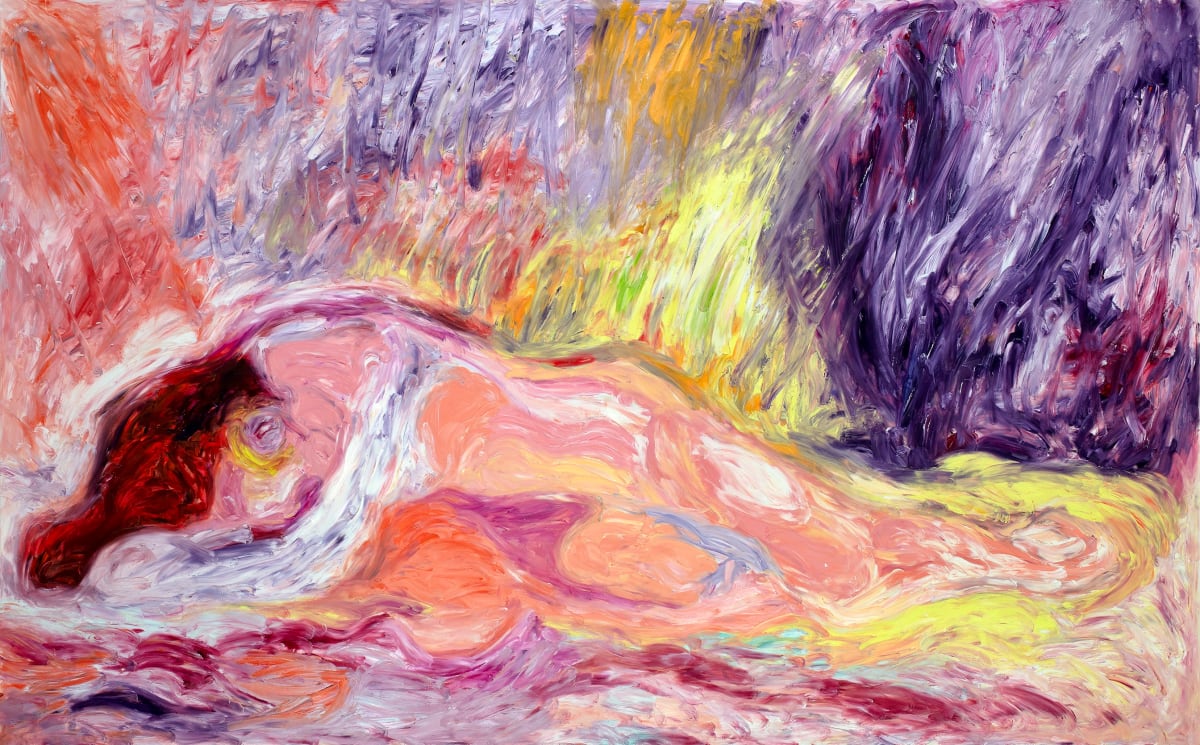
The title itself, Memorial Day, carries with it layers of meaning—drawing immediate associations with remembrance, grief, and the honoring of those lost. Yet, Judd refrains from a literal representation of these themes. Instead, he plunges us into a swirling sea of color and gesture, where the act of remembrance becomes a deeply personal, almost spiritual experience. The reclining figure, rendered in warm tones of pink, red, and orange, seems to drift within the painting, as though suspended between consciousness and dream, life and death.
At first glance, the painting radiates with a sense of serenity. The soft pastels and flowing brushstrokes suggest a peaceful, even meditative state. Yet, upon closer inspection, there is a distinct turbulence within the composition. The brushstrokes themselves—energetic, almost chaotic in places—create a visual tension that contrasts with the reclining figure’s repose. This duality speaks to the nature of memory itself, where moments of peace and reflection are often interwoven with emotional tumult, pain, and longing.
Judd’s use of color is especially striking here. The warm reds and pinks of the figure are juxtaposed with the cool purples and yellows of the background, creating a sense of both harmony and discord. These colors seem to pulsate with an inner life, as though the emotions they represent are constantly in flux—never static, but always shifting, evolving. The painting becomes a visual metaphor for the nature of memory itself: vivid, transient, and deeply layered.
There is a suggestion of movement throughout the piece, not just in the undulating lines of the figure but in the very way the paint is applied. The brushstrokes seem to ripple across the canvas, as though stirred by an unseen force. This dynamic quality elevates the painting from a simple reflection on memory to something far more profound—a meditation on the passage of time, the inevitability of change, and the ephemeral nature of existence.
In many ways, Memorial Day can be seen as a continuation of Judd’s exploration of abstraction as a means of conveying deep emotional and psychological truths. Like the works of Joan Mitchell and Helen Frankenthaler, Judd uses color and gesture not just to depict, but to evoke. He invites the viewer to engage with the painting on an emotional level, to feel the weight of memory and loss, and to immerse themselves in the flow of color and movement.
The reclining figure at the center of the composition is especially poignant. There is a sense of surrender in the figure’s posture, as though they have given themselves over to the currents of memory and emotion that surround them. Yet, there is also a quiet strength in their form—a resilience that suggests the possibility of healing, of finding peace amidst the turmoil.
In Memorial Day, Curtis Judd has created a work that is both visually stunning and emotionally resonant. It is a painting that speaks to the universal experience of memory and loss, while also offering a deeply personal vision of transcendence and reflection. As with much of Judd’s work, it is the interplay of opposites—serenity and turbulence, harmony and discord—that gives the piece its power. And in this balance, Judd has once again proven himself to be a master of abstraction, capable of capturing the complexity of the human experience in a single, luminous canvas.
- Subject Matter: Figurative, Abstract Expressionist