The Fourth Lagoon On Mixing, Mapping, and Territory
Dieter Ronte and Evelyn Weiss, curators from the Kunsthalle in Cologne who were looking for California artists for their exhibition Project ‘74, had come to look at Crab Farm. We promised them that we would do a fish-farm work for the show. We were looking to expand on what we’d done in the Second Lagoon. We had just finished our first conceptual sketch for the sequence of the Lagoon Cycle, with Sri Lanka being the First lagoon and Sea Grant the Second. The Third Lagoon took shape as a response to an imagined question: How much would a crab hectare cost, and how much would it earn? The Fourth and Fifth Lagoons would have something to do with the Salton Sea.
The Fourth Lagoon was the first one begun intentionally as part of the cycle. In a way, it was also the final correction on the Portable Fish Farm. The idea was to find a place where we could design a work on the ground; where there was water (both salt and fresh), land was cheap, and the temperatures close to tropical. This turned out to be on the shores of the Salton Sea, a shallow, saline lake in the Salton Sink area of the Colorado Desert in Southern California whose great attractions were that land was selling for 120 dollars or less an hectare, and fresh water was available from the nearby All-American Canal for 20 dollars an hectare, or about 6.6 dollars for a million liters. We decided to scale up the crab farm and design a polyculture system on the shores of the Salton Sea. The design consisted of a sequence of gravity-fed ponds in which the waste of crabs in the bottom pond would nourish algae in the top pond which in turn would feed clams and mussels whose waste would nourish oysters in the middle pond, with the cockle and clam and oyster becoming the food for the crab. The overage would be harvested, with the harvest acting to preserve the system.
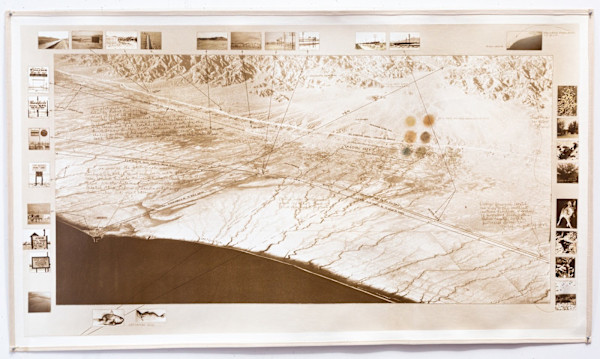
The Fourth Lagoon which was subtitled On Mixing, Mapping, and Territory not only mapped a polyculture system onto the Salton Sea but reframed the photography into the mapping and the mapping back into the photography, at the same time making clear that all this activity was happening at the base of the Chocolate Mountains, designated as a bombing range for a nearby Air Force base.
Though the Salton Sink has alternated between being a lake and a desert for hundreds of thousands of years, the modernday Salton Sea was created at the beginning of the twentieth century by an accident in the process of controlling the Colorado River for irrigation; since then, it has become poisoned by agricultural wastes. The Fourth Lagoon developed as a flat-out argument against the monoculture paradigm that dominated the Coachella Valley, and within which the hundreds of square kilometers of the Salton Sea resided but did not flourish.
The area was socially desolate, consisting of docks and houses in small communities that may once have flourished but now were just remnants. Who, after all, would want to live and work with an agricultural sewer adjacent to a bombing range? With this realization, a new question emerged: If the Salton Sea was poisoned, could we find a way to clean it? This became the subject of the Fifth Lagoon.
Dieter Ronte and Evelyn Weiss, curators from the Kunsthalle in Cologne who were looking for California artists for their exhibition Project ‘74, had come to look at Crab Farm. We promised them that we would do a fish-farm work for the show. We were looking to expand on what we’d done in the Second Lagoon. We had just finished our first conceptual sketch for the sequence of the Lagoon Cycle, with Sri Lanka being the First lagoon and Sea Grant the Second. The Third Lagoon took shape as a response to an imagined question: How much would a crab hectare cost, and how much would it earn? The Fourth and Fifth Lagoons would have something to do with the Salton Sea.
The Fourth Lagoon was the first one begun intentionally as part of the cycle. In a way, it was also the final correction on the Portable Fish Farm. The idea was to find a place where we could design a work on the ground; where there was water (both salt and fresh), land was cheap, and the temperatures close to tropical. This turned out to be on the shores of the Salton Sea, a shallow, saline lake in the Salton Sink area of the Colorado Desert in Southern California whose great attractions were that land was selling for 120 dollars or less an hectare, and fresh water was available from the nearby All-American Canal for 20 dollars an hectare, or about 6.6 dollars for a million liters. We decided to scale up the crab farm and design a polyculture system on the shores of the Salton Sea. The design consisted of a sequence of gravity-fed ponds in which the waste of crabs in the bottom pond would nourish algae in the top pond which in turn would feed clams and mussels whose waste would nourish oysters in the middle pond, with the cockle and clam and oyster becoming the food for the crab. The overage would be harvested, with the harvest acting to preserve the system.
The Fourth Lagoon which was subtitled On Mixing, Mapping, and Territory not only mapped a polyculture system onto the Salton Sea but reframed the photography into the mapping and the mapping back into the photography, at the same time making clear that all this activity was happening at the base of the Chocolate Mountains, designated as a bombing range for a nearby Air Force base.
Though the Salton Sink has alternated between being a lake and a desert for hundreds of thousands of years, the modernday Salton Sea was created at the beginning of the twentieth century by an accident in the process of controlling the Colorado River for irrigation; since then, it has become poisoned by agricultural wastes. The Fourth Lagoon developed as a flat-out argument against the monoculture paradigm that dominated the Coachella Valley, and within which the hundreds of square kilometers of the Salton Sea resided but did not flourish.
The area was socially desolate, consisting of docks and houses in small communities that may once have flourished but now were just remnants. Who, after all, would want to live and work with an agricultural sewer adjacent to a bombing range? With this realization, a new question emerged: If the Salton Sea was poisoned, could we find a way to clean it? This became the subject of the Fifth Lagoon.