Series Title: Sacramento Meditations (full title: Meditations on the Sacramento River, the Delta and the Bays at San Francisco)
Timeframe: 1976 to 1980 (original run); revival exhibition circa mid-2010s
Exhibitions:
Timeframe: 1976 to 1980 (original run); revival exhibition circa mid-2010s
Exhibitions:
- 1977, Sacramento Meditations, San Francisco Art Institute, San Francisco, CA (catalogue)
- 1977, Sacramento Meditations, San Francisco Museum of Modern Art (part of The Floating Museum, commissioned 1976), San Francisco, CA (catalogue)
- 1977, The Floating Museum, San Francisco, CA
- 1978, From the Lagoon Cycle; From the Meditations, Portland Center for Visual Arts, Portland, Oregon
- 1980, Talking Water (revised, traveling), Ronald Feldman Fine Arts, New York, NY
- 1980, Options IV: Helen and Newton Harrison/Talking Water (revised, traveling), Chicago Museum of Contemporary Art, Chicago, IL
- circa 2014–2015 (year unconfirmed), Sacramento Meditations (revival exhibition named after and centered on the original work), Verge Center for the Arts and Sacramento City Hall, Sacramento, CA — staggered openings, June 11 at Verge / June 30 at City Hall
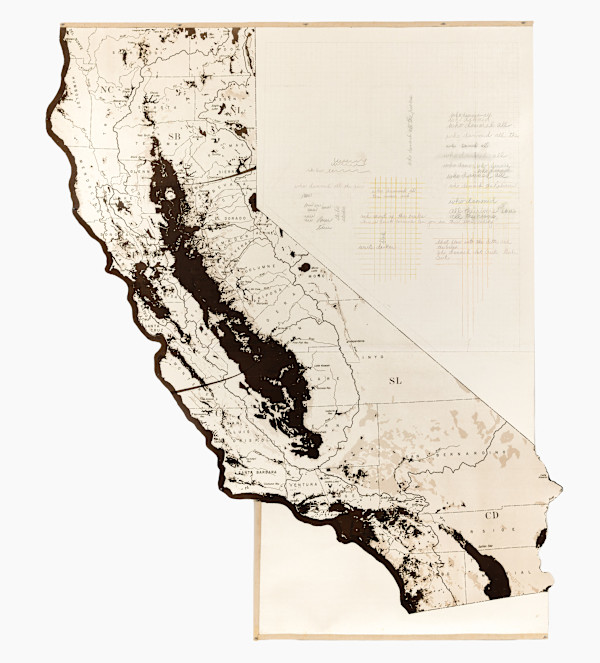
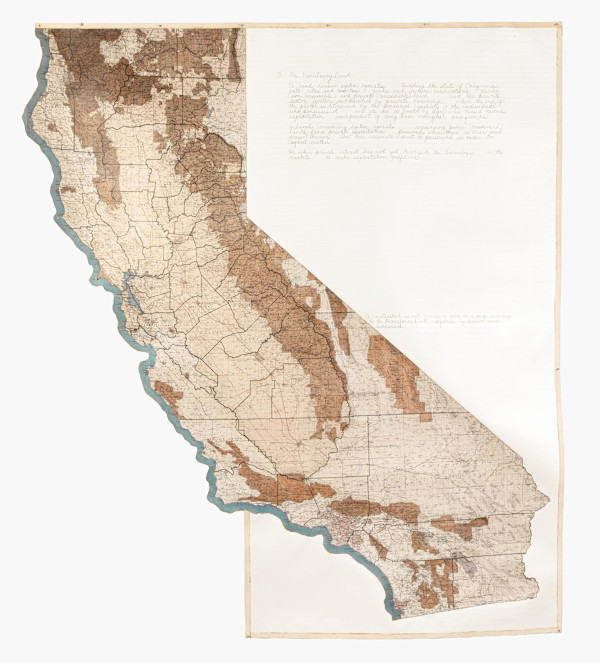
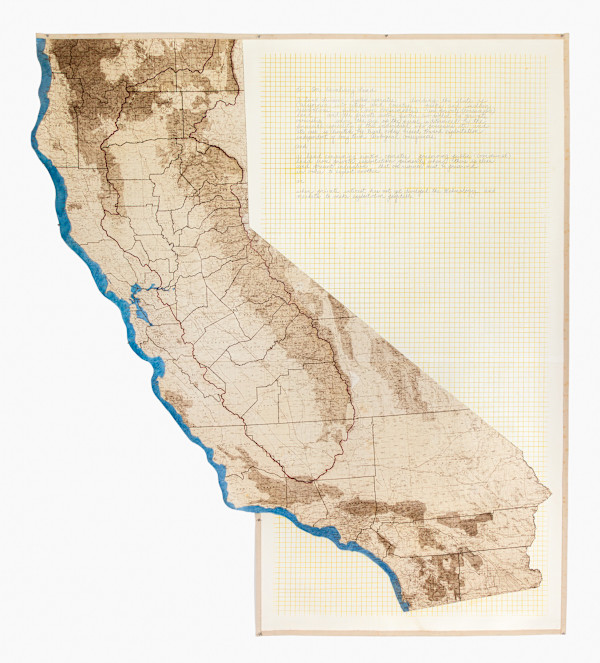
Performance, Graffiti, Billboards, and Posters. Commissioned by the Floating Museum of San Francisco and exhibited first at the San Francisco Museum of Contemporary Art as part of a three-museum show that also included street posters, billboards and street graffiti. This was the first critique of the green revolution and intensive irrigated farming in art, linking the loss of bio-diversity to the green revolution and industrialized agriculture. It also advocated an early bio-regional approach to the Central Valley of California. Written about extensively, it was twice on the cover of Art Week. Included in the catalogue, “From the Lagoon Cycle; From the Meditations: Newton Harrison and Helen Mayer Harrison” published by the San Francisco Art Institute. The posters are reproduced in the catalog, “Social Works”, produced by LAICA in 1978 and they were reprinted in modified form in the magazine “New Wilderness Letter.” The nine texts of the Sacramento Meditations are a work that was commissioned by the Floating Museum in 1976 and was hung in the San Francisco Museum of Art in 1977. The text and images were later slightly revised for an exhibition at Ronald Feldman’s gallery that traveled to the Chicago Museum of Contemporary Art (1980). The nine mappings of the state of California consists of a drawing, a satellite photo, a political boundary map and each was repeated once, as well as maps of water resources, irrigable land and topology
The poster sketch contains 11 posters each beginning with “For instance…if…” and ending with “What if all that irrigated farming isn’t necessary?” that we posted with the help of San Francisco Art Institute students and others, on street corners throughout San Francisco. There were also two huge brown and blue billboards saying “Water.” In addition, there was street graffiti written on the sidewalks in chalk such as “Somebody’s crazy, they are draining the swamps and growing rice in the desert,” “Let every community empty its wastes upstream from where it takes its drinking water,” and “He who builds on a floodplain must expect to be visited by water.” There were performances which included the simultaneous but slightly offbeat readings of a four page bibliography called “Overload.” There was a videotape of a Water Board meeting as well as several radio spots, readings, and a series of bits of ‘advice’ to important water personnel stated in the personal columns of the local paper. Each bit of “advice” was derived from the Buddha’s eight fold path and applied to water. For instance,” Dear Ron Robie: Right Water Thought,” “Dear Jerry Brown: Right Water Action.”
This work owes its existence to six months of research at the Berkeley Water Resources Library, which for many years after the event, displayed a set of the original posters. All the information presented here that was not public knowledge when the work was first done, since has become readily available in various articles, reviews, etc. 650,000 of the 6,500,000 acres under irrigation have long become too salty to farm, and the wetlands at the end of the reversed flow of the San Joaquin have become deadly; several severe draughts have made people begin to question water priorities and subsidized intensive irrigated farming which continues as usual through good times and bad.