
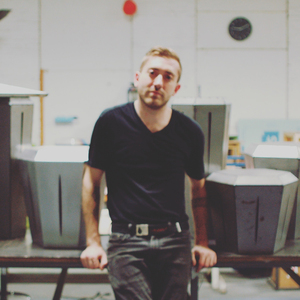
Topher Gent is a designer, researcher, and educator. Through his multifaceted practice, he explores questions of materiality, craft, and design in an increasingly digital and dematerialized world. Based in Providence, Rhode Island, his practice spans furniture and art objects, ceramics, critical craft, and design theory.
Topher holds a BFA from the Rhode Island School of Design and a Master of Design from the University of Bergen, Norway, where he engaged with European approaches to artistic research and design inquiry. His career has spanned luxury goods, furniture design and fabrication, wearable technology, and material research—including founding Gent Design Co., his own bespoke furniture and lighting studio, and leading design research in advanced materials at the Center for Functional Fabrics at Drexel University. This sustained engagement with making and research informs his current approach to creating discursive objects that critically engage their position within the built environment.
He is currently an Assistant Professor in the Division of Experimental and Foundation Studies at the Rhode Island School of Design, where his material-driven studio practice and commitment to design education are deeply interconnected. In addition to his teaching, he publishes Object Report, a hybrid design journal that engages his studio practice and offers critical discourse about designed objects and material culture.
Artist Statement
I am an artist, designer, and object maker, working primarily with ceramics, wood, metal, and other mixed media. I see my practice as a form of design research, using craft as a primary methodology for exploring the constantly evolving human-object relationship, where objects serve as material experiments and research artifacts rather than end products.
My process is often driven by investigating the tensions between traditional handcrafting processes and digital fabrication methods. Through the act of making, I work to understand how objects express themselves and reveal traces of their creation, and how human making and technological production impact contemporary material culture.
For example, the surface of a wheel-thrown ceramic vessel carries different information than one that is slip-cast, or one that is 3D printed. In the same way a hand-forged metal form speaks differently than a laser-cut or CNC-milled piece. These distinctions matter because they shape how we perceive authenticity, value, and the maker's presence in an increasingly dematerialized world.
The objects I create are positioned intentionally between art and industry, questioning fundamental assumptions about the value and future of craft. At times, individual pieces may appear understated on their own but function as "material hypotheses" for testing ideas. I'm particularly interested in moments where these different approaches create ambiguity as discursive objects—when viewers can't necessarily discern how something was made or what traces of the maker they're actually seeing.
My recent focus centers on ceramic vessels and domestic objects, and are often made as multiples and arranged in compositions. Because I work in series that evolve over time, pieces I made years ago might suddenly gain new meaning with current work, or even become integrated into new compositions as part of a continuing investigation. This temporal quality reflects my belief that objects exist in relationship—to their makers, their users, their materials, their environments, and to each other across time.
Through this work, I hope to foster greater collective care for the objects that shape our built environment and more conscious engagement with material culture. By challenging preconceptions about craft authenticity and revealing the complex relationships between humans, objects, and different modes of production, I hope my work contributes to broader conversations about how we create meaning through making in a digital era.
Topher Gent - Providence, RI, USA
Powered by Artwork Archive