
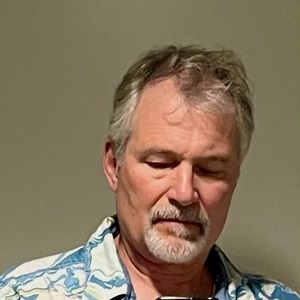
Anton Mogilevsky
Lake Oswego, OR
Anton is a painter, metalworker, woodworker, and musician living and working in the Pacific Northwest (USA).
Message
Anton Mogilevsky grew up in the 1960's in a small town on the coast of Florida. Just 7 miles from the Kennedy Space Center, the Merritt Island Wildlife Refuge and Playalinda Beach, his early life influences were the ocean and saltwater marsh habitat and space exploration.
Anton's Mother, Joan, was a creative fiber artist specializing in dying, spinning, and weaving. His Father, Michael, was a NASA technologist who found creativity in woodworking and turning beautiful bowls, plates, and containers.
Several of Anton's extended family members are visual artists and the arts and music have been very important parts of the Mogilevsky households for generations.
Anton began his artistic journey shortly before his retirement from a career as an aerospace/mechanical engineer in 2016. He first experimented with metal sculpture and encaustic painting, then cold wax and oil painting, acrylics, and gauche.
He remains an avid woodworker, kayaker, and percussionist. Anton and his wife, Victoria, live in the Pacific Northwest and travel extensively where they find joy and fulfillment learning about the natural world and the cultures of the world.
Statement
Artist’s Interview
- What is the main theme or idea behind your work?
I paint the joy, wonder and beauty, humor and playful fun that touch my heart.
- How do you choose the materials, techniques, and styles that you use?
I love working in oils as they allow me to “sculpt” a painting. Oils stay fluid for several days, so I can take time to move the paint as I come back to the studio after taking time to rest my eyes and brain. Seeing things fresh helps me to see areas that aren’t quite right - that don’t meet my vision of the project or that don’t fit the rest of the painting.
I also enjoy digital painting as it can be good practice for working out composition, color harmonies, and values. It’s also great to be able to take on an airplane or do in a car or while listening to TV or music. And I sometimes import my oil paintings into my digital painting programs to mark them up for revisions to make on the canvas.
- What are some of the influences or inspirations for your work?
I find real inspiration in nature - particularly the ocean and marine life. I am a kayaker, and I enjoy sea kayaking and watching the birds, seals, whales, fish….as well as boats and land formations. I grew up on the coast in Florida, and I’ve always felt at home by the sea. Marinas always held a romance for me. I love the sound of ships bells, fog horns, lines slapping a mast and sea gulls calling.
- How do you want your audience to feel or think when they see your work?
I hope people will feel what I feel when I paint a painting. Whether it’s awe at a breaching whale, or the sheer joy of a little girl at play in a fountain, or the peace of looking at a calm sea and sailboat at anchor. When I paint, I can relive these moments over and over again as I work the paints onto the canvas. If people enjoy my paintings and feel these emotions when they look at these images then I have succeeded, and I’m happy. It’s really encouraging to read comments from someone who reacts with the same emotions I felt as I painted.
- What are some of the challenges or difficulties that you face as an artist?
It can be a bit of a challenge to decide how much is enough, and not go too far. What I mean by that is that if you are trying to convey a feeling, too much detail can confuse the viewer. I don’t want people to have to study my images too long to get the message. I see photo realistic paintings and I am impressed by technique - I mean, some of those paintings took months to complete and have many many layers of paint - but in all of my contemplating the technique I haven’t been moved. I haven’t felt joy. I don’t want to try to replace a camera. I want people to FEEL something.
- How do you balance your artistic vision with practical or commercial considerations?
I don’t. I am fortunate enough to be able to paint what I want and not worry about the commercial side. If my art makes someone feel good, perhaps they will like it enough to want to see it often or share it with someone they love.
- How do you measure your success or progress as an artist?
I keep an art journal so I can track my progress. I periodically look back through what I have painted over time and I can see how my composition, attention to value and color, edges, control have changed. I also have a number of friends and relatives who are artists and I ask them for critiques. Visual arts are like any art form: you have to keep practicing to stay proficient and to keep moving forward. If you stop practicing, you slide backwards.
- How do you cope with criticism or feedback on your work?
Someone gave me some good advice early on: Share everything. No matter what you share with the world, someone will love it and someone will hate it. So if I can learn from a comment, I welcome it. It’s not always easy to hear at first, but you suck it up and try to incorporate the recommended changes.
- How do you keep yourself motivated and creative?
I have a file of inspirational photographs that I look thru from time-to-time. When I’m not feeling it, I don’t paint. I go for a hike or a bike ride or a kayak. But I don’t really neglect painting for long. Sometimes I just paint junk. And that’s ok because I learn from that, too.
- What are some of the goals or dreams that you have for your future as an artist?
I just want to be making Art and improving until the end. That is enough of a goal in and of itself. The process is its own reward. It’s my therapy. It’s how I see the wonder and good and beautiful in an otherwise not always wonderful world.