
Puruṣottama: The Supreme Person
द्वाविमौ पुरुषौ लोके क्षरश्चाक्षर एव च।
क्षरः सर्वाणि भूतानि कूटस्थोऽक्षर उच्यते॥
उत्तमः पुरुषस्त्वन्यः परमात्मेत्युदाहृतः।
Two puruṣas exist in this world — the perishable and the imperishable. All embodied beings are the kṣara; the unchanging is called the akṣara. Yet the highest Puruṣa is other than these — He is called Paramātmā.
— Bhagavad Gītā 15.16–17
The 15 chapter of the Bhagavad Gita establishes the jīva as an eternal fragment of Kṛṣṇa traversing embodied existence, and reveal Kṛṣṇa as the sustaining force behind all life — present in the light of the sun, the nourishment of the earth, and seated in every heart as the source of memory, knowledge, and their loss.
Kṛṣṇa identifies two puruṣas: the kṣara, all perishable beings caught in the churn of saṃsāra, and the akṣara, the unmanifest, unchanging principle beyond all becoming. Yet even the akṣara is not the highest. Kṛṣṇa as Puruṣottama transcends both, pervading and sustaining all three worlds — a claim grounded in scripture and celebrated across tradition.
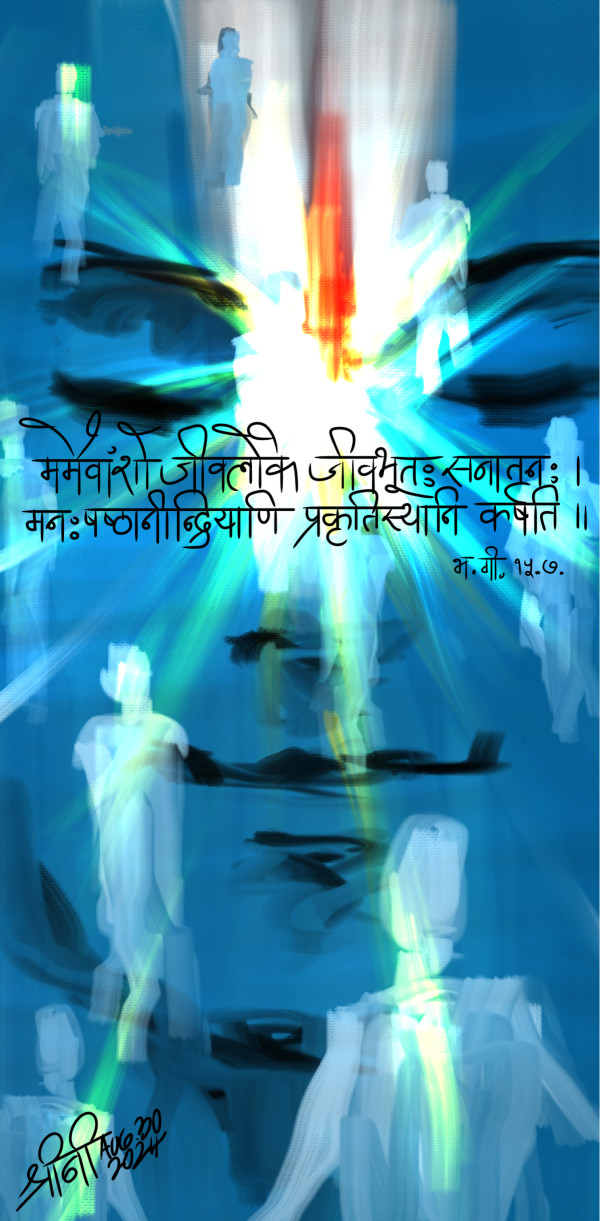
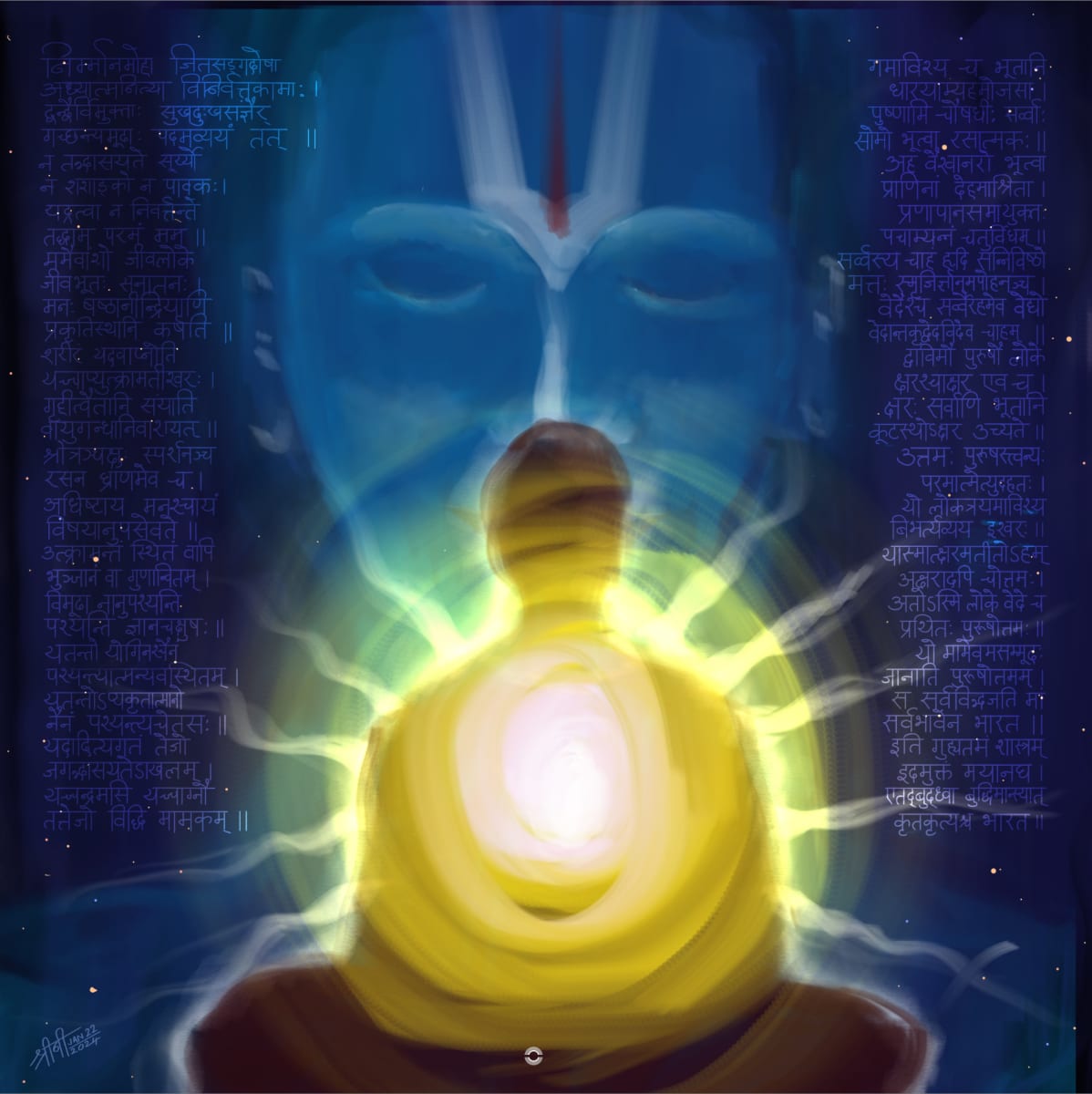
The artwork captures a vision that is inspired by this truth. A meditating figure blazes with golden light at the heart center, the jīva made radiant by the indwelling presence, while the vast, serene face, blue and eyes closed, presides silently behind as Puruṣottama. The Sanskrit ślokas of the entire chapter form a luminous border, as though the words of the Gītā themselves are the container for this vision.
This, he declares, is the guhyatamam śāstram — the most secret of all that the śāstras contain, knowledge of which renders one kṛtakṛtya: one for whom nothing remains undone.
- Collections: Bhagavad Gita