
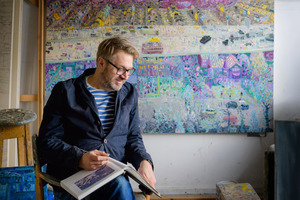
Robbie Bushe
Edinburgh
Robbie Bushe is a painter and Royal Scottish Academician whose work fuses personal history and research-led storytelling in layered figurative paintings
Message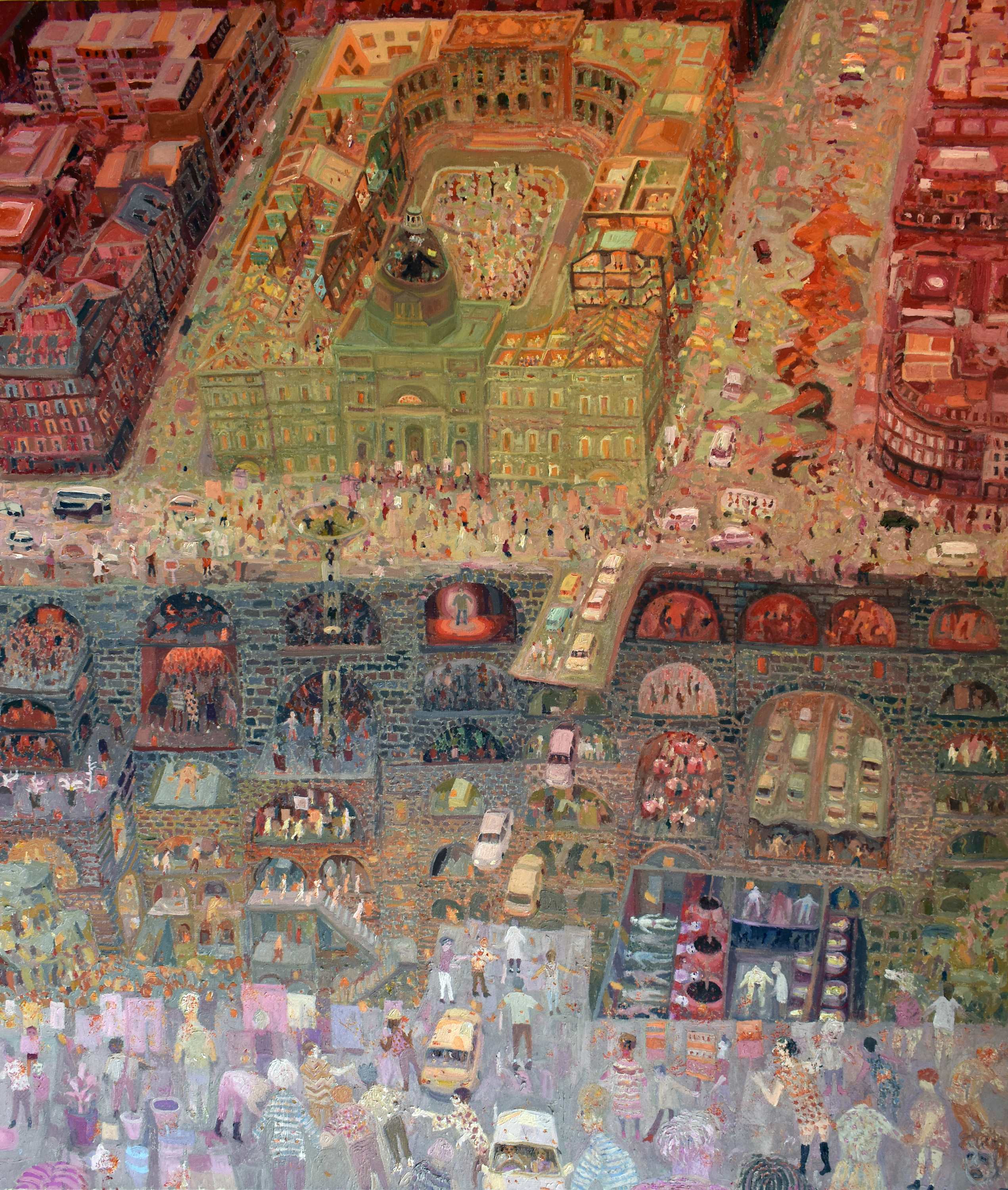
Robbie Bushe (b. 1960s) lives and works in Edinburgh, Scotland. He studied Fine Art and holds an advanced research-degree in painting. He is senior teaching fellow at the University of Edinburgh, where he leads studio courses, supervises postgraduate research and contributes to painting pedagogy. He is an elected member of the Royal Scottish Academy.
For over twenty years he has developed a practice of narrative painting grounded in rigorous research and collaboration. His exhibitions include major solo shows, most recently the project NEONEANDERTHALS (2019) at the Royal Scottish Academy’s Findlay Room, which drew more than 30,000 visitors and engaged archaeology and anthropology communities. His painting Neanderthal Futures Infirmary was shortlisted for the John Moores Painting Prize 2021 and won a prize there.
His awards include the John Moores Painting Prize, the Blackadder Houston Mid-career Painting Prize, and others. He has published and lectured internationally, and his practice often draws on cross-disciplinary enquiry, working with collaborators and research partners. Alongside exhibition work he has held residencies, curatorial roles (for example co-writing the Frontiers exhibition and catalogue for the Royal Scottish Academy), and maintains a committed teaching role.
Through his work he investigates how personal narrative, mythic form and collective memory intersect in painting. He uses the tools of visual storytelling to engage social, cultural and historical questions whilst remaining committed to the physical, material act of painting.
My practice begins with a story, a fragment of memory, a mythic form or a shared human question. I work in paint because the surface, the gesture, the built-up layer of pigment give weight to the idea of time, sediment and accumulation.
I make images that sit between the personal and the communal. I look at how memory and myth lodge themselves inside bodies and places, how cultural sediment is carried, erased, re-inscribed. I explore how ancient narratives and contemporary realities meet: how the Neanderthal, the human-animal hybrid, the archaeological trace become metaphors for lived experience, identity, and transformation.
In recent years (for example in NEONEANDERTHALS) I have used collaboration—to bring in voices of archaeology, anthropology, geology, material culture—to interrogate painting’s capacity to hold research-led enquiry. I believe painting can be both rigorous and open-ended. It holds questions rather than answers. It invites the viewer into an intimate transaction.
My studio work is physical, layered, iterative. I build forms and then disrupt them. I use mark-making, colour and surface to hold tension between figuration and abstraction, presence and absence, memory and imagining. I want the viewer to feel a trace of what it is to be alive in particular moment, to be part of a lineage of image-makers and story-tellers, to register that every painting carries its own past and its own future.
I teach because I believe that painting matters: it teaches risk, duration, reflection, engagement. My role as a teacher and researcher feeds directly into my practice. The studio becomes a place of enquiry and of encounter, where image-making is not only an outcome but a question.
Statement
My practice begins with a story, a fragment of memory, a mythic form or a shared human question. I work in paint because the surface, the gesture, the built-up layer of pigment give weight to the idea of time, sediment and accumulation.
I make images that sit between the personal and the communal. I look at how memory and myth lodge themselves inside bodies and places, how cultural sediment is carried, erased, re-inscribed. I explore how ancient narratives and contemporary realities meet: how the Neanderthal, the human-animal hybrid, the archaeological trace become metaphors for lived experience, identity, and transformation.
In recent years (for example in NEONEANDERTHALS) I have used collaboration—to bring in voices of archaeology, anthropology, geology, material culture—to interrogate painting’s capacity to hold research-led enquiry. I believe painting can be both rigorous and open-ended. It holds questions rather than answers. It invites the viewer into an intimate transaction.
My studio work is physical, layered, iterative. I build forms and then disrupt them. I use mark-making, colour and surface to hold tension between figuration and abstraction, presence and absence, memory and imagining. I want the viewer to feel a trace of what it is to be alive in particular moment, to be part of a lineage of image-makers and story-tellers, to register that every painting carries its own past and its own future.
I teach because I believe that painting matters: it teaches risk, duration, reflection, engagement. My role as a teacher and researcher feeds directly into my practice. The studio becomes a place of enquiry and of encounter, where image-making is not only an outcome but a question.