
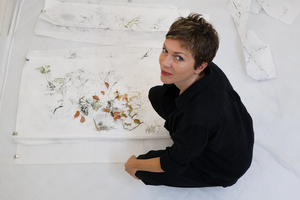
Nina Fraser
Lisbon
Nina Fraser explores the relationships between ecology, community and systems of knowledge through the materiality of paper and print
MessageNina Fraser (b. 1984, St Albans, UK) is a Lisbon-based multidisciplinary artist. She holds a Postgraduate Degree in Curating and Commissioning Public Art from HDK-Valand, University of Gothenburg, and a Bachelor’s Degree in Textile Art from Winchester School of Art, University of Southampton (UK). Fraser has participated in numerous group exhibitions internationally and has presented several solo exhibitions in Portugal and the UK.
Her artist residencies often focus on ecology and sustainability, including A Strange Loop, OSSO Collective, Portugal (2026); Plant Thinking, Estação Viva, Portugal (2023); Mycelium, Roccamonfina, Italy (2023); and Body & Place, Owlpen Manor, UK (2019).
In 2025 she was a participatory artist with LABECO — Cooperative Laboratory for Artistic and Ecological Practices, working between Lisbon and Marseille. In 2026 she is artist-in-residence with Art & Craft Refúgio, a collective of migrants, artists, and refugees sharing creative and cultural practices at Jardins do Bombarda in Lisbon.
Statement
My practice explores the relationships between memory, ecology, community and systems of knowledge. Working across installation, experimental drawing, collage, and participatory projects, I investigate how people, places and more-than-human environments shape one another through processes of exchange, adaptation and contingency. I am interested in ecological thinking as a framework for understanding interdependence, resilience and collective forms of art making, and how memory, place, and ecological systems overlap.
Drawing on plant-thinking and ecological theory, I explore alternative models of learning, communication and organisation that challenge individualistic and hierarchical structures. I often work with found materials, site-responsive methods and collaborative processes, using artistic practice as a way to trace connections between social and environmental systems. Forms emerge through accumulation, fragmentation, and repetition, reflecting systems of growth, decay, and regeneration. Materials are chosen for their tactile and symbolic qualities, allowing surfaces to hold traces of time, use, and transformation.
Alongside studio-based research, I develop socially engaged projects that create opportunities for dialogue, skill-sharing and collective creativity. These projects are informed by ecological concepts such as mycelial networks, feedback loops and mutual support, and seek to cultivate meaningful relationships between participants, places and local contexts.
My main areas of interest include ecology, systems thinking, community-building, place-based research, regenerative practices and the role of art in fostering connection, imagination and social transformation. I see artistic practice as an evolving ecosystem—one that brings together material experimentation, critical inquiry and collective experience to explore more sustainable and equitable ways of being in the world.