
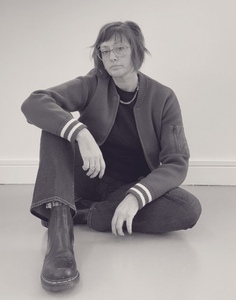
Nicole Bricker (b. Minneapolis, 1977) is an artist based in the Northeast United States. Her work examines the visual language of Midwestern American suburbia, reframing the aesthetics of kitsch as a site where identity and belonging are constructed through memory and domestic experience. Drawing from family keepsakes and cultural ephemera, she reconstructs fragments of the home into layered compositions that merge personal narrative with cultural frameworks.
Spanning painting, assemblage, and sculpture, Bricker brings together found objects, cast elements, and tactile surfaces to create forms that shift between familiarity and distortion.
Bricker’s work has been exhibited at the Lyman Allyn Museum (New London, CT), Rosalux Gallery (Minneapolis, MN), and Field Projects (New York, NY). She participated in The Canopy Program residency in 2023–24, where she received the James Bernard Haggarty Scholarship. She is the founder of Anonymous Society, a Connecticut based gallery supporting artistic experimentation and dialogue.
Statement
My artwork examines the visual language of Midwestern American suburbia, reframing kitsch as a site where memory, identity, and belonging are constructed within domestic life. Drawing from keepsakes passed down through my family such as homewares, toys, and photographs, I reconstruct fragments of the domestic space into layered compositions that merge personal narrative with cultural frameworks.
Each assemblage begins with writing and color mapping. Post it notes filled with words and memories evolve into carefully constructed palettes of collected materials and constructed fragments. Through processes of accumulation and transformation, I physically assemble cast forms, found objects, and tactile surfaces to create compositions that shift between familiarity and distortion. Household motifs reappear in unexpected color relationships and material combinations, where fragments of the familiar become slightly strange, both tender and irreverent. The work balances humor, sentiment, and introspection.
Beneath their surface charm, the work examines how memory is shaped, circulated, and reinforced through domestic and cultural belief systems. By reclaiming visual codes often dismissed as decorative or sentimental, I position kitsch as a structure that organizes attachment and value. The work treats these objects not as artifacts of nostalgia, but as active agents in shaping how identity is formed and understood within the domestic sphere, transforming kitsch into a form of emotional architecture