
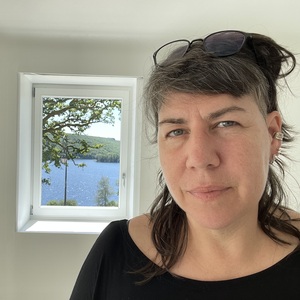
Nadia Myre
Montreal, Quebec
Nadia Myre is a Montreal-based Algonquin and Québécois artist whose work explores identity, memory, and the entangled legacies of cultural encounter.
MessageNadia Myre is a Montreal-based Algonquin and Québécois artist and a member of the Kitigan Zibi Anishinabeg First Nation. Her multidisciplinary practice—spanning beadwork, sculpture, video, photography, installation, and performance—explores themes of identity, resilience, and the entangled legacies of colonialism. Drawing from both personal and collective histories, Myre’s work invites reflection on the complexities of cultural encounter and the ways stories are shared, inherited, and transformed.
Her practice often engages with material processes—sewing, weaving, casting—as methods of inquiry and resistance. She is known for participatory and text-based works that investigate language, memory, and the politics of representation. Major projects such as The Scar Project and Indian Act have toured internationally and are held in significant collections, including the National Gallery of Canada, the Montreal Museum of Fine Arts, and the Musée national des beaux-arts du Québec.
Prominent solo exhibitions include Waves of Want at the National Gallery of Canada (Ottawa, 2025); Lignes et Cordes at the Centre international d’art et du paysage (CIAP) on Île de Vassivière, Beaumont-du-Lac, France (2024); Balancing Acts at the Textile Museum of Canada, Toronto (2019); Tout ce qui reste / Scattered Remains at the Montreal Museum of Fine Arts (2017); Decolonial Gestures or Doing it Wrong? Refaire le chemin at the McCord Museum, Montreal (2016); Code Switching and Other New Works at The Briggait, Glasgow International (2018); and Acts that Fade Away at the Ryerson Image Centre, Toronto (2018).
Myre received the Sobey Art Award in 2014, Canada’s most prominent contemporary visual art prize. She was also longlisted for the award in 2011, 2012, and 2013. Additional honours include the Compagne des arts et des lettres du Québec (2019), the Prix Louis-Comtois (2021), and the Banff Centre Indigenous Commission Award (Walter Phillips Gallery, 2016). She was elected to the Royal Canadian Academy of Arts in 2012, and previously received the Pratt & Whitney Canada “Les Elles de l’art” prize (2011) and the Prix à la création artistique du Conseil des arts et des lettres du Québec for the Laurentides region (2009).
Myre holds a Canada Research Chair in Indigenous Arts Practice and is Associate Professor of Studio Arts at Concordia University. She is the founding director of the Kìnawind Lab, a research-creation studio grounded in Indigenous knowledge systems, and a co-founder of daphne, the first Indigenous artist-run centre in Quebec. Her public art includes Tree of Shifting Forms, commissioned for the Canadian Embassy in Paris (2018). A commission for the Société de transport de Montréal is currently in development.
Statement
My work is rooted in a desire to make visible the layered relationships between bodies, histories, and materials. As an Algonquin and Québécois artist, I navigate and probe the spaces between identities, between what is remembered and what is forgotten, and between what is inherited and what is made anew.
Through beadwork, sculpture, photography, video, installation, and text, I explore the ways that knowledge travels across generations, lands, and cultural boundaries. Material processes—such as sewing, weaving, and casting—are not only formal strategies but also methods of inquiry: ways of engaging in dialogue with ancestral practices and collective memory. In my work, the act of making becomes a form of listening.
I am interested in how objects hold memory, how language shapes understanding, and how stories—personal and political—can be reclaimed, reimagined, or disrupted. Many of my projects invite public or participatory engagement, creating space for the accumulation of shared experience, and for the acknowledgement of pain, joy, and resilience.
Whether working with archival fragments, codes of writing like Gregg shorthand, or the repetition of gesture in beadwork, I aim to create works that carry both beauty and tension. I see the studio as a site of slow research—a space for contemplation, experimentation, and the unfolding of relations.
At its core, my practice is concerned with the transformative potential of art: how it can hold complexity, unsettle fixed narratives, and allow for the emergence of new understandings.
Powered by Artwork Archive