
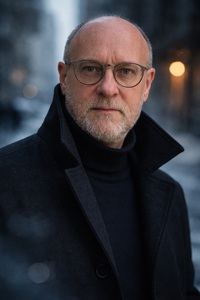
Michael Moore
Gosport, Hampshire
Michael Moore is a Hampshire-based British painter exploring memory, perception, and reflective urban spaces through layered acrylic and oil paintings.
MessageAbout
Michael Moore is a contemporary painter based in Hampshire, UK. Working primarily in acrylic on canvas, his paintings explore perception, memory, and the quiet instability of how places are experienced over time. Drawing from reflective urban environments, layered architecture, and fractured surfaces of glass and light, his work moves between observation and abstraction, creating spaces that feel simultaneously familiar and uncertain.
Rather than documenting the city directly, Moore uses the urban landscape as a way of examining attention itself. Buildings dissolve into reflections, perspectives shift, and fragments of structure emerge and recede like incomplete recollections. The paintings often suggest places passing through states of awareness rather than fixed locations observed from a distance.
Underlying many of the works is an interest in stillness within complexity. Thin glazes, interrupted geometries, and layered architectural forms create compositions where clarity and ambiguity coexist. Reflections become more than visual phenomena; they act as metaphors for memory, perception, and the unstable relationship between the seen world and the remembered one.
Moore studied Art at university before spending thirty-five years in education. Alongside teaching, painting remained a constant and increasingly necessary form of enquiry, shaping a practice rooted in sustained observation and slow looking. His work reflects a longstanding fascination with the unnoticed edges of experience: quiet streets, reflected light, temporary alignments, and the subtle emotional residue carried by urban spaces.
His paintings have been exhibited widely, including selection for Sky Arts’ Landscape Artist of the Year, the Salisbury Museum Open, Southampton City Art Gallery’s Biennial Open Exhibition, and the Mall Galleries. His work is held in private collections and continues to develop through an ongoing body of interconnected paintings, texts, and exhibition projects exploring reflection, memory, and perception.
And then, instead of separate “Vision / Mission / Big Ideas” sections, I’d strongly recommend condensing everything into a shorter contemporary statement like this:
Artist Statement
My paintings begin with real places, usually fragments of urban environments shaped by reflections, layered surfaces, and shifting light. From there, the work moves away from documentation and towards something less stable: the way places are remembered, reconstructed, and emotionally inhabited over time.
I am interested in moments where perception feels uncertain. Reflections in glass, repeated architectural forms, interrupted perspectives, and translucent layers allow the paintings to exist between clarity and dissolution. Familiar structures remain present, but never entirely fixed.
The work is less concerned with the city itself than with the experience of attention moving through it. Many of the paintings emerge slowly through layered glazes and partially disrupted processes that allow memory, intuition, and visual fragmentation to shape the image as much as direct observation.
I think of the paintings as thresholds rather than windows. They are not attempts to describe a place precisely, but to create conditions where stillness, reflection, and recognition can gradually emerge through sustained looking.