

M A R K H U E B N E R
Puerto Jiménez/ Santa Teresa, Puntarenas
Mark Huebner is a Visionary Multi Media Artist known for his extensive work in painting, Installations and live Performances.
Message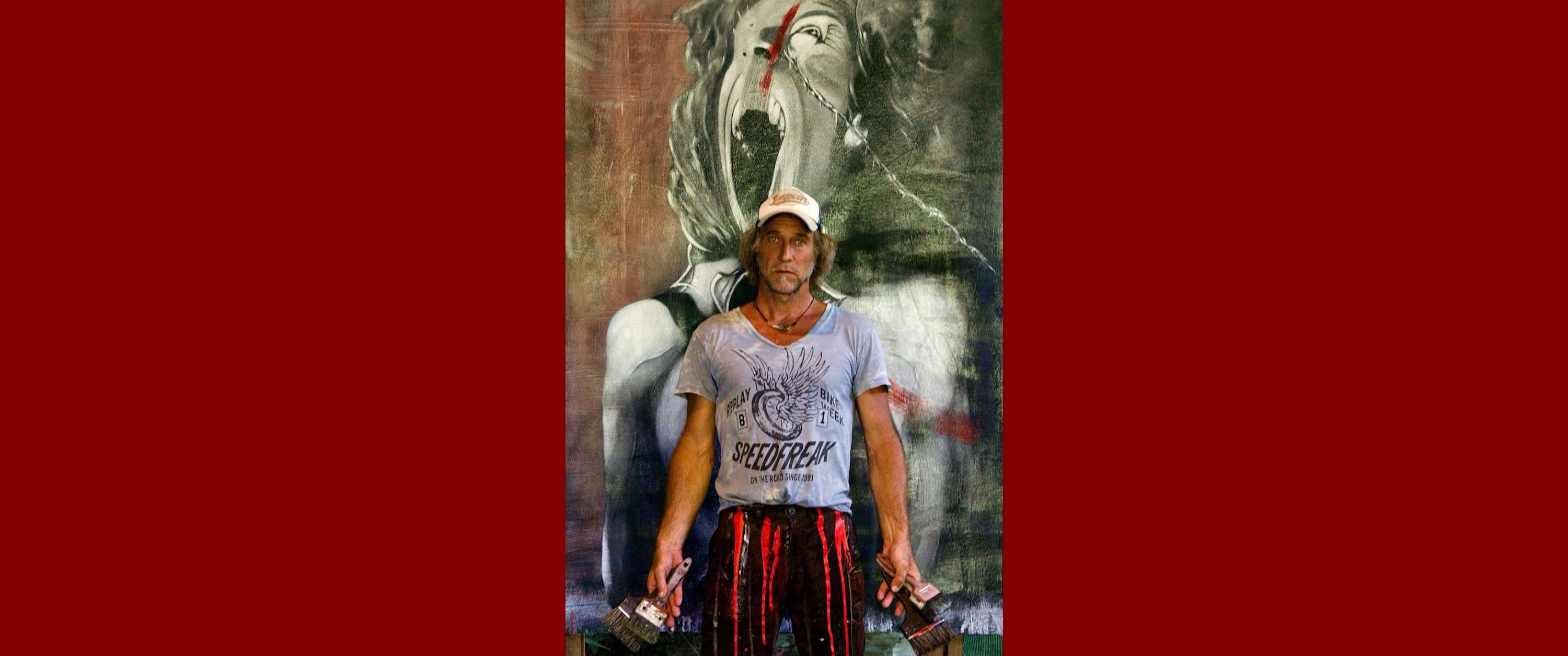
Mark [born as Mark Huebner in 1966 in Frankfurt/Main, Germany] is a visionary multi media artist known for his extensive work in painting, large-scale installations and live performances.
Mark has explored an immense range of artistic disciplines throughout his career.
His work is a deep reflection on our very existence.
His multifaceted approach invites viewers
to engage with existential themes.
“These latest large bodies of paintings are both mystical and allegorical
In MARK, we have a truly Renaissance man…” [Anthony Fawcett]
quick overview:
- Industrial Period (1989–1999): While based at the Praterinsel in Munich, Huebner specialized in large-scale steel installations and "performative" art. A central theme was the Impact Phenomenon, where he used heavy hammers to drive steel spikes through thick metal plates as a live ritual of "destruction and creation".
- Natural Transition (2000–Present): After moving to Costa Rica, he shifted focus to sustainable building and organic materials, specifically bamboo. He developed a unique "peg and hole" construction method using hardwood dowels instead of traditional nails or lashing.
- Contemporary Painting: His current work features mid- to large-sized visionary paintings characterized by dynamic strokes and themes of existential inquiry.
In 1989, he established his first studio at the Praterinsel in Munich, positioning himself as a pioneering figure among established artists. During this period, he engaged in intensive sculptural work, creating large installations primarily forged from steel, often accompanied by live performances. Collaborating with notable artists he gained significant exposure in various exhibitions in Europe, America and Asia. In 2000, Mark relocated to the Península de Osa in Costa Rica, where he shifted his focus to natural resources, particularly bamboo, leading to the creation of "Bamboo Rocks." He initiated a “lifestyle experiment” called Ojo Del Mar, which evolved into a recognized nature refuge and advocated for environmentally sound building methods, including constructing the tallest natural build tower in Central America. He debuted an installation and live performance project at the Museum of Contemporary Art in San José, further solidifying his presence in the art world. Mark's paintings, characterized by large sizes, feature dynamic strokes combined with innovative techniques, along with his current work including live painting.
Mark Huebner’s paintings are described as having a deep spiritual and metaphysical significance, functioning as a bridge between the physical world and the „Essence of Existence“
STYLE:
Contemporary visionary multimedia artist Mark Huebner is widely recognized for his raw aesthetic that relies heavily on a restricted palette of monochromatic tones, raw earth pigments, and deep blacks. By focusing on these colors, he emphasizes texture, form, and emotional weight over bright color values. [1, 2, 3]
His mixed-media approach typically blends traditional painting mediums with gritty raw materials to create highly tactile surfaces. [1, 2]
Typical Mediums in Huebner's Work
Oil & Acrylic Base: He uses heavy oil or acrylic paint layers on large canvases to establish structural depth and broad, dynamic strokes. [1, 2]
- Charcoal & Pigments: Raw charcoal and loose earth pigments are worked into the paint, which darkens the values and provides a gritty finish. [1]
- Industrial & Natural Textures: His technique often integrates physical elements that reflect his background—combining structural, industrial geometry (from his early days working with steel) with organic, textured layers inspired by his long-time residency in the Costa Rican jungle wilderness. [1, 2]
While his visual results appear complex and deeply layered, his foundational application steps are indeed very direct and effectual. His straightforward method relies on bold, intuitive actions rather than intricate, delicate brushwork.
This combination of a minimal color scheme and heavily layered media gives his "Project Paths" [such as Dark-Light or Mind Extinction] a distinctively apocalyptic, metaphysical, and deeply atmospheric quality.[1, 2, 3, 4]
The spiritual weight of his current work is defined by several key themes:
- The Search for Truth: Huebner views his art as a trigger for a process of "distinguishing the truth from the superficial perception of our existence". His paintings are meant to dig into the most profound layers of who we are.
- A "Metaphysical Combination": His return to the canvas is described as a fusion of his "steel hard-core" industrial past and his current life in the jungle. This blend creates a "metaphysical combination" that explores the origin of life and our connection to a "perfect nature".
- The Whale as a Spiritual Sentinel: In many recent works, Huebner uses the image of a whale as a "sentinel for life on earth," explicitly calling it both an environmental and spiritual reflection of our state of existence.
- Cyclical Philosophy: His paintings reflect a belief in the inevitable cycle of life and death—that everything born will die, and everything destroyed will be recreated in a new form. To Huebner, this cycle is the essence of nature, and we are an inseparable part of it.
- Active Observation: He challenges viewers to move from a passive state to an "active state of mind," suggesting that "waking up" to the reality of our inner and outer worlds requires conscious action.
- +4
His work is not about religious dogma but a visionary inquiry into the human spirit's place within the vast, sometimes tragic, tapestry of Existence.
- Existential Inquiry: He is recognized as a Visionary Multi-Media Artist who uses the canvas to trigger a process of "distinguishing truth from superficial perception," digging into the profound layers of human existence.
The Nature of the Transition
- Melting Worlds: His recent paintings function as a synthesis where the "steel hard-core" energy of his 1990s Germany period meets the organic experience of the Costa Rican wilderness.
- From Action to Reflection: While his early performances were "unadulterated experiences" of raw action, his paintings allow for a more contemplative, "boundless" exploration of the inner mind space.
His main work cycles are :
‘THE IMPACT PHENOMENON / THE MENTAL ASPECT / MIND ATTACK / THE ATMOSPHERIC EXPERIENCE / THE BIOTOPE CONTAINED / NATURE IN DEFENSE / MIND EXTINCTION / DARK LIGHT / MASTER OF THE UNIVERSE / INTO EXISTENCE / OTHERWORLD
Mark Huebner’s performances are recognized for their bridge between German Industrialism and Metaphysical Existentialism. While he began as a pioneering figure in the Munich art scene during the late 1980s, his transition to Costa Rica shifted his work into a unique category of "lifestyle experiment" and sustainable intervention.
His workplace and performance style carry meaning in several key areas:
Destruction as Creation: Much like the avant-garde movements of the 20th century, Huebner’s work (specifically "Attack", "Impact Zone" and “Atmósfera”) posits that the act of destroying a material is a "rudimentary ceremony" necessary for re-creation.
- Physicality & Catharsis: His performances are noted for their "palpable kinetic energy," using visceral actions—like hammering steel or throwing spikes—to represent internal human struggles that cannot be expressed through words.
- Institutional Presence: His "workplace" has expanded from industrial studios in Munich to major institutional settings, such as his 2003 debut at the Museum of Contemporary Art in San José.
- Eco-Industrial Dialogue: In the broader contemporary art world, Huebner is valued for his ability to "melt together" his background in hard-core steel work with organic, sustainable materials like bamboo, highlighting the tension between urban and natural environments.
Mark Huebner’s paintings are described as having a deep spiritual and metaphysical significance, functioning as a bridge between the physical world and the „Essence of Existence“
The spiritual weight of his current work is defined by several key themes:
- The Search for Truth: Huebner views his art as a trigger for a process of "distinguishing a deeper meaning from the superficial perception of our existence". His paintings are meant to dig into the most profound layers of who we are.
- A "Metaphysical Combination": His return to the canvas is described as a fusion of his "steel hard-core" industrial past and his current life in the jungle. This blend creates a "metaphysical combination" that explores the origin of life and our connection to a larger entity.
- The Whale as a Spiritual Sentinel: In many recent works, Huebner uses the image of a whale as a "sentinel for life on earth," explicitly calling it both an environmental and spiritual reflection of our state of existence.
- Cyclical Philosophy: His paintings reflect a belief in the inevitable cycle of life and death—that everything born will die, and everything destroyed will be recreated in a new form. To Huebner, this cycle is the essence of nature, and we are an inseparable part of it.
- Active Observation: He challenges viewers to move from a passive state to an "active state of mind," suggesting that "waking up" to the reality of our inner and outer worlds requires conscious action.
His work is not about religious dogma but a visionary inquiry into the human spirit's place within the vast, sometimes tragic, tapestry of nature.
Mark Huebner’s transition from the intensive steel Performances in Germany to his bamboo work in Costa Rica is a narrative of metamorphosis—shifting from a focus on internal human conflict to a dialogue with the natural environment.
His evolution contains the following aspects:
- Philosophical Continuity: Huebner maintains that his core philosophy has remained the same: the cyclical nature of creation and destruction. While his early work used the element of "steel hard-core" energy, his later bamboo structures represent a "melting together" of that industrial background with the experience of living in the jungle.
- "Atmósfera" and “The Bridge” (2003/2012): The performance and installation project Atmósfera served as his debut in Costa Rica at the Museum of Modern Art in San José. It utilized the same high-intensity energy as the prior performances but directed it toward environmental issues. Driftwood trees were "slaughtered" with chainsaws to the sound of continuous drumming, highlighting the contrast between human destruction and the subsequent re-creation of resources.
- Bamboo as "Pioneer Work": When Huebner first began using local bamboo, it was dismissed as a "poor man's building material." He performed what he calls pioneer work, applying his industrial precision to create sophisticated "Tower Structures" that emphasized a "light-on-the-earth" footprint.
- The Peg and Hole Method: Transitioning from the raw force of hammers and spikes, Huebner developed an evolved peg and hole method to assemble massive bamboo structures. This was notably used for "The Bridge," a 20-meter-high installation in San José that stood for nine months as a symbol of the contrast between urban and organic environments
- q: "The ultimate challenge for me is giving form to the unknown; creating something so undefined that it precedes our very understanding of it."
In the context of Mark Huebner’s work, the Socratic paradox "I know that I don’t know"serves as the foundation for his creative process. It transforms the act of painting from a reproduction of reality into a journey of discovery.
By admitting he doesn't have a definitive answer or "descriptive title" for his work, Huebner passes the power to the observer. He believes that whatever thought or emotion the work triggers comes from the viewer's own imagination and "State of Mind."
He continues to live and work in the Pacific Rainforest of Costa Rica and in Europe.
Statement
“A TRANSFORMATION INTO THE EXTRAORDINARY “
”Art begins where words fail “
”AN ARTWORK IS AS GREAT AS ITS PERCEIVER “ / [MARK ROCKS]
ref.: quote:
"I think that the very great artists were not trying to
express themselves. They were trying to trap the
fact, because after all, artists are obsessed by life
and by certain things that obsess them and that they
want to record. And they've tried to find systems and
construct the cages in which these things can be
caught."
- Francis Bacon quoted with David Sylvester
©️MARK | 2025, all rights reserved
Powered by Artwork Archive
Statement
“A TRANSFORMATION INTO THE EXTRAORDINARY “
”Art begins where words fail “[MARK ROCKS]
”AN ARTWORK IS AS GREAT AS ITS SPECTATOR “
ref.: quote:
"I think that the very great artists were not trying to
express themselves. They were trying to trap the
fact, because after all, artists are obsessed by life
and by certain things that obsess them and that they
want to record. And they've tried to find systems and
construct the cages in which these things can be
caught."
- Francis Bacon quoted with David Sylvester