
THE LONGING IS THE RETURN
Through my tears I heard a message.
I was crying out for my mother in a way I hadn’t done since she passed into the next life nearly eight years ago. Maybe in a way I never had. Even after all this time, the pain of her loss was as fresh as it ever was.
And I heard the words, “I’m still here”.
As I wept, she answered. My longing was the returned message, as Rumi described in his poem, Love Dogs.
In the poem’s next line, he writes,
the grief you cry out from
draws you toward union.
The union I was drawn toward that day wasn’t only a reunion with my mother. It was the certainty of a connection between the living and the dead, between all things– human, animal, plant, water, earth.
Connection to my mother is connection to the earth. How could it not be?
She was my first home, my first experience of life on this earth, my first country, as poet Nayyirah Waheed writes. She is now literally a part of that earth.
As she returned to dust, so will I someday return.
In that way, we are always here, never gone.
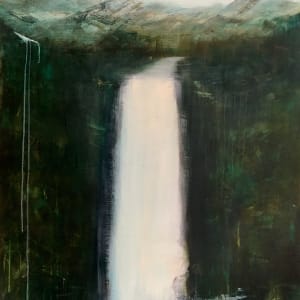
These emotionally expressive landscape paintings recall not a specific place on this earth, but moments, however brief, in which I felt myself at the center of a confluence of connectivity. In which I felt the energy of the world around me flowing through me, the world that included and will always include my mother. The landscape moving toward me yet floating away into infinity. Drips and runs are reminiscent of the tears that continue, always, just under the surface. But also a gift, a reminder.
The connection, forever existing, unseen yet heard, felt.
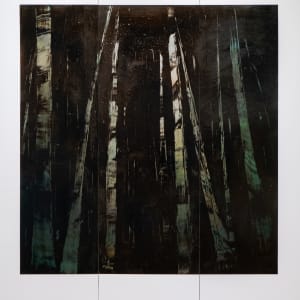
NOCTURNES
Dionysys wrote of a Divine Darkness– a darkness that only appears dark because it is so dazzlingly bright.
As I reluctantly set my clocks forward to Daylight Savings Time, I kept thinking.. What is it about our modern culture that we fear the dark of night so much? We seem obsessed with lighting up every little corner of our sphere.
So out into the wilderness I go.
Backpacking several miles into the mountains seems the only way to get away from all the artificial brightness. It is dark, yes. But it can also be shockingly bright, as the moon and stars shine brighter where there is no competition.
It is that feeling of luminous darkness I’m seeking to capture.
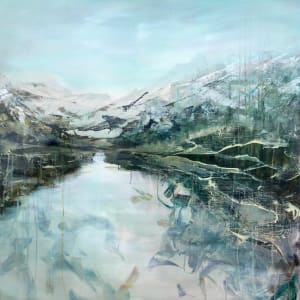
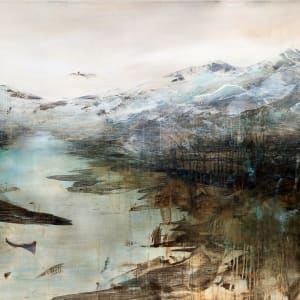
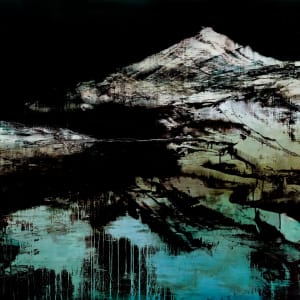
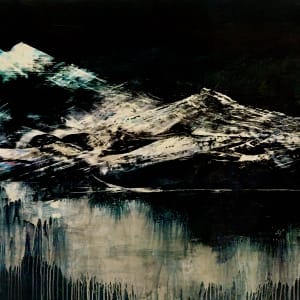
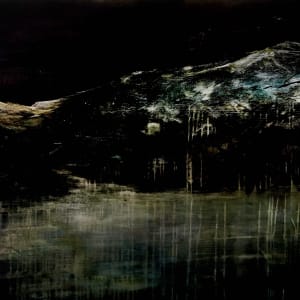
These paintings begin with layer upon layer of light, visually textured and abstracted underpaintings. Then, in a process that is either incredibly brave or equally foolhardy, the light underpainting is completely covered in a dark, opaque layer of paint.
Through a process of subtractive rendering including the use of water, brushes, squeegees, and whatever else is at hand, the landscape and the light reveal themselves.
As I cover up the underpainting, I have no idea of the final scene that will be revealed.
A journey into darkness is necessary to find my way.
It is in the unknowing in the midst of the darkness that the light becomes bright enough to see.
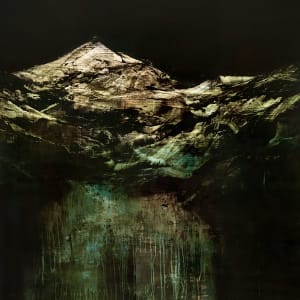
PALACE OF NOWHERE
Taoist philosopher Chuang Tzu said, “come with me to the palace of nowhere, where all the many things are one”.
In creating this body of work, I kept ruminating on a harrowing experience of being lost in dense fog in the North Cascade mountains this Autumn.
Unknowingly, we had turned around 180 degrees from where we thought we were.
Not able to see much of anything, we were in that point of nothingness in the midst of being. And once we stopped seeking, we found our way.
In these paintings, the fullness of abstracted mountains and limitless dense waters recall for me those moments, not of being lost, but being found and discovering union within the void. The white lines, sometimes window-like, create a sense of destination but also of detachment. The Palace of Nowhere is there to find, but we must first lose ourselves in the seeking.
View the exhibition catalog and read Sarra Scherb's catalog essay, Getting Lost: The Works of Lesley Frenz, here https://www.blurb.com/books/10603813-lesley-frenz-palace-of-nowhere
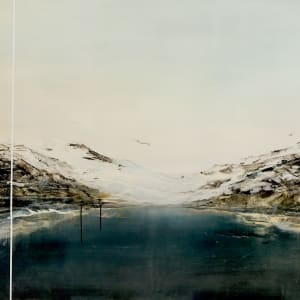
LEMOLO
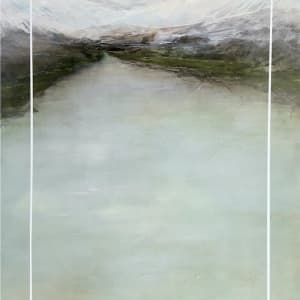
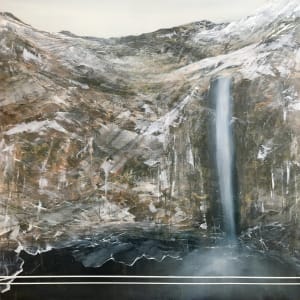
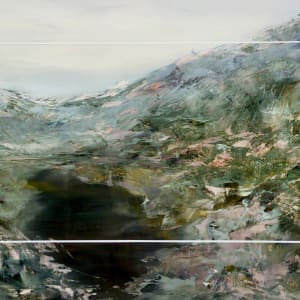
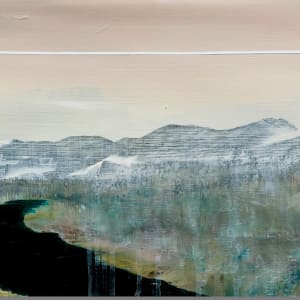
LEMOLO is a Chinook tribal word meaning “wild” or “untamed”. Most of these abstracted landscapes are not based on specific places, but are conglomerations of the wild places I’ve been, the memories and impressions that endure in my mind. These untamed places speak to and connect us with the raw, earthly spirit inborn in each of us. Whether we realize it or not, these places call to us. We long to take in their scent, to feel their cool breezes, hear the sounds of their rushing waters and rustling leaves.
Each painting begins as a simple painted sketch, worked into over and over until a scene begins to appear. That scene will change and shift over time as I strive to give way my control of the composition, instead letting the wilderness appear before me. As the composition takes shape, it may remind me of a certain place– the Olympic wilderness, the Lost Coast of California, the North Cascades, the Northern Rockies. But I strive to keep the space loose and abstracted enough for the viewer to be able to find themselves in their own version of wilderness.
It is in the end that the graphic lines come in– representing an interruption, an intrusion– whether upon our own experiences of a place or whether we are the intruders ourselves.
VENTERS
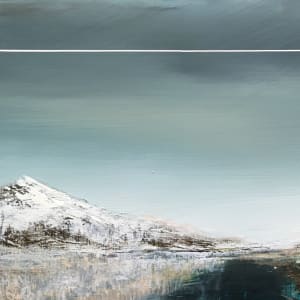
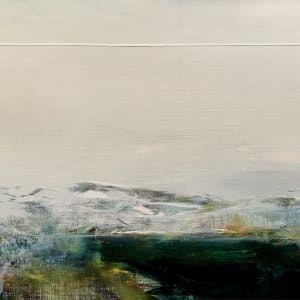
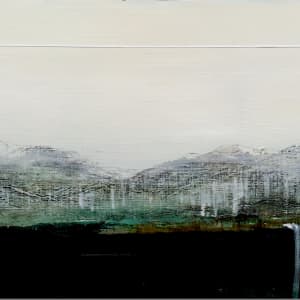
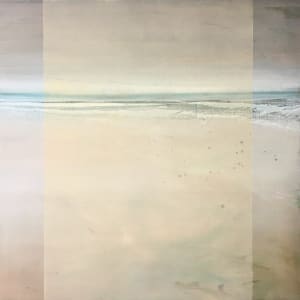
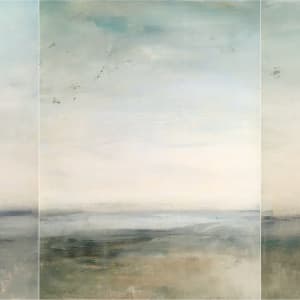
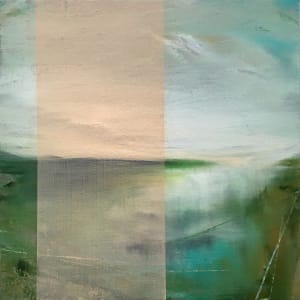
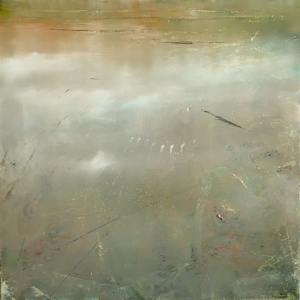
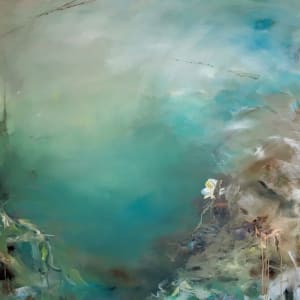
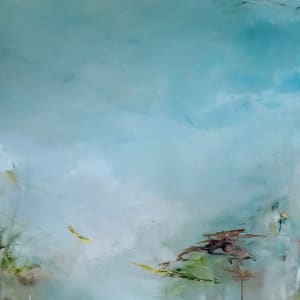
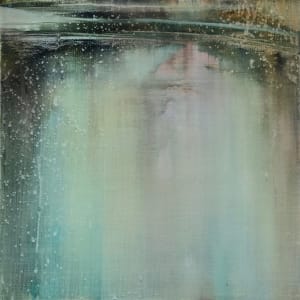
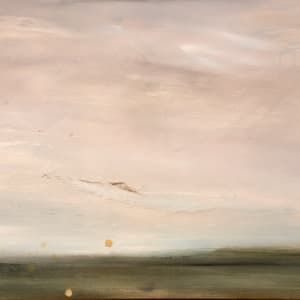
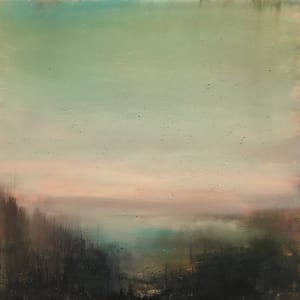
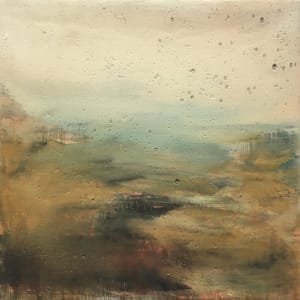
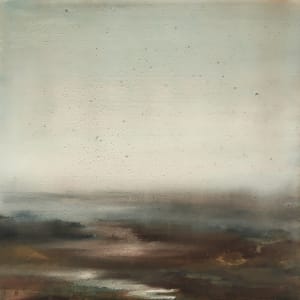
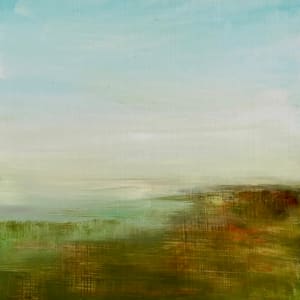
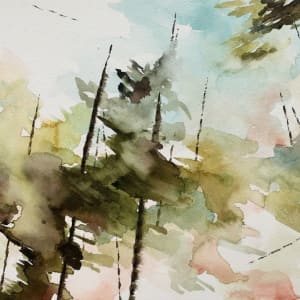
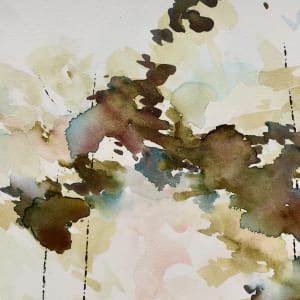
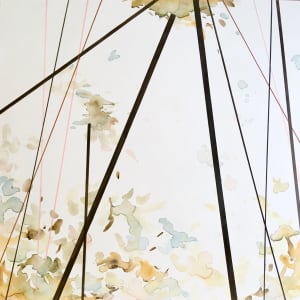
VENTERS is a noun that describes what is brought to shore upon an ocean’s wave. A few years ago, I traded the Atlantic Ocean for the Pacific.
As I was creating the most recent of these seascapes, I was influenced as I always am, by the coastal waterways of the Puget Sound-- the seascape where I spend the most time these days.
But I also kept a box of childhood photos with me in the studio.
I have a few favorite beach scenes among them.
One day, I looked more closely at some of those 1970s era photos and noticed that the color was changed where one photo had laid on top of another one for years in storage.
The geometric shapes created by that chemical change inspired these new paintings.
Memories layered over one another, changed forever with time and distance.
ARCHIVE
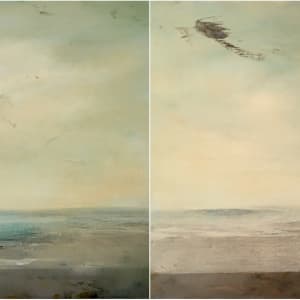
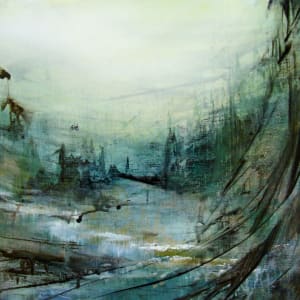
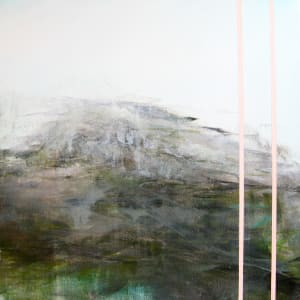
Some select older work I'm proud of.
*please note none of this work is available for sale and I will not create commissions based on work in this collection.
INVOCATIONS
An invocation is an address to a deity or muse that often takes the form of a request for help; frequently said at the beginning of a church service or public gathering.
As I began this new body of work, I was unsure of its destination. I instead approached these paintings as a journey– allowing them to truly take me where they would have me go.
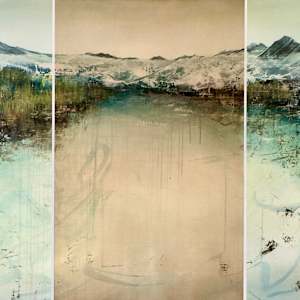
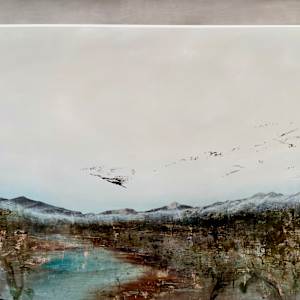
Mountainscapes being an undeniable muse, I followed their path. Each painting’s composition unknown to me until it was revealed. I felt a sense of guidance on this pilgrimage– I hadn’t asked for help, yet there it was, as if a sherpa was steering me through a haze of creative self doubt.
The idea of an invocation kept coming to mind. As a child and into adulthood, I spent much of my life immersed in the Protestant faith– an invocation always a part of every service. The natural world replaced the modern church for me years ago and continues to be my source, not only of inspiration but of solace, of rest, of renewal.
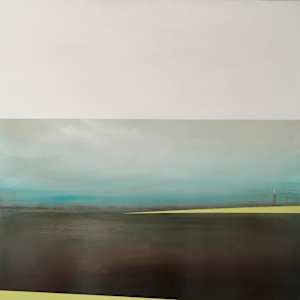
I see these paintings as prayers, as invitations to a sojourn. Their white lines portal-like, beckoning to a far off destination, panes of transparent color frame and filter as stained glass in a cathedral.



SKY BECOMES WATER
In the beginning, all was water– a belief backed by science and held at the heart of many creation stories across cultures.
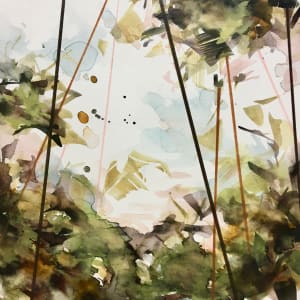
Water plays an important role in my work, if not always figuratively as the subject, then literally as part of my painting process. As I set out to begin this body of work, I allowed myself to let process be my guide. Rather than being “inspired” by a certain landscape or event or theme, I began with how I wanted the work to feel– poetic.
Lyrical, dreamlike, beautiful in an unconventional way, but perhaps illogical or incongruous.
Abandoning a more densely applied approach to painting, I circled back to my love of transparent layers of diluted paint. Watery acrylic applied sometimes with a quick, carefree action, allowing long drips to flow with abandon or taken more deliberately and carefully, the solution of water, binder, and pigment breaking apart slowly, lightly caressing and covering the surface instead of running downward. Continuing my pursuit of intuitively formed landscapes, I found myself often turning the panels upside down, so that the sky became water and water transformed to sky. It was in those actions that I was reminded of the creation stories– how multiple stories chronicle the way of the world’s beginning as the way of one body of water separating into two– a separation begetting a duality where there once was unity.
There became an above and a below. Yet, water remains a significant element of both. And sometimes, as when rain falls heavily from the sky into the ocean, obscuring the horizon, the separation seems to disappear. Our bodies being two-thirds water as is the earth and sky, we are all submerged in and indistinguishable from our original source.
As the fluid pigment runs down the surface, from sky to sea or lake and then back again, I’m reminded of the way water is connecting us all– to the earth, to our source, to every living thing.


