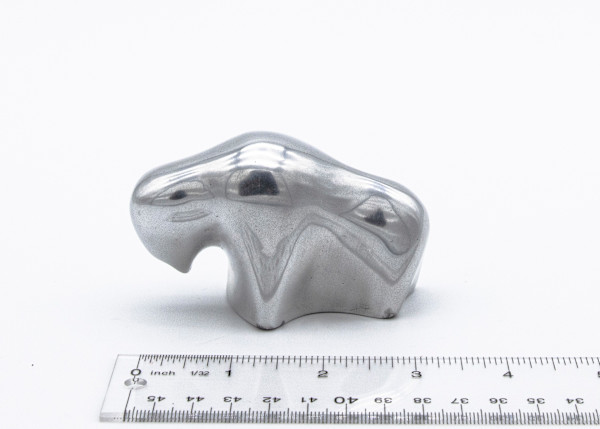

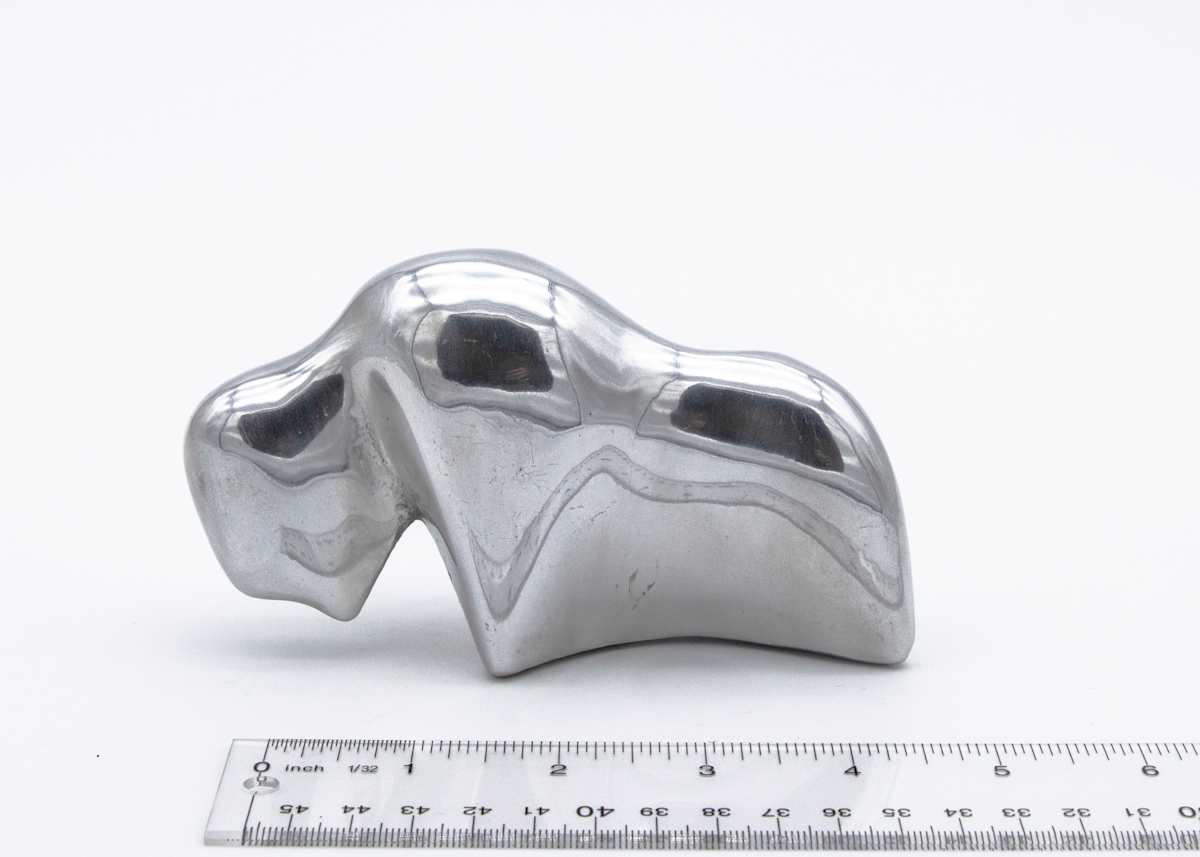

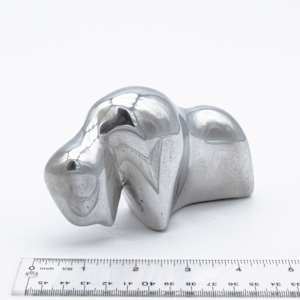
Three Hoselton bison in the collection — two examples of Model #318 and one of Model #319 — represent the most distinctly Canadian pieces in a catalog that otherwise spans global manufacturing traditions. All three are cast from recycled aluminum using the sand-casting process developed by studio founders Gord and Carl Hoselton beginning in 1967 in Trenton, Ontario, and refined over decades in partnership with craftsman Allan Butters. Each piece bears the characteristic Hoselton finish: a prolonged hand-polishing that brings the aluminum to a soft, luminous silver that stops just short of a mirror shine, giving the sculptures their signature fluid warmth.
The two #318 examples and the single #319 are related in form but meaningfully distinct as models. #318, the smaller of the two designs at approximately 3.5 inches in length, presents a compact, low-profile composition in which the animal's mass is consolidated into a nearly abstract ovoid — the hump, shoulders, and lowered head flowing into one another with minimal anatomical interruption. The result reads simultaneously as bison and as pure sculptural form, the animal's identity preserved in silhouette while its surfaces dissolve into continuous reflection. #319, the larger variant, lifts the composition and more prominently articulates the hump, lending it a more assertive presence. Viewed together across all three pieces, they function as a small study in scale and proportion within a single design vocabulary.
The two #318 examples are themselves not perfectly identical — a fact that illuminates rather than undermines the Hoselton process. Because each sculpture is produced from an individual sand mold and finished by hand, no two pieces are exactly the same. The differences between the two #318s are subtle: slight variations in surface tension, the precise quality of the polish, minor shifts in how the form settles. These are not flaws but signatures — the expected and valued byproduct of a craft process in which human hands mediate every stage from casting to finish. Hoselton has been explicit about this from the beginning, positioning the inherent variation as a feature of authenticity rather than a limitation of production. A collector who acquires two examples of the same model number is not acquiring duplicates; they are acquiring two distinct objects that share a design.
Hoselton Studio was founded in 1967 when brothers Gord and Carl Hoselton envisioned creating something beautiful from scrap metal. Based in Trenton, Ontario, the studio has become internationally recognized for its distinctive handcrafted sculptures made from recycled aluminum. The production process is consistent across the entire catalog: original drawings are developed from research and sketches, a carving is made, and from that carving a two-piece sand mold is fabricated. Molten aluminum at 1,200 degrees Fahrenheit is poured into the mold, allowed to cool, and then subjected to an extensive hand-polishing process. The studio's commitment to recycled materials predates the contemporary sustainability movement by decades — scrap aluminum has been the feedstock from the beginning, making the environmental ethic structural rather than promotional.
Authentic Hoselton sculptures are signed and carry a model number, typically found on the base. The numbering system functions as a genuine production catalog: the studio maintains nearly 6,000 molds spanning woodland animals, people, waterfowl, trees, birds, marine life, Inukshuks, and more. Within that vast output, the bison occupy a particular position — one of the few subjects connecting Canadian wildlife tradition to the broader North American bison iconography more commonly associated with American Plains imagery. That the Hoselton bison is abstracted rather than naturalistic reflects the studio's modernist design sensibility, which draws on mid-century Scandinavian influence and prioritizes form over documentation.
Within the collection, the three Hoselton pieces occupy a precise cultural niche: Canadian gift-shop collectible elevated by genuine craft integrity. Hoselton sculptures appear in gift shops, home accessory stores, and antique shops across Canada, and the studio ships worldwide. They were never positioned as fine art in the gallery sense, yet the quality of execution and consistency of the house aesthetic have sustained a collector following that distinguishes them clearly from mass-produced souvenir ware. The bison subjects carry resonance in Canadian conservation history — the wood bison recovery in Wood Buffalo National Park, the plains bison populations managed across the Prairie provinces — that parallels the animal's significance in American culture. The three pieces together, with their subtle variations and shared design lineage, make an unusually coherent argument for what hand-craft means in an industrial age.
- Subject Matter: Bison
- Current Location: BLD 20
- Collections: Thomas Hill Bison Figurine Collection