
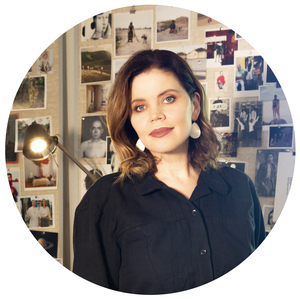
Kris Davidson
Seattle, Washington
Artist working in photography and collage, collapsing past, present, and future while probing how technology mediates reality and fiction.
MessageKris Davidson is a Swedish-born artist whose formative years spanned the Scandinavian subarctic and Texas. Her work examines storytelling as a system that moves across time, media, and technological regimes. Working with photography, collage, and AI-generated imagery, she constructs layered visual environments in which past, present, and speculative futures coexist.
Her practice is grounded in what she terms an aesthetics of collapse: a method for working with unstable images, partial information, and the visible seams between fact and fiction. Using both digital and hand processes on photographic prints, she investigates how stories are translated, distorted, and reconstituted through memory, myth, and contemporary media systems. Artificial intelligence is approached not as a tool of replacement, but as an emerging form of mass media that reshapes how narratives are generated and circulated.
Before transitioning into a research-driven art practice, Davidson spent 15 years as an editorial photographer for leading international publications, with work appearing across the print and digital platforms of National Geographic, Lonely Planet, and other global media outlets. This foundation informs her ongoing interest in how images produce meaning, authority, and belief.
She has taught for the National Geographic Society in multiple locations and at the Academy of Art University in San Francisco. Her work draws from media theory, posthumanism, and cultural history.
Davidson holds a BA from Loyola University in New Orleans and an MFA from the School of the Art Institute of Chicago (SAIC). She is based near Seattle, Washington.
Statement
I create lens-based artworks that merge photography, speculative fiction, and emerging technologies to investigate how stories operate across time. Working with staged and unstaged photography, archival material, and generative AI, I construct layered visual systems—speculative portraits and uncanny landscapes—in which human and machine perception converge and the boundaries between memory, myth, and media begin to dissolve.
My work treats images not as static documents but as temporal objects: sites where past, present, and imagined futures coexist. Through hybrid processes of digital and hand-cut collage, lenticular overlays, writing, and installation, I explore storytelling as a technology—one of humanity’s earliest tools for making sense of uncertainty, loss, and the unknown. These compositions reflect what I describe as an aesthetics of collapse, a condition in which narratives, identities, and images continually rewrite one another as stable frameworks of meaning erode.
Three questions guide this practice: How do the life cycles of stories shape identity and cultural memory across generations? How does fiction function as a means of metabolizing complex or traumatic experience? And how does our understanding of time—through concepts such as deep time, simultaneity, and the block universe—influence how stories are told, transmitted, and believed?
Anchored in research and speculative inquiry, my work draws on media theory, posthumanism, and cultural history alongside personal and inherited mythologies. It operates at a moment when the systems that carry stories—photographic, computational, and social—are increasingly unstable, and when distinctions between sender, message, and receiver collapse into recursive feedback loops in which memory and machine shape one another.
Powered by Artwork Archive