
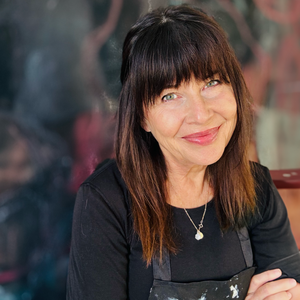

Katherine Filice is an abstract artist based in Northern California whose practice is rooted in direct material collaboration with the natural world. Working with ink, oil, charcoal, earth pigments, and found organic materials, she makes paintings shaped as much by landscape, time, and living process as by her own hand. Central to her practice is a method of burying raw canvas in forest environments and excavating it after a year or more — allowing soil, moisture, roots, and seasonal change to mark the surface before she returns to it in the studio. Art writer Nancy Kay Turner has described the resulting works as "sensuous, tactile, and provocative."
Her practice has been shaped by sustained mentorship from New York painter Michael David and by deep engagement with the critical community through the Yellow Chair Salon and NYC Crit Club programs. She is a Kipaipai Fellow. Before devoting herself fully to painting, Filice founded and led a creative studio in Silicon Valley for over thirty years — a foundation that informs her rigorous approach to visual problem-solving and her long attention to the relationship between making and meaning.
Filice's work has been exhibited in solo and group exhibitions throughout the United States, Europe, and Asia, and is held in private and corporate collections worldwide. Solo exhibitions include The Nature of Things at Be Seen Gallery, Lost in the Woods at the Pacific Art League, and Lost & Found at 1202 Contemporary. Her work has been included in the Monterey Museum of Art Biennial, the Triton Museum of Art, the New Museum Los Gatos, and art fairs including the San Francisco Art Fair, LA Art Show, Atlanta Art Fair, and Aqua Art Miami. An exhibition at the Sasse Museum of Art is forthcoming in 2026.
Statement
My practice is centered on a material dialogue with the forest. Each work begins as an encounter, with ink, sculpted paper, mica, ground stone, paint, and found natural elements layered with marks that carry both intention and accident. I often bury raw canvas for seasons at a time, allowing soil, weather, and time to leave their own record. These processes create substrates shaped as much by the land as by my hand.
The forests of Northern California are not so much subjects as collaborators. Bark fragments, beetle-carved patterns, and other natural forms become structural components, shifting the work into a space where drawing, painting, and sculpture converge. Through these materials, I consider how place holds memory and how the natural world journals events in ways we often overlook.
I am interested in the thresholds between what is visible and what is lost, how surfaces store histories, how remnants become evidence, and how connection can be sensed. The resulting works behave as layered documents: part artifact, part gesture, and part ecological and spiritual record.
Rather than answering the question "Where are we?" my work proposes that location, both physical and spiritual, is porous. We exist within multiple spaces at once: the remembered, the felt, the inherited, and the unseen.