
BECAUSE YOU LIVED
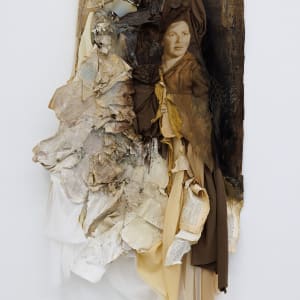
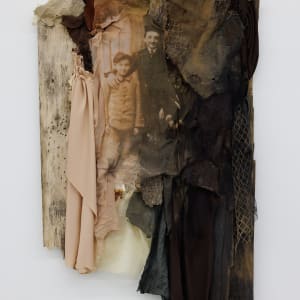
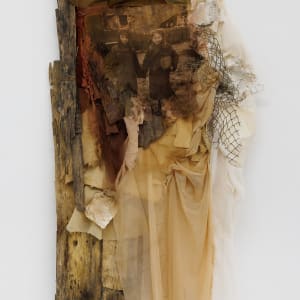
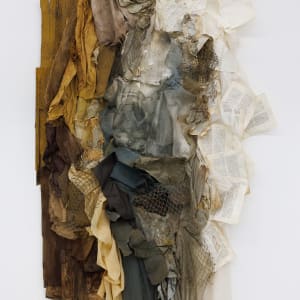
In honor of Women’s Month, I've been granted a remarkable opportunity to share the story of one of the most cherished and influential figures in my life: my Bobe (Yiddish for “grandmother”), Fanny Waserman.
Entitled "Because You Lived," this exhibition is an autobiographical tribute to my dear Bobe Fanny. She was born in Janow Lubelski, Poland and became the first in her family to flee to Mexico in 1936, ahead of the Holocaust. Despite her family's hopeful promises to follow, they were lost to the horrors of World War II, leaving Fanny as her family’s sole survivor.
In Mexico, she lived a life marked by silence about the unspeakable horrors she endured, grappling with the guilt and solitude of surviving when her family did not. Now, I find myself here, a voice shaped by the echoes of her unspoken pain. The burden of living while her family perished, the unanswerable questions that shadowed her existence were fragments of a story etched in the deepest recesses of her being, unwillingly passed down to subsequent generations.
"Because You Lived" aims to break the silence, serving as a humble voice for Fanny’s untold story and a beacon of remembrance. Confronting the harsh reality of obliterated stories and exterminated lives, I bear witness to her resilience. As we reflect on the past, the echoes of history reverberate in the present. The dream of "never again" often feels distant, with some denying the very occurrence of the Holocaust.
This exhibition seeks to highlight these harsh realities, and the profound impact of Fanny’s survival on generations that followed. Her legacy, now spanning 63 descendants, is a testament to how life’s fabric can continue to weave from the survival of one courageous woman. It is a celebration of the enduring human spirit and the hope that can emerge from adversity.
While I've always advocated for healing, love, and reconciliation, I've come to understand the necessity of confronting struggles to truly heal. The journey back to my roots and confronting our familial pain has underscored the pressing reality: the wounds of the past are still felt today. As we face modern antisemitism, "Because You Lived" serves as a vital reminder of our collective history, urging a commitment to combat prejudice and discrimination, to heed the lessons of our past, advocating for awareness of both historical and current struggles. This exhibition is a call to find hope within, to forge a brighter future, and to craft a narrative of tolerance and unity. While darkness may persist, it's imperative that our light shines even brighter.
Even if the world persists focusing on division, differences, hate, and war, it is crucial to recognize that such paths lead us nowhere. We are part of a shared humanity, intricately woven into an unbreakable tapestry of existence. The sought-after light lies in the uncharted territories of acceptance, unity, tolerance, and love—the only true pathways forward.
Bienal Tamayo
ABOUT THE TAMAYO BIENNIAL
Tamayo's purpose in founding the Biennial of Painting was to promote and strengthen the pictorial expressions of the country. In this sense, the contest continues with this purpose and contributes to the exploration of artists in innovating and offering various approaches to this discipline, maintaining spaces for the exhibition and reflection of the works created in this medium.
The jury established the selection method with the purpose of starting a conversation between different ways of understanding painting respecting approaches, traditions and challenges faced by each creator. The selection jury was convened by the Secretariat of Culture, the National Institute of Fine Arts, the Secretariat of Cultures and Arts of Oaxaca, the Rufino Tamayo Museum of Contemporary Art, the Museum of Contemporary Art of Oaxaca, and the Olga y Rufino Tamayo Foundation.
The jury reviewed a total of 817 records of participating artists, who entered 1634 works for this contest and selected 51 works by 51 artists, which will make up the Itinerant exhibition that will remain open to the public at
Starting on October 29, 2020 at the Museum of Contemporary Art in Oaxaca, and will culminate at the Rufino Tamayo Museum in Mexico City.
ART PIECE
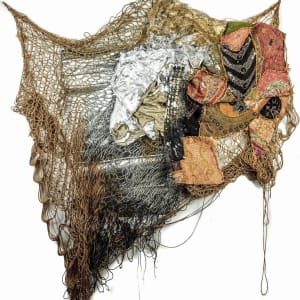
The title of the work is "Interweaved";
The piece is an assembly made of a Mexican hammock with pieces of cloth and paper sewn together. The sewn parts form a tapestry, a composition that looks like a single piece, although it is made of fragments. The piece is then intervened with paint and wears and wears away, revealing a sense of the passage of time.

Natural State
Everything wears down. Objects, things in nature, our bodies, are impermanent. All things are in a constant state of becoming and dissolving. I find beauty in the imperfection, in the passage of time, in the rusty and old,even in decay. I understand deterioration as a part of the process of life, the circle of nature, the death, of the physical. I enjoy objects at the moment of fragility when they are approaching into nothingness.
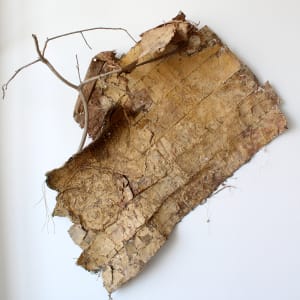
PINTA: Vestigios
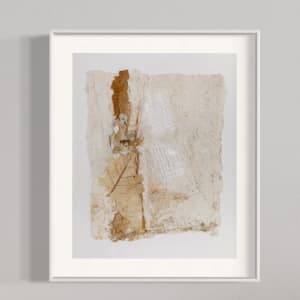
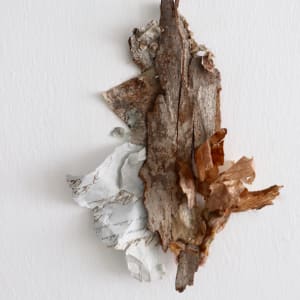
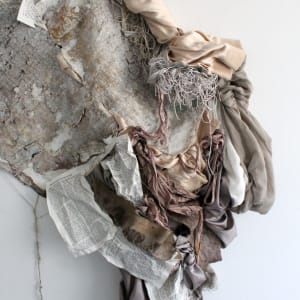
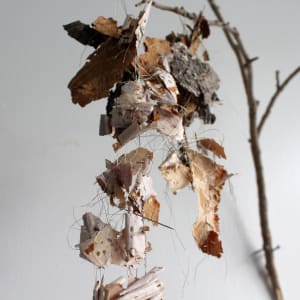
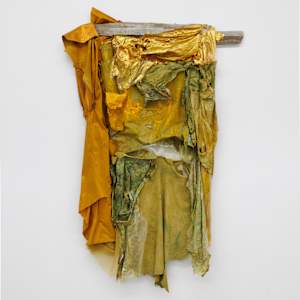
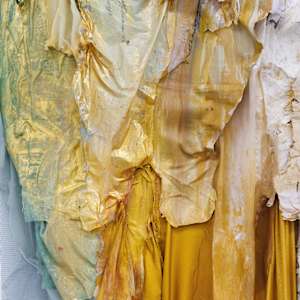
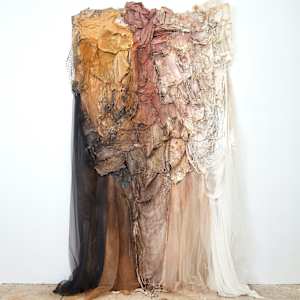
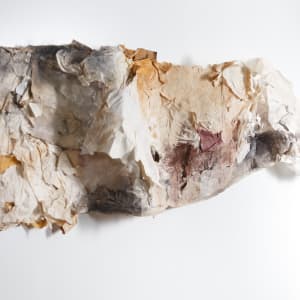
In this series, Karla Kantorovich continues her exploration of matter as a vessel of memory and transformation. Through processes of gathering, deconstruction, and reconstruction, the artist turns earth, fiber, paper, and clay into breathing surfaces — skins that hold traces of time, origin, and becoming.
The works form a cycle that moves from the vital breath of the earth to its final exhalation, and ultimately, to renewal. Each piece emerges as a fragment of that continuous process of erosion and regeneration that defines both nature and human experience. Together, they invite contemplation of the balance between fragility and endurance, matter and spirit, silence and revelation.
Kantorovich leads us into a territory where matter becomes language and the handmade gesture transforms into an act of reconnection with the essential. What breathes here is not only the earth, but the possibility of returning to it — of hearing its quiet pulse once more.

Reclaiming Poetry
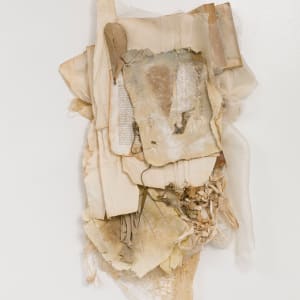
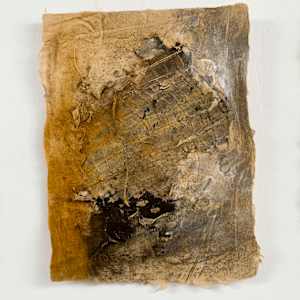
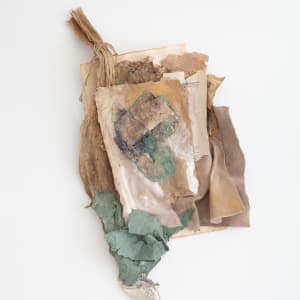
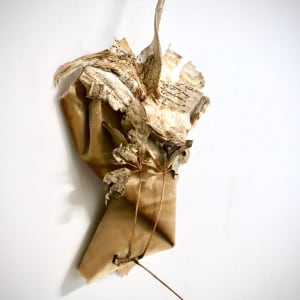
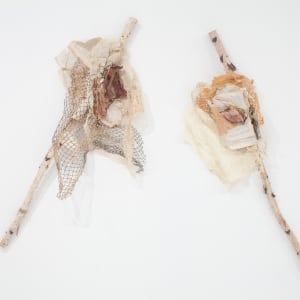
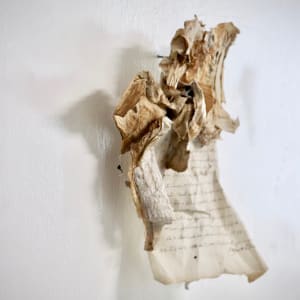
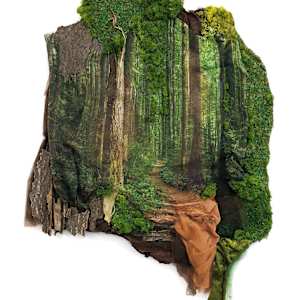
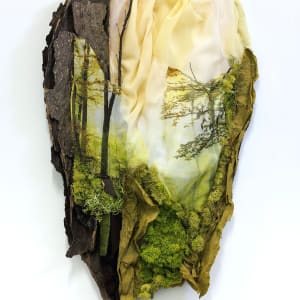
My most recent work draws inspiration from nature; its cycles, change, and beauty. The textures, hues, and nuances I find in the environment are incorporated into the work, it is my own way of expressing my spiritual connection to life. “Reclaiming Poetry “invites audiences to feel and explore the possibility that our existence extends far beyond the physical body and transcends materiality.
Reverse Topography
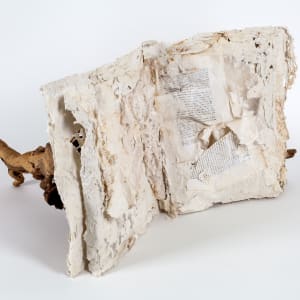
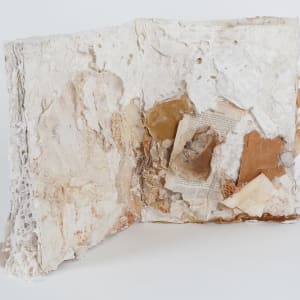
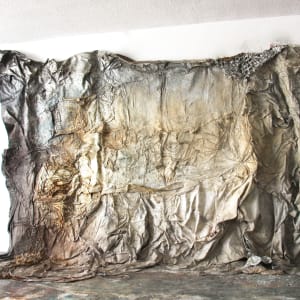
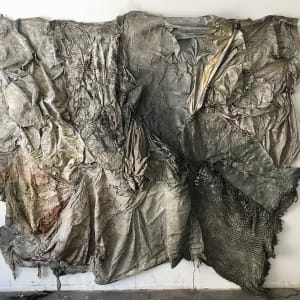
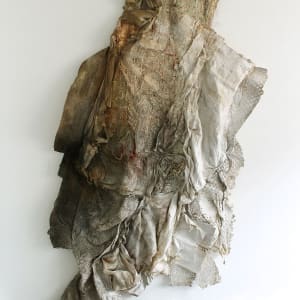
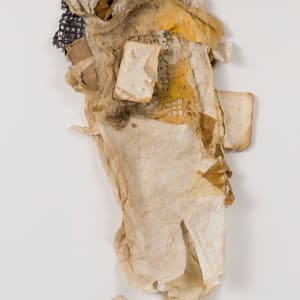
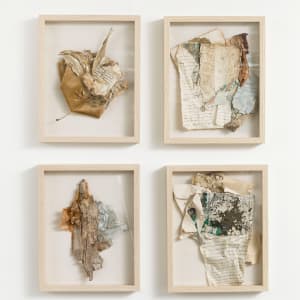
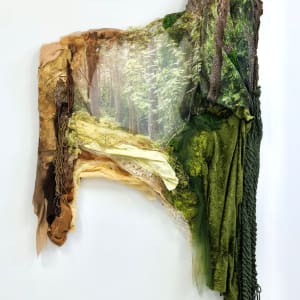
The materials I use tell a story: they have been places, the wear and tear make them valuable to me. I revive the materials and give them hope. I make the fragile strong by mending discarded remnants into vast assemblages that present the history of many who have been forgotten. I unify all the different surfaces that resemble scars and hurts from their past. I see its light. I see a new beginning, I heal through the process by transforming what already exists into what I feel it needs to become and assembling a whole new puzzle: one that is multidimensional, multi-textured, and one that combines old, new, extraordinary, and mundane.
Rewriting
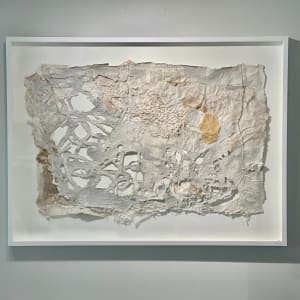
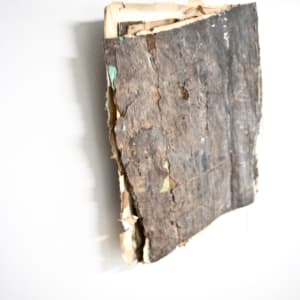
The paper assemblages are used as vehicles to unite unlikely elements -old and new, natural and man-made- to create one cohesive piece representative of unity and our binding humanity. Much like paper, reality can be rewritten and reassembled; it is fluid and ever-changing. “Rewriting” invites the audience to inspect our ephemeral nature and the human ability to heal, mend, and alter reality.
UNITY
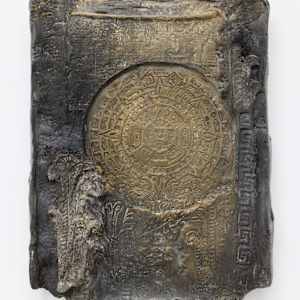
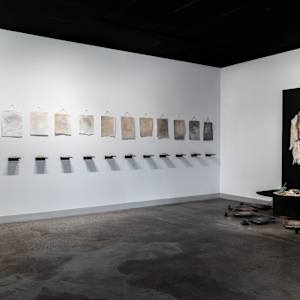
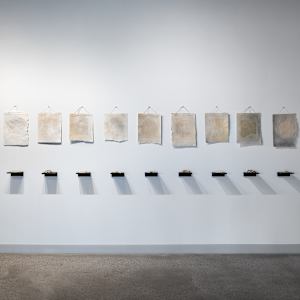
UNITY was presented at the Instituto Cultural de México, located at the Mexican Consulate in Miami, as part of the exhibition Un Beso a Mi Tierra. It is a deeply personal installation that seeded a body of work centered on memory, transformation, and healing. The project weaves together layers of symbolism drawn from my grandmother’s history and from what Mexico has represented to my family.
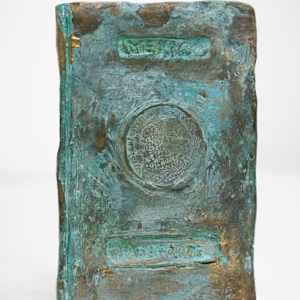
The installation features my first bronze sculpture, multiple ceramic works, and thirteen embossed paper pieces—each a reflection on ritual, intention, and continuity. These elements are interwoven with ancestral and Mayan symbolism, particularly the use of materials such as obsidian and copal, long associated with protection, purification, and spiritual healing.
In creating UNITY, I began to uncover resonances between my grandmother’s lived experience and the ancestral practices of Mexico. What began as an art installation has since expanded into an exploration of the mystical intersections between migration, ritual, and inner landscapes—threads that continue to shape my artistic practice.

ÁMATE
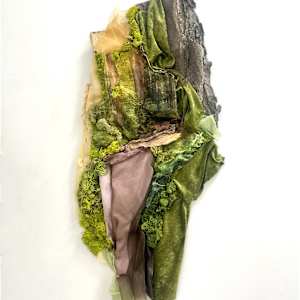
Ámate is an immersive art installation inspired by ancestral paper techniques, particularly the Mexican Amate paper tradition. Artist Karla Kantorovich invites visitors on a transformative journey of healing, love, and self-discovery through a contemporary interpretation of handmade paper works using locally sourced recycled materials.