
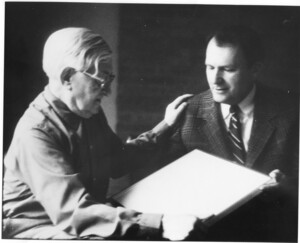
Joseph McCullough
Cleveland, Ohio
Joseph McCullough (1922-2012): American colorist trained by Joseph Albers, Abstract Expressionism painter steeped in "old master" techniques, and arts leader.
Message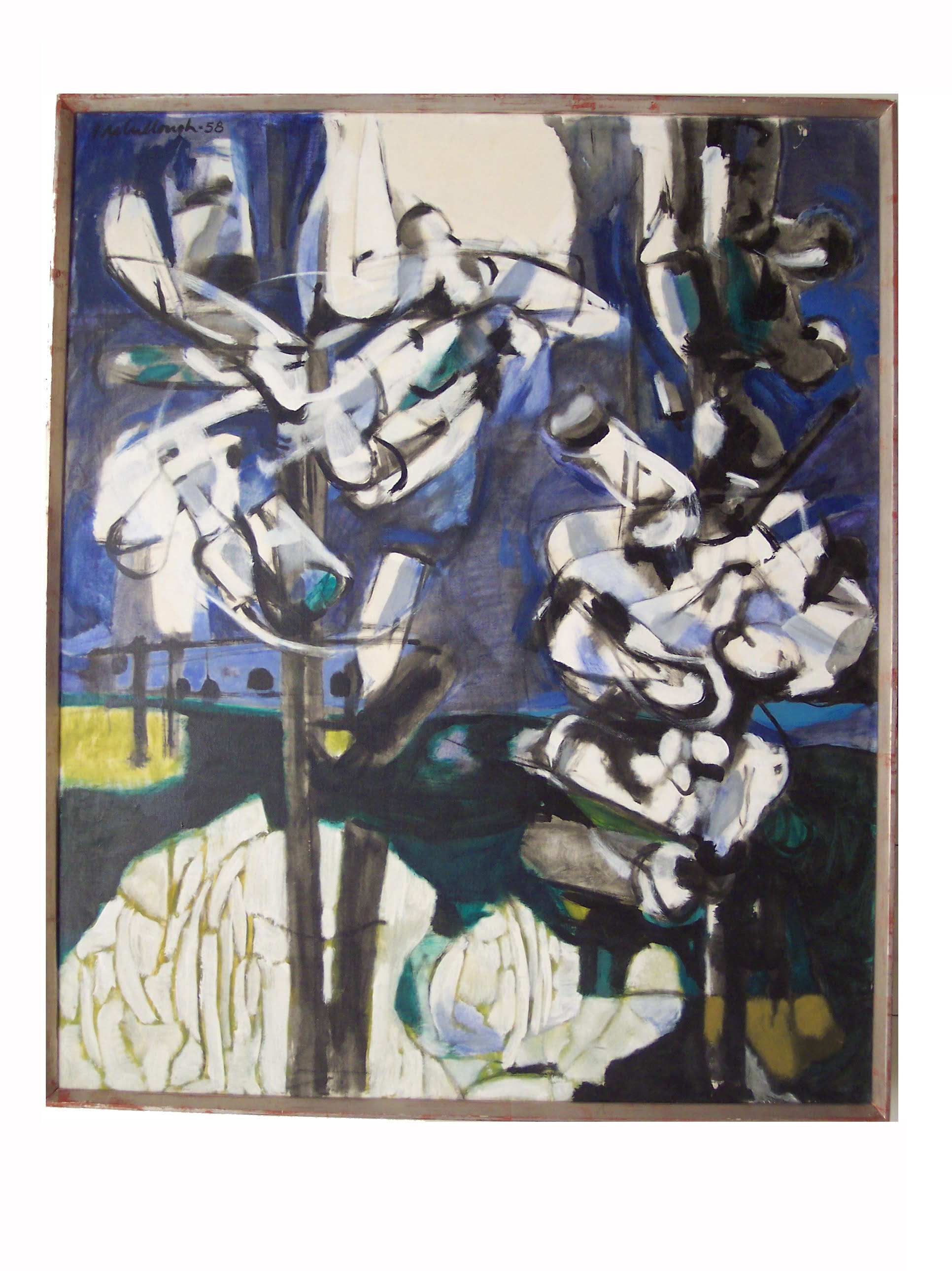
Joseph McCullough’s body of work makes a unique and influential artistic contribution to the American Midwest. His long career was centered in Cleveland and Pittsburgh and spanned the end of the Depression, World War II, the midcentury style of the 1950s and space age innovation of the 1960s. Later works reflect the international explorations of a significant leader in the arts community.
His training began with Saturday classes at the Carnegie Institute of Technology, followed by the Cleveland School of Art (1940–41 and 1946–48), which was bisected by combat duty as the pilot of 35 B-24 missions over occupied Europe and Nazi Germany. After a year as an instructor at San Jose State College, he then used the GI Bill to support graduate training at Yale University, where he studied under Lewis E. York and Josef Albers, earning a BFA in 1950 and an MFA in 1951. While he was still an early career painter, he was invited by Laurence Schmeckebier to return to the Cleveland Institute of Art as Assistant Director. After Schmeckebier left for Syracuse in 1954, McCullough became the Director and later President, serving 33 years. Each of these periods may be found in his work.
Major series:
Born in Pittsburgh in 1922, his early paintings capture the cramped working neighborhoods of the Rust Belt, as they felt after years of economic struggle.
Infernal machines: Sharp and angular forms were originally inspired by folk art encountered on a country drive, but transformed through the use of “old master” techniques such as encaustic wax, tempera, and goldleaf. These are bold reflections on postwar technologies and ambitions.
Soundscapes: an expressive and dramatic series of abstract canvases painted from memory and designed to resonate in the mind’s eye and ear. They capture the smoke of war, folk art found along country roads, and the natural beauty of downstate Ohio. Paintings of bottletrees intersect with the Black Atlantic tradition, while other forms seem purely musical, hovering on the canvas. While the painter provided some clues during his lifetime, his explanations were rarely specific, giving space to viewers to form their own feelings and associations.
During decades as an arts administrator, he traveled widely, finding resonance in Japan, Spain, and Ireland that emerged in a late series of watercolors. Many of these works retain the pilot’s aerial viewpoint, while others communicate in spare and concentrated brushstrokes.