

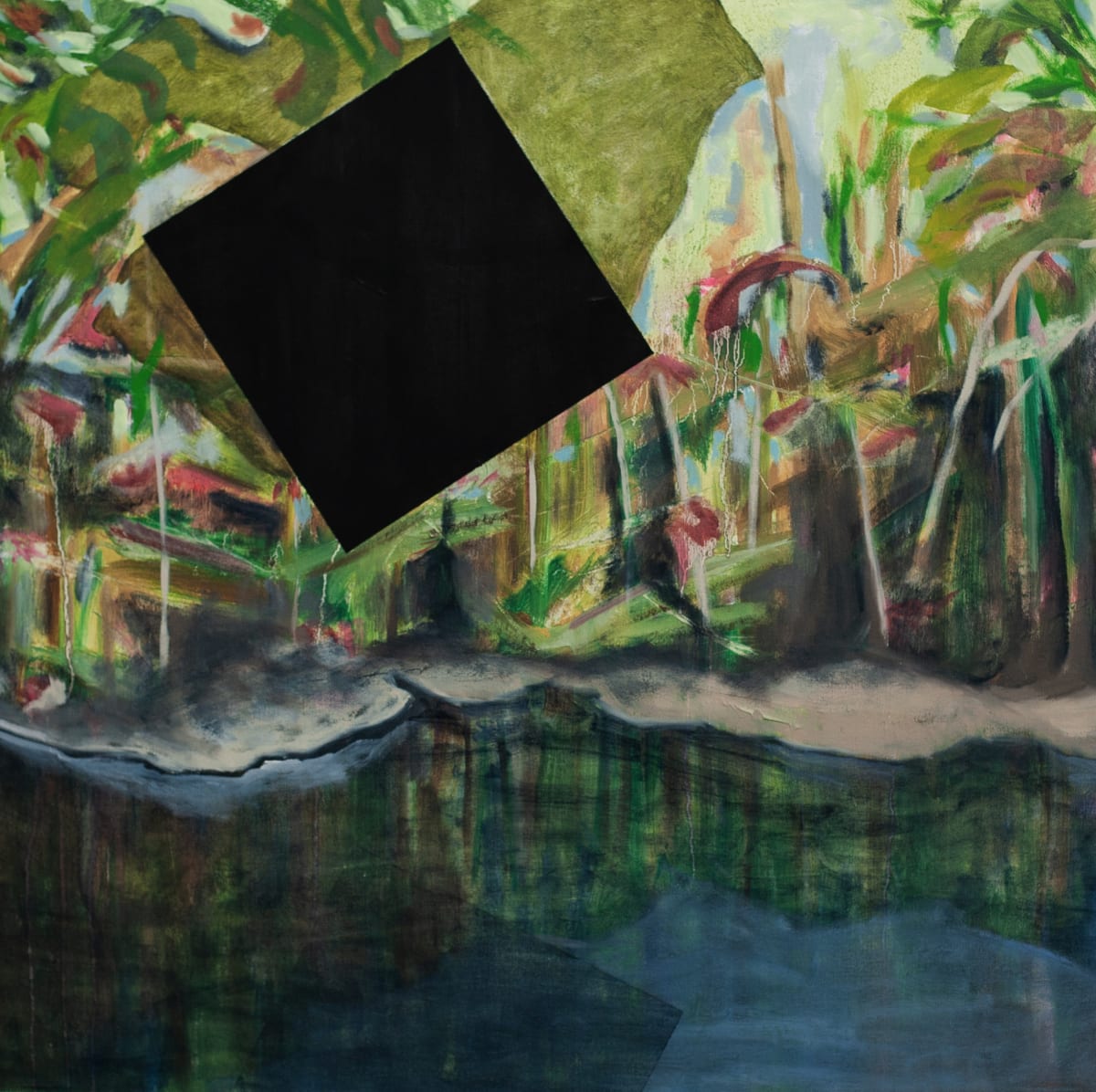
Here, the black square is placed within an environment defined by organic growth and unpredictability. Its rigid geometry enters the landscape as an imposed presence—first suggesting the effects of human action on nature, and then opening onto a broader sense of intervention: deliberate, absolute, and held in tension with its surroundings.
Painted while the struggle for Hong Kong’s autonomy unfolded alongside the 2019 Extinction Rebellion demonstrations in London, the work brings political and ecological pressures into the same field of attention. The black square can be read as a form of human intervention—an attempt to regulate, contain, or reshape natural systems—but also as a broader gesture of interruption, reflecting the ways in which human action seeks to redirect the course of environmental futures.
Yet the landscape does not fully yield. It continues to operate according to its own rhythms and internal logic, neither erased nor resolved by the square’s presence. Rather than asserting control, the work points to the limits of human agency—suggesting that even acts of protection, repair, or resistance remain partial when set against forces that exceed intention.
What emerges is not a fixed opposition, but a condition of tension and coexistence, where intervention and autonomy remain in continual negotiation.
Exhibition History
- Collections: The Black Square