
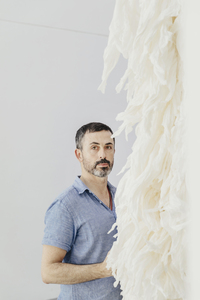
JAVIER LEÓN PÉREZ
SEVILLA, ANDALUCIA
Javier León Pérez (Seville, 1977), multidisciplinary artist exploring painting, sculpture & installations with Japanese paper and Andalusian roots.
Message
Javier León Pérez, b. 1977, Seville, Spain.
Originally from Seville, multidisciplinary artist with very diverse influences, his father is of gypsy descent and his Andalusian roots have deeply marked his work and his way of seeing life. Javier was trained at the University of FINE ART of Seville, Javier León Pérez specialised in painting, ceramics and sculpture in bronze before completing a research MA in Art, Investigation and Production at the Complutense University of Madrid.
He is the recipient of numerous awards in Spain and his work on Japanese paper was recognized in the Paper Biennial of Contemporary Art at the Museum Rijswijk in the Netherlands, the Biennale of Contemporary Art Lalin in Spain, and International Paper Arte Biennial of Shanghai 2021. Javier has held multiple exhibitions across Europe, with his first solo show in Hong Kong in 2015. He has participated in art fairs in Spain, France, Portugal, Holland, Germany, the UK, Hong Kong, Korea, Indonesia, Istanbul, Taiwan, New York, Houston and Miami. His works have been acquired by important collections, including La Caixa Foundation (Spain), Valentín de Madariaga (Seville), and DEARTE Collection (Spain), Galila`s POC Foundation (Brussels), Boghossian Foundation (Brussels), Fengxian Museum (Shanghai), and by prominent collectors in Hong Kong, Taiwan, Indonesia, the Philippines and Korea.
Statement
STATEMENT — Javier León Pérez
I am an artist born in Seville, a land where light, the blending of cultures, and a deeply rooted popular sensitivity have profoundly shaped the way I see and feel. My Andalusian roots, together with my father’s Gypsy heritage, have defined my relationship with matter, rhythm, and space. From an early age, I found in art a territory for contemplation and inner exploration.
My initial training began in a bronze art workshop, where I came into contact with traditional sculpture and prominent Andalusian academic artists. I then continued my studies at the School of Arts and Crafts in Seville, focusing mainly on ceramics and academic drawing, and later at the Faculty of Fine Arts of Seville, where I specialized in painting. I subsequently completed a Master’s Degree in Research, Art, and Artistic Production at the Complutense University of Madrid, where I developed research focused on silence and meditative elements in the pictorial and drawing process.
My relationship with art began among the materials of the sculpture studio, where bronze taught me the resistance, weight, and memory of matter. However, it was through the reading of Buddhist and Zen philosophy that I realized my true concern did not lie in permanence, but in the ephemeral and the delicate. A spiritual restlessness arose within me that transformed the way I approached creation. Since then, my practice has moved within a constant dialogue between order and fluidity, between the visible and the intangible, between the rational and the spiritual.
In my early works, repetition became a language. Through minimal gestures—lines, points, cuts, or folds—I built organic structures that referred to the patterns of nature. Each gesture acted as a mantra, a meditative action requiring physical and mental concentration. In this repetitive process, I discovered silence and a connection with the essential.
During my years in Madrid, between 2008 and 2011, I developed a body of drawing closely linked to meditation and the search for trance through highly rigorous repetitive processes. Sequences of lines, dots, or accumulations of scribbled marks combined chance and control within the same act. The result was a series of monochromatic drawings conceived as spiritual exercises and as a search for inner silence.
Over time, Japanese paper (washi) became the core of my language. This handmade material, crafted from plant fibers, allows me to work with light as if it were matter itself. Its irregular texture and translucency invite me to explore the threshold between fragility and strength. In my three-dimensional works, I fold and interweave hundreds of fragments of paper, creating rhizomatic or fractal structures—roots, clusters, or organic networks—that evoke both the rhythms of nature and the inner landscapes of the mind.
For me, paper is a metaphor for skin: a porous boundary between the self and the other, between interior and exterior. Through it, I have developed what I call a philosophy of paper—a language where the material and the spiritual converge, where vulnerability and sensitivity become forms of resistance and strength.
Although my process is precise and meticulous, I always leave room for the unpredictable. The small variations inherent in manual work—deformations, wrinkles, and accidents—introduce a degree of chance that I consider essential. From the union of control and accident emerges what I call an “organized naturalness,” a structure that recalls the patterns of the cosmos, the growth laws of nature, and the invisible flows of vital energy. Science, cosmology, and Eastern philosophies remain constant sources of inspiration in my practice.
UMBILICAL — Hanging Paper Sculptures
The UMBILICAL series marks a key stage in my evolution: a transition between my three-dimensional paper collages and my later return to painting. These hanging sculptures, made of Japanese Manila hemp fiber paper and coated with thin layers of pigment, ink, or varnish, were born from the desire to endow paper with corporeality and movement in space.
Each piece is suspended from the ceiling like a descending cord that twists and spirals, forming undulations and branch-like structures that seem to pulse. I chose the name UMBILICAL because it evokes the cord that connects the fetus to the mother—a metaphor for the channel of union between two complementary forces: above and below, air and earth, emptiness and fullness. Through these forms, I seek to represent the invisible channels through which vital energy flows, the subtle processes of balance that occur in the unseen realm.
The physical act of working the paper—crumpling, twisting, and folding it by hand—requires great physical tension. This technique, inspired by origami but taken to a more sculptural terrain, allows me to explore the idea of the fold of time: the wrinkles in the paper form both randomly and coherently, generating a fractal structure that suggests infinity.
UMBILICAL represented a turning point in my career. By lifting paper from the two-dimensional plane into space, I understood that light, movement, and gravity could become active parts of the work. This series became the bridge between my research on paper as matter and my subsequent return to painting.
STILL LIGHT — The Return to Painting
After this process of spatial expansion, I felt the need to return to painting—to its silence and density. Thus was born the STILL LIGHT series, which represents my most recent stage and a synthesis of my entire artistic journey. In these oil paintings, pictorial matter becomes a means of connecting with a deeper part of myself.
To create these works, I begin with models made of paper—folded structures that function as contemporary still lifes. Through them, I revisit the classical still life genre, reinterpreting it as a reflection on the “archetype of creation.” If traditional still lifes depicted objects that spoke of life’s transience, my models refer to the genesis of being, the construction of the self.
On the canvas, color and form intertwine to create a space of inner resonance. Light becomes the true protagonist: it emerges from matter and reveals hidden layers of meaning. These paintings are, ultimately, a dialogue between the visible and the invisible, between perception and intuition. Shadows, reflections, and transparencies act as metaphors for thought—for what remains veiled yet continues to exert its presence.
Each work in STILL LIGHT is a journey inward. Color expands as an emotional vibration, a sensory language that seeks to contain the ineffable. Painting becomes both a mirror of our own experiences and a window open toward the contemplation of human existence.
Ultimately, my work—whether with paper, suspended structures, or oil painting—seeks to understand the invisible order that sustains life. Each piece is an attempt to reveal the flow that traverses us all, to make the intangible visible. I believe in art as a space of connection between the human and the cosmic, between matter and consciousness. In the silence, rhythm, and light of each piece, a shared vibration emerges: the memory of what we are and the infinite web that binds us together.